“If you cannot bring home a girlfriend before Tomb-Sweeping Festival, then don’t bother coming back to sweep your grandpa’s grave. How could you face your late grandpa if you’re still single?” Ran, a young man from Chongqing, received this text message from his mother on April 1, 2016. He still visited his grandfather’s grave, but alone, without his mother’s knowledge.
In 2015, in Shaanxi Province, Li, a 31-year-old restaurant owner, faced an even worse headache. His parents showed up at his restaurant, drove away all his customers and smashed one of his computers in a bid to force him to promise he would marry. While extreme, such conflicts sparked by unmarried offspring are part of daily life in a society still obsessed with the institution of marriage as the only viable safeguard against a lonely, destitute dotage.
In recent years, the issue of “forced” marriage has moved from being a domestic problem to a widespread social phenomenon. Parental bids to push their reluctant children into unwanted marriages are becoming ever more dramatic, moving away from well-meaning nagging and persuasion to irrational threats, verbal assaults and emotional abuse. The “values gap” between the older and younger generations is now exemplified by irreconcilable differences between, as some have termed it, “us and the enemy.”
The division over marriage has intensified in a country in a period of unprecedented transformation in which values, concepts, institutions and structures are all undergoing breakneck change. The marriage
of one’s (in most cases) only child, while far from a guarantee of absolute lifelong security, is still viewed by older people, paralyzed by the fear of poverty and loneliness, as the only bulwark against their
insecurities.
See-saw
“My mother has gone too far in forcing me to marry,” said Yang Yiyi, a 35-year-old woman from Hubei Province who is currently working in Beijing. Yang described her mother’s “abnormal” mental state to our reporter, explaining that forcing marriage on her daughter is now “her foremost mission in life.”
“She is particularly good at weaving this issue into almost every facet of my existence,” said Yang. Her mother’s constant hysteria has left Yang worn out. After a good day, she would sometimes hum to herself at home, which would elicit the response: “Nobody wants you. What have you got to sing about?”
When she decided to learn to cook, her mother remarked: “What’s the point? You’ve no chance of cooking for a man!” Her mother’s far deeper emotional insecurity emerged during a family dinner, when Yang was eating congee with her parents. Her mother began to sob uncontrollably, and told her daughter: “I fear that one day, when you are old, you’ll still be single, childless, poor and alone. No one will take care of you. No one will feed you congee.”
As a highly educated graduate with a decent and well-paid job in Beijing, Yang’s achievements didn’t matter to her anxious parents for as long as she remained unmarried. Yang’s father’s words were as vicious as his wife’s. “Look at yourself! You are over 30, but you’ve still accomplished nothing!” Several years ago, Yang received an online message from her father saying: “If you do not marry, your mom and I will never find any meaning in our life!”
“They are freaking me out. They make me feel that my life is worthless unless I have a husband. It seems that being single is a sin,” Yang told our reporter.
In February, a survey on forced marriage was published by the China Youth Concern Committee for the Advancement of Health and Physical Culture Development. More than 70 percent of single young people in China, according to the survey, described themselves as being under “constant” pressure from their parents to marry. Those aged between 25 and 35, the survey said, suffered the most, with 86 percent reporting consistent pressure. Older, unmarried women are frequently labeled “leftover women,”a derogatory catchphrase liberally used by China’s media for years.
The term usually refers to well-educated urban women who are still single in their late 20s, women stereotypically dismissed as being too “choosy” to pick a partner. Another survey indicated that 50 percent of Chinese men consider a woman “leftover” if she is unmarried by the age of 25.
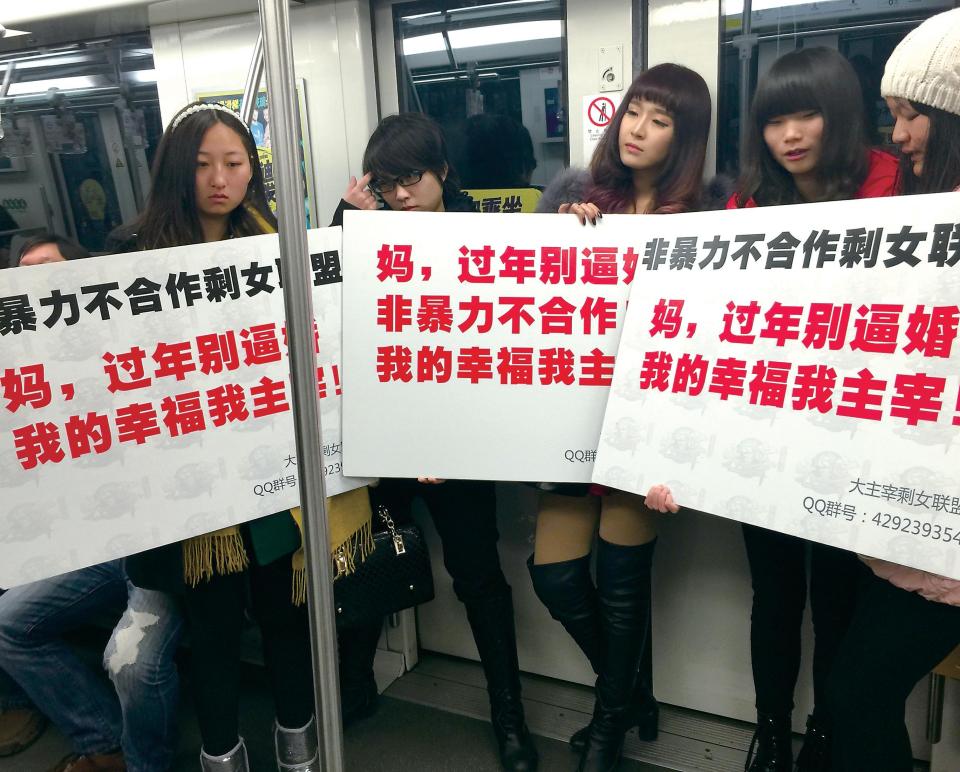
Battle lines are now being drawn between millions of happily unmarried young people and their anxious, belligerent parents. On the morning of February 4, 2016, commuters passing through Beijing’s crowded Dongzhimen subway station were greeted by a new poster. Designed and paid for by a group of single young women via an online crowdfunding project, the Dongzhimen ad was China’s first anti-forced marriage advertisement. The text read: “Dear Mom and Dad, please do not worry. The world is so huge, and lifestyles so diverse. Being single can also have its joys.” On February 4, 2015, a group of single young women in Shanghai formed the “Civil Disobedience Leftover Women Alliance” and appeared in the city’s People’s Square holding placards reading: “Mom, don’t force me to marry over Chinese New Year. My happiness is in my hands.”
The emergence of a genuine movement against forced marriage has led netizens to choose sides in what is viewed as the definitive clash of values of China’s millennial generation.
Split
“The emergence of the “anti-forced marriage” phenomenon is an indication of the younger generation’s growing sense of subjectivity,” said Wu Xiaoying, head of the Family and Gender Research Office of the Chinese Academy of Social Sciences.
From Wu’s point of view, the increasing emphasis on subjectivity, boundaries, individual choice and free will exhibited by Chinese millennials is a manifestation of changing family values in a period of immense social transition. In a time in which more and more Chinese are embracing individualism and diversity, marriage no longer serves as a primary, or even sole form of self-expression mandatory for all, but instead has emerged as just one lifestyle choice among many.
Li Xiaoqiang, a 36-year-old Shanghainese divorcé, believes that his parents simply view him as another capital asset, like a house or a stock option. A graduate from the prestigious Tsinghua University who has founded an education startup in Beijing, his parents’ constant meddling in his private life, and incessant attempts to push him into marriage exasperate him.
“They have no idea that boundaries should be set between human beings, even among the closest family members. When it comes to my personal life, my parents know nothing about privacy,” Li told NewsChina. When Li was in high school, his mother would secretly rummage through his school satchel for his contact book, making calls to teachers and classmates to check up on her son’s academic performance and behavior. Years later, she began calling employers, colleagues and friends to dig up the same information. According to Li, she even called his ex-wife’s parents to find out exactly why his first marriage ended. Li could have told them the reason his first marriage didn’t work out – he only got married to assuage his parents. “At that time, the pressure they placed on me was so huge that I would rather have died than lived,” Li said. “My mother’s logic is: ‘You should live the way I say, because I love you’ and ‘you should listen to me and treat me well because I treat you so well.’”
Li described his relationship with his parents as “allopatric speciation.”In biology, “allopatric speciation” occurs when two biological populations of the same species evolve entirely different characteristics due to long-term isolation from one another. From Li’s perspective, he and his parents, living in different cities, have already become two different species and can no longer understand one another.
“Many people of earlier generations, who went through the planned economy era and later marketization, may feel unutterably confused when facing fundamental questions like ‘Who am I?’ ‘What kind of life do I want?’ ‘What is happiness?’ ‘What is individual value?’” said Sun Peidong, associate professor of history at Shanghai’s Fudan University, who, in 2007 and 2008, conducted field research in Shanghai’s People’s Park’s “matchmakers’ corner” marriage market, resuming the project last year. “Their lives were carried along on a tidal wave of the times they lived in, where there was little room left for individual will or independent choices.”
Lu Yue, chief consultant with the Beijing-based Hope Cure Psychological consulting company, uses the term “Collective Self” to explain the psychology of most Chinese parents. “Under the culture of ‘collective self,’ the individual ‘self’ does not exist,” Lu told our reporter. “For instance, if a child has a noticeable birthmark on his head, his relatives will willfully discuss it while disregarding the effect such discussion might have on the child’s self-esteem.
Many Chinese believe that they share extreme intimacy with family members because they are tied by blood. Such a bond is so direct and intimate that family members can interfere in each other’s lives without even considering the other person’s sense of self-worth.”
Brought up in a collectivist culture, many older Chinese, the argument goes, like worker ants, sacrificed their individualism in a bid for recognition from the entire community. They attach their sense of self-worth to the supposed social role they play, garnering their sense of personal fulfillment by performing their interpersonal duties to the letter. Consequently, with retirement comes a crushing sense of worthlessness. “Am I still useful? What is the meaning of my life from now on?” A new identity, tied to a preconceived notion of what it means to be a “grandpa” or “grandma,” becomes the new source of individual identity, and performing this set role becomes a retiree’s raison d’être.
Fear
“There are three ways to be unfilial; the worst is childlessness,” runs one idiom attributed to Chinese philosopher Mencius, seen as the spiritual successor to the father of Chinese thought, Confucius. Such sentiments are still hardwired into traditional notions of family and marriage in China and across East Asia.
Wan Ling described watching a TV show with her 34-year-old daughter. The episode showed a sad mother accompanying her unmarried pregnant daughter to get an abortion. Wan, seeing the actress playing the mother weeping and sighing outside the operating room, turned to her daughter and said: “If I were her, I would support you in having the baby.”
“I can take care of the baby. You don’t have to think of it as a burden,” Wan said. Wan, 58, describes her daughter’s single status as her biggest source of anxiety, and is now cajoling her child to find a man, any man, and have a baby, then divorce if she likes.
“I do hope that my daughter can find a suitable husband and not get divorced. But if she cannot find a match, that’s also okay,” Wan told NewsChina, revealing that her own husband’s infidelity left her with few illusions about the sanctity of marriage. “Having a child is of the greatest importance. All the people I know have their own children. Those who can’t get pregnant can adopt. To put it bluntly, without children, who will take care of you when you are old? Who will pick up your body when you die alone at home?”
News reports of single, elderly Chinese people whose barely identifiable corpses were discovered by neighbors are a mainstay of local journalism in China, and whenever Wan comes across such a story, she passes it on to her daughter as a warning. Concern over security in old age is a common anxiety among older Chinese. The government slogan “one child is enough – the government will support the old,” designed to garner support for the One Child Policy, has fallen by the wayside. Welfare provision in education,healthcare and housing, once guaranteed by the State, has all been marketized. “Now, people have redirected their hopes and expectations away from the public realm and into the private sphere.
Rather than depending on the country and their work unit, people rely on family and personal relationships to find a sense of security and certainty,” said Sun Peidong. Wan Ling retired in 2008 on a pension of less than US$300 a month. “The money is just enough to make ends meet, but far from enough to afford my medical expenses if I get sick,” said Wan, adding that she will depend on her daughter for financial support in the future. Upon whom, she reasons, will her daughter rely, if not her as-yet-unborn children?
Millions of middle-aged Chinese parents fear that their children will ultimately be left alone and uncared for. “‘Fear’ is a prominent word in the older generation’s lexicon,” Sun Peidong writes in her book Who Will Marry My Daughter? The Parental Matchmaking Corner in Shanghai. “Fear is the alarm bell that always haunts them.”
“Given the underdeveloped social welfare system in China, many Chinese believe that various kinds of risks and problems present in daily life cannot be entirely solved by the government, social institutions or relationships with colleagues or friends,” Wu Xiaoying told NewsChina. “Family has become the ultimate bastion against uncertainties and risks from the outside world.”
 Old Version