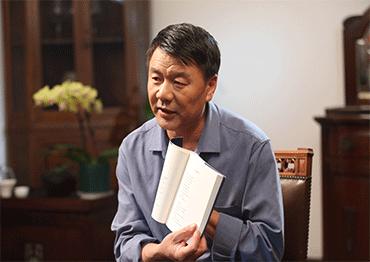
Born in 1969 into a poor family in a small village in Xuzhou, Jiangsu Province, Wang dropped out of middle school due to financial hardship. At 19, he left home for Shenyang, Liaoning Province in northeastern China to work on construction sites.
There, he gradually developed an interest in literature. After work, he browsed secondhand bookstores, reading magazines and popular fiction.
One day, he was in a store reading a martial arts novel about a hero who intervenes when a bully harasses a mother and son. Unable to finish the book, Wang returned to his dormitory and imagined the ending himself, writing how the hero defeated the villain. Later, when he picked up the novel again, he discovered the plot closely resembled what he had written.
"My passion for writing was instantly ignited," Wang said. "It felt like writing wasn't that difficult after all."
After staying in Shenyang for a year, he returned to his hometown and worked on sand-mining boats, a job he described as the "most grueling" he had ever done. Standing in water and sand all day, his body constantly bruised, he turned to writing as relief from physical exhaustion.
From 1992 onward, Wang published several short stories in literary journals and later attempted a full-length novel. But his devotion to writing was seen as eccentric by fellow villagers. His father once destroyed the draft of a 200,000word manuscript.
Forced to abandon his literary ambitions, Wang joined the ranks of migrant workers, taking odd jobs in cities. In 2002, he and his wife settled in Kunshan, Jiangsu Province, where they opened a grocery store three years later. He began writing poetry in 2009.
Before getting into food delivery, Wang worked as a courier in a residential community, pushing a cart loaded with an endless pile of packages. The routine felt stifling.
"It was like being a farmer trapped on the same plot of land," he said.
Becoming a delivery rider changed Wang's perspective. Riding his moped through the city gave him a sudden sense of openness. "My perspective changed," he said. "I immediately fell in love with the freedom of moving through every corner of the city."
Unlike most riders, Wang enjoys long-distance orders, which others often avoid because they take more time. On his return trips, he deliberately takes unfamiliar routes, sometimes exploring more than a dozen paths between the same two points.
Inspiration comes to Wang constantly. One poem, "3 PM," was sparked by a quiet moment at a restaurant.
While on an afternoon delivery, Wang saw a young restaurant owner asleep on a sofa, her small son cradled in her arms. Not wanting to wake them, he moved as quietly as possible to retrieve the order.
"I was deeply moved by that scene," Wang said. "As I left, I wrote the poem."
In it, he describes the woman and child as "a dream cradling another dream," while he tiptoes like a thief, stealing "the most exhausting part of their sleep." The Italian version of the poem was published on the Italian magazine Internazionale in 2024, translated by Martina Benigni who was an exchange student at Shanghai University from Sapienza University of Rome. She was deeply touched by the poem when she read it in a bookstore on Shanghai University campus.
In 2022, Wang gained widespread attention after his poem "People in a Hurry" was shared online by renowned poet Chen Zhaohua. The poem vividly captures the lives of delivery riders:
"People in a hurry have no four seasons, only one stop after another.
The world is a place name...
Every day I meet delivery riders racing out, hammering the earth with their feet to quench this human flame." The poem resonated with countless readers and went viral. Media outlets and literary circles soon took notice of the deliverer-poet. In 2023, he received the Annual Poet Award from the Xuzhou Writers' Association.
Since then, Wang has published a whopping five poetry collections, the latest called The World Lights Me Up (2025).
In January 2026, he released his first essay collection, Chengzhen, named after his mother. The book reflects on his parents, hometown and village life amid social change.
 Old Version