Zhu Xi’s life was far from easy. Despite his reputation, his official career was repeatedly derailed by political struggles. Yet his setbacks only strengthened his philosophical resolve.
At the heart of Zhu Xi’s thought lay the concept of “principle” (li), the underlying rational order of the universe. He believed that everything in existence shared this universal principle, though it manifested differently in each thing. This idea of “universal principle with particular manifestations” (li yi fen shu) became the cornerstone of Neo-Confucian philosophy.
Equally central was his practice of self-cultivation. Zhu believed that personal moral development was the foundation for social harmony and good governance. His famous eight-step model – “investigate things, extend knowledge, make intentions sincere, rectify the mind, cultivate oneself, regulate the family, govern the state and bring peace to the world” – captured the Confucian ideal of connecting inner virtue with outward action.
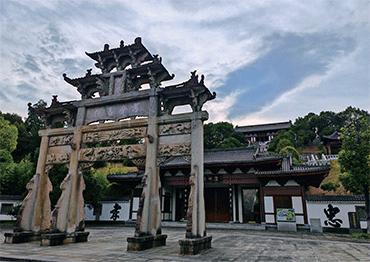
As an educator, Zhu Xi transformed the Chinese academy system. During his service in what is today’s Jiangxi Province, he revived the historic White Deer Grotto Academy, one of the four great academies of China, enriching its library, recruiting teachers and writing the academy’s educational rules. These guidelines, emphasizing discipline, humility and moral inquiry, became the model for private academies across China for the next seven centuries.
Later, he founded the Wuyi Jingshe Academy along the Jiuqu River in the Wuyi Mountains of northern Fujian. In his own poetic description, the academy was built “in harmony with nature, beside mountain and spring,” a space where learning and contemplation merged with the beauty of the landscape.
Zhu’s approach to education foreshadowed modern holistic learning. He believed that natural surroundings shaped moral character, centuries before educational reformers like American philosopher and psychologist John Dewey would make similar observations.
Zhu also dedicated decades to writing and editing. His greatest intellectual achievement, Collected Commentaries on the Four Books, provided detailed annotations of Neo-Confucianism’s central canon: The Great Learning, The Doctrine of the Mean, The Analects and Mencius. Drawing on more than 3,000 earlier commentaries, he synthesized them into a clear and coherent system that ordinary readers could understand.
From the Yuan Dynasty (1271-1368) onward, Zhu’s Commentaries became the core texts of the imperial civil service examinations until their abolition in 1905, shaping Chinese thought, education and values for centuries. His work came to hold in China the same canonical status that the Bible did in Europe or the Quran in the Islamic world.
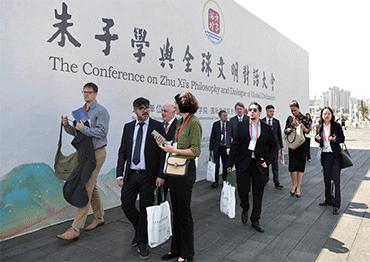
Deng Xiujun, a professor and associate dean at the School of International Journalism and Communication, Beijing Foreign Studies University, has long researched the global dissemination of Chinese culture. In his opinion, the internationally recognized term “East Asians” specifically refers to a group of people characterized by black hair, dark eyes, outstanding diligence and a globally acknowledged sense of teamwork.
According to Deng, the reason they are uniformly labeled as “Chinese” by “the other” is that the cultural core they share is Zhu’s Neo-Confucianist views, which emphasize a strong aptitude for learning, respect for laws and order, teamwork and a high degree of obedience. “The appeal of traditional Chinese culture, particularly Confucian culture, has shaped this cultural community,” he told NewsChina.
Zhou Yuanxia, an associate professor at the Fujian Academy of Social Sciences, said that East Asian Confucianism, represented primarily by Zhu’s philosophy, is a vital element of Eastern civilization. She added that it stands in sharp contrast to Western civilization and embodies the principle of “unity in diversity.”
“Viewed globally, East Asian Confucianism represents a distinctive branch of world civilization, while together with Christian and Islamic civilizations, it constitutes the shared essence of human civilization,” she told NewsChina.
Zhu’s views, however, also brought him trouble. In 1194, after Emperor Ningzong ascended the throne, Zhu was appointed imperial tutor. He used the opportunity to lecture on The Great Learning, urging the emperor to cultivate moral virtue before exercising power. His emphasis on ethical restraint offended the court’s powerful ministers, and after just 46 days, he was dismissed for being “impractically idealistic.”
Two years later, the “Qingyuan Party Purge” swept the court. Zhu and his followers were accused of spreading “false learning.” Some of his disciples were imprisoned or exiled. Zhu, stripped of office and reputation, retired to his home in Fujian, where he continued to teach until his health failed.
In the spring of 1200, nearly blind and gravely ill, he dictated revisions to his unfinished works, determined to complete his philosophical legacy. He died that year at the age of 70. Despite official prohibitions, nearly 1,000 students and admirers attended his funeral.

 Old Version