Old Version
Culture

King of Comedy

Renowned comedian Chen Peisi’s film The Stage has garnered acclaim for its exploration of when art conflicts with power. However, some question whether its underlying bawdiness is suitable for the modern age

By Yi Ziyi Updated Dec.1

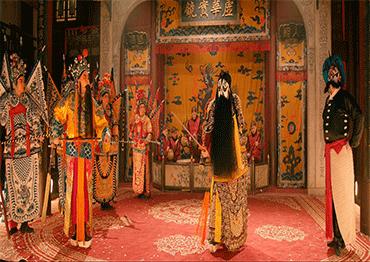
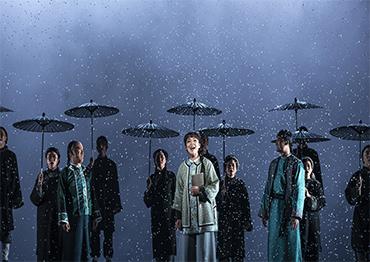
A scene from The Stage

It was Chinese New Year’s Eve in 1984. People across China were glued to the television Spring Festival Gala, one of China’s most influential shows presented by China Central Television (CCTV). Annually broadcast on Chinese New Year’s Eve, the show was initially launched in 1983. The next year, CCTV’s Spring Festival Gala offered something more than songs and dances.  

To the sounds of a nation laughing out loud, 30-year-old Chen Peisi and his partner Zhu Shimao presented a groundbreaking skit called “Eating Noodles.” In the 18-minute sketch, Chen played a nameless extra vying for a tiny part in a film. As the director’s demands became more extreme, Chen struggled to eat bowls of noodles one after another. The comic noodle-eater rose to fame overnight.  

Chen and Zhu’s sketch was so influential that it became a genre of comedy in its own right – known as the “CCTV Spring Festival Gala sketch.” It had a tremendous influence on both comedians and audiences. From 1984 to 1998, Chen and Zhu performed 11 sketches at the annual galas, helping to bring in a laughter-filled New Year’s Eve.  

This year, the 71-year-old has returned to the big screen after 32 years, directing and starring in an adaptation of his satirical stage comedy The Stage, which was first performed in 2015. Set in the 1930s during the Republic of China (1912-1949), a turbulent period plagued by warlords, The Stage revolves around a Peking Opera troupe as they are forced to change their cast and content by a threatening and boorish warlord.  

Released on July 25, the dark comedy had taken in over 404 million yuan (US$56.4m) by August 26. The film earned plaudits but also drew criticism, especially for its depictions of gender. It epitomizes Chen’s comedy philosophy: At the heart of comedy, there lies tragedy. 

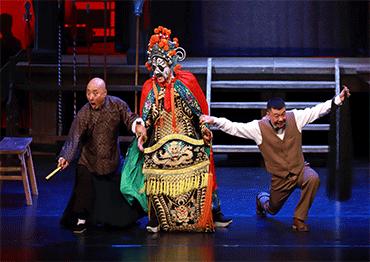
Chen Peisi (left) performs in his satirical stage comedy The Stage, Tianjin, August 24, 2019 (Photo by VCG)

New Comic Genre 
Born in 1954 in Changchun, Jilin Province, Chen was always interested in acting, influenced by his father, Cheng Qiang, one of China’s most famous movie villains and a pioneer of China’s film industry.  

Chen made his acting debut in the 1979 feature film What a Family, the first comedy film made after the Cultural Revolution (1966-1976). He plays Hu Jiaqi, a young dramatic actor who falls in love with a saleswoman at a bookstore. His father, Chen Qiang, performed Jiaqi’s father, Hu senior, a diligent and old-fashioned manager at a woolen mill.  

From the late 1970s to the early 1990s, Chen and his father appeared together in several famous comedy films about ordinary families during the reform and opening-up period, including Father and Son (1986), Er Zi Has a Little Hotel (1987) and Father and Son Open a Bar (1992). While Chen Peisi played different characters, they always had the same name, Erzi, which means “second son.”  

After the “Eating Noodles” sketch made Chen a household name, it opened the eyes of Chinese people to the power of modern comedy.  

Chen and Zhu became the main draw of the Spring Festival Gala. Watching their sketches on New Year’s Eve became a collective memory for an entire generation. Yet, in 1998, the duo bowed out, performing their last sketch, The Prince and the Postman. They never returned to the Gala.  

Rumors circulated about their disappearance. In a 2021 interview with talk show My Bronze Age, Chen said that the main reason was a lack of freedom due to excessive limitations and constraints from CCTV.  

It was on stage that Chen found room for creativity. Since his successful debut play The Swindler in 2001, the comedian has produced, directed and performed in 12 comedy stage shows. Among them, The Stage (2015) and The Interrupted Dream (2021) are the most lauded. Both concern the fate of folk opera troupes in the war-torn Republican period. Many critics and theatergoers acclaimed the two works as “the pride of Chinese comedy plays.” 

‘Art Transcends All’ 
For Chen, his movie The Stage tells a story of how “art transcends all” – a motto that features on the movie poster. “Art transcends all” is a principle held among traditional Peking Opera performers, meaning no matter what happens, the show must go on, and artists should put art above all else.  

Written by distinguished playwright and Chen’s childhood friend Yu Yue, The Stage has been performed more than 330 times in 65 cities, including Vancouver and Toronto, Canada. The play scored audience ratings as high as 9/10 on China’s leading review website Douban.  

In the movie, Hou Xiting, played by Chen, is the leader of the famous Wuqing Troupe. The group travels to Beijing to perform classic opera Farewell, My Concubine, where they meet General Hong, a capricious and uncultured warlord who mistakes a waiter in a steamed bun restaurant for the troupe’s top star. General Hong threatens the troupe, forcing them to cast the waiter as the male lead, which leads to a series of calamities. Under huge pressure, the cast and crew are torn between their devotion to art and their fear of someone with power over them.  

The conflict in the movie is a common predicament that affects artists throughout history: the arbitrary interference in art by those with power. General Hong forces the troupe to change the tragic ending of the ancient classic Farewell, My Concubine into a tawdry, happy ending. The warlord’s rude and overbearing demands give the artists no way out, making them determined to sacrifice their lives to defend the principle “art transcends all.”  

In an interview with the People’s Daily in August, Chen explained his ethos. “People nowadays like to use the word ‘long-termism.’ In the past, older generations of artists used the expression ‘art transcends all.’ These two phrases deliver similar meanings. Generation after generation, artists in traditional opera troupes have stuck to this principle. They believe that a good show is a product practiced and polished for years. Artists must have such tenacity and persistence,” he said.  

“Always respect our audience and never fool them. No matter how trends change, artists must stick to the rules and principles of art, no matter what,” Chen said.  

The Stage movie has earned a high rating of 8/10 on Douban. Most viewers praised the work for boldly depicting artists’ persistence in defending the dignity of art in the face of a mighty power. “Political forces always change, but art remains constant. Classic art has an inner vitality that withstands time and war,” commented Douban user Li Meng. “Essentially, Chen Peisi uses a story set in the Republican period to satirize common phenomena, such as laymen guiding professionals, politics overriding art and institutions suppressing individuals,” another user Paradox commented.  

“Either the narrative style or the comedy effects, The Stage is a typical ‘Chen Peisi-ish work,” said Huo Tang, a film critic based in Beijing. “Chen is particularly good at designing the plot around mix-ups, be it wrong locations or mistaken identities. The comedic effect comes from the dramatic irony they create – the audience knows what is happening, but the characters do not,” Huo told NewsChina.  

In recent years, Chinese comedy films have heavily relied on jokes, wordplay and punchlines – “As if we are watching a standup comedy show or reading an audiobook of jokes” as Huo puts it. “But the thing is, audiences can easily enjoy funny skits in short videos or ultrashort dramas on Douyin. So why should they buy tickets and go to cinemas for a comedy film?” he said.  

“The Stage, nevertheless, is a typical well-made play. The format features exquisitely designed plots, unexpected twists and tense theatrical conflicts. Creating such a well-structured, deliberately designed comedy is way harder and of higher quality than making a compilation of funny jokes,” he said. 

‘Old School’ 
As many viewers commented, The Stage feels like an “old-style” film. Some have criticized it for being old-fashioned both in its cinematic language and in some of its values.  

“Chen Peisi seems to have been away from the film industry for too long. The way they express themselves in The Stage is very old-school. The silver screen isn’t the stage. Adapting a stage play for film requires changing dramatic techniques into cinematic language. But The Stage seems more like a play than a film,” commented Douban user Evenc.  

“This film is very ‘old,’ both in a good way and a bad way. It’s a well-told story about old-style artists’ persistence in art. That’s very good. But the bad thing is that it also conveys the old artists’ outdated values, especially regarding gender,” commented user Ah Sen.  

The film’s sexualized portrayal of the sole female character, along with a few crude jokes, has drawn weighty controversy. Many viewers have criticized the film as being vulgar and misogynistic.  

The female character, Siyue, or Concubine Six, is the sixth concubine of General Hong. She is an enthusiastic Peking Opera fan and admires the troupe’s top star, who always performs the male lead. She throws herself at the star, and even mistakes the miscast waiter for the male lead when he is in his stage make-up. Much of the comedic effect comes from a few crude jokes and sexual innuendo.  

“I saw the play version of The Stage in May this year. The play itself was good, very deep and profound. But I found the disrespectful portrayal of a woman unpleasant. To be honest, among all the stage performances I’ve ever seen, this one had the most dirty jokes,” said Qing Mao, a 30-year-old theater enthusiast from Beijing who has seen nearly 200 plays.  

“When I knew the play was being adapted for the screen, I expected it would cut those vulgar jokes and have a better portrayal of Concubine Six. But after I watched the film, I found it still kept all those uncomfortable dirty jokes and sexual innuendos. It was a real pity,” Qing told NewsChina. 

Comedy Is Tragedy 
“The core of comedy lies in tragedy,” is Chen’s principal theory of writing comedy.  

Since 2012, Chen has held the Dadao Comedy Training Camp, an annual two-month program for around 20 young comedy artists and enthusiasts. During the camp, the veteran comedian shares his decades-long experiences and thoughts about comedy acting.  

“For decades, the most basic part of creating comedy for me is to manifest tragedy in a comedy. Whether it’s a joke, a crosstalk punchline or a play, all comedic effects that make people laugh must have a tragic core,” Chen said during a course at his first training camp in June 2012, which has been uploaded to platform NetEase Open Course.  

From Huo Tang’s perspective, the essence of Chen Peisi’s comedy is to present life’s absurdities and mix-ups, which are rooted in tragedy. “Chen’s work often makes you laugh about the absurdities at first, then you start to doubt whether these absurdities are real. Eventually it makes you reflect on the reasons behind the mistakes and absurdities,” Huo said.  

The comedian never sees comedy as simple, light entertainment meant just to make people laugh. “A good comedy must be a meaningful story for both individuals and society. The meaning is not something forcefully imposed on the audience. Instead, it is hidden in the absurdity of the plot, within the predicaments of the characters, waiting for the audience to uncover it themselves. This is the essence of comedy in my mind,” Chen told People’s Daily.  

He believes that the depth of comedy is deeply rooted in culture. “True comedic conflicts grow in the fertile soil of culture. As artists, we should respect what we are doing and respect the stage. We embrace innovation and new breakthroughs in art, but we should never forget the roots of culture. It’s just like tree planting – you can trim the twigs and leaves, but if you cut the roots, the tree will die,” Chen said.

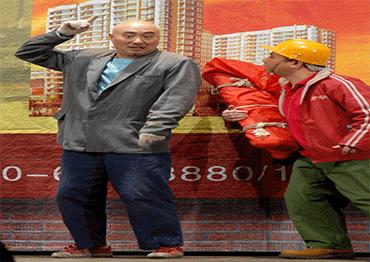
Chen Peisi performs in his self-produced and directed stage play The Balcony, Nanning, Guangxi Zhuang Autonomous Region, January 14, 2009 (Photo by VCG)

Print