Historically, Jingdezhen porcelain was prized in international trade, particularly during the Age of Discovery, the period from roughly the 15th to the 17th centuries when European maritime exploration greatly expanded global trade.
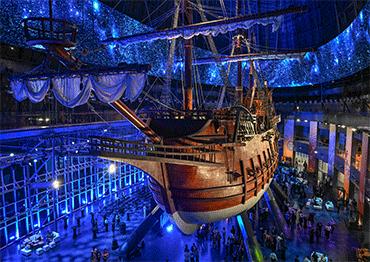
In June, an 18th-century merchant ship carrying a large cargo of Chinese porcelain was discovered about 600 meters below the Skagerrak Strait off southern Norway. Most of the porcelain recovered from the wreck is blue-and-white ware. The Ancient Ceramics Gene Bank, a database for ancient pottery shards launched in Jingdezhen in 2022, confirmed that the pieces originated in Jingdezhen.
The National Museum of Korea in Seoul houses a fine collection of bluishwhite porcelain produced at Hutian Kiln during the Song Dynasty. Recovered from archaeological sites dating to Korea's Goryeo period (918-1392), the works are celebrated as masterpieces of exceptional craftsmanship. Topkapi Palace Museum in Istanbul, Türkiye and the National Museum of Iran in Tehran also house substantial collections of Yuan Dynasty blue-and-white porcelain, most of it produced in Jingdezhen.
During the Ming Dynasty, Jingdezhen strengthened its commercial ties with overseas markets. Huge quantities of export porcelain were shipped abroad, with many pieces specially designed and fired to meet European tastes.
Armorial ware is a classic example. Commissioned by European aristocratic families, these pieces featured coats of arms and other heraldic designs. Their patterns and shapes were carefully adapted to European aesthetic preferences.
After the 16th century, Jingdezhen's exported porcelain influenced not only European markets but also the development of Japanese ceramics. Japan's Imari ware, which emerged in the late Ming Dynasty, widely adopted forms, decorative motifs and firing techniques associated with Jingdezhen porcelain.
In the 18th century, after Europeans acquired the skills needed to manufacture porcelain, early products from ceramic centers including Meissen, Germany and Delft in the Netherlands absorbed elements of Jingdezhen blue-and-white porcelain in both technique and artistic style.
This made Jingdezhen not only a major global center for porcelain trade but also a crucial source of ceramic techniques and artistic influences exchanged across cultures.
Naturally, such exchanges were never one-sided. The evolution of Jingdezhen's porcelain industry changed through sustained interaction between cultures.
Yuan Dynasty blue-and-white porcelain provides important evidence of exchanges between China and the Middle East. Samarra blue, the cobalt-based pigment used to decorate much of this style, largely came from the Middle East, its decorative motifs drawing heavily from Islamic artistic traditions.
Qing Dynasty (1644-1911) artisans incorporated European techniques and influences such as cloisonné, in which metal wires form compartments filled with colored enamel reminiscent of stained glass, and famille rose porcelain, known for its richly colored overglaze decoration.
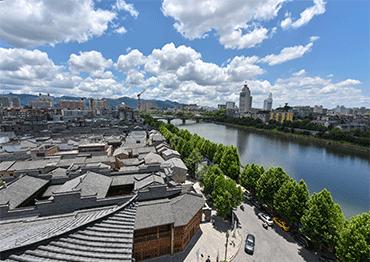
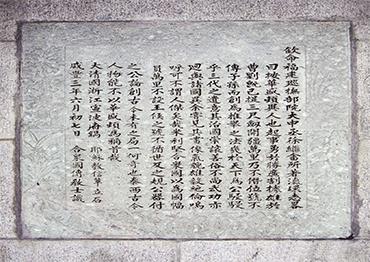
Within Jingdezhen's historic quarter, ruins of the Tianhou Palace and the city's mosque offer examples of cross-cultural exchange.
Tianhou palaces are temples dedicated to the sea goddess Mazu, a protector of sailors and fishers prominent in the folk religion of the Minnan people of Southeast China's Fujian Province.
Jingdezhen's Tianhou Palace not only represents how important maritime transport was for the city's economy, but also the influx of Minnan to the region attracted by the porcelain trade.
The palace was long believed to date to the reign of Qing Emperor Kangxi (1662- 1722). New archaeological findings, however, have traced its origins to the reign of Ming Emperor Wanli (1573-1620).
This earlier date closely corresponds with the Longqing Opening, a Ming Dynasty policy that lifted long-standing maritime trade restrictions and officially allowed private Chinese merchants to trade overseas. It also coincided with the rise of the Manila Galleon Trade, a maritime network in which Spanish ships sailed between Manila in the Philippines and Acapulco, Mexico, exchanging Chinese porcelain, silk and other East Asian goods for American silver.
Excavations at Jingdezhen Mosque ruins reveal its prior history as a workshop producing high-quality ceramics as early as the late Southern Song.
Unearthed artifacts include Arab magic square porcelain, decorated with square motifs associated with the Islamic world, vassal kings' wares and porcelain produced under a system in which production was privately run under official oversight.
Archaeologists interpret its conversion to a mosque during the reign of Qing Emperor Kangxi as evidence of the interplay between religious needs and commerce, as well as the growing influence of merchant guilds.
This dialogue continues today. A series of academic conferences focused on Jingdezhen's porcelain heritage has brought archaeologists and heritage researchers from around the world to the city.
Cross-cultural dialogue also lives in Jingdezhen's ancient alleys, which are home to thousands of ceramic creators from more than 60 countries pursuing their creative aspirations.
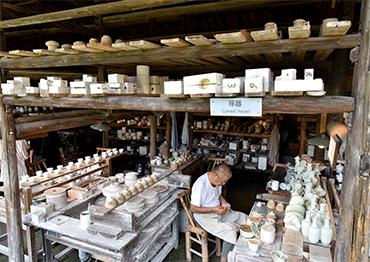
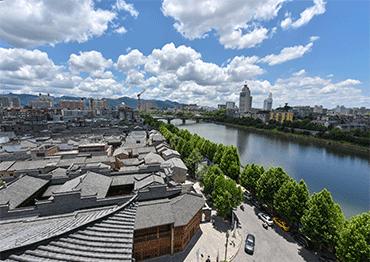
Kiln smoke no longer billows over Jingdezhen as it once did, yet the fires still burn. Ancient kiln mounds, weathered quarries and old docks stand alongside bustling workshops, where local craftsmen and jingpiao bend over potters' wheels under the same light.
 Old Version