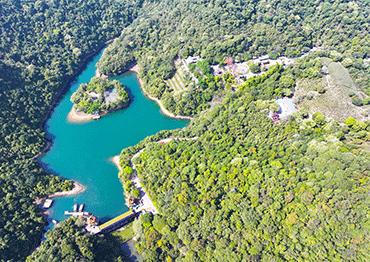
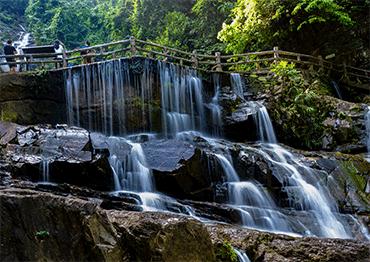
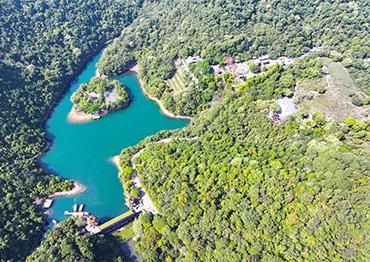
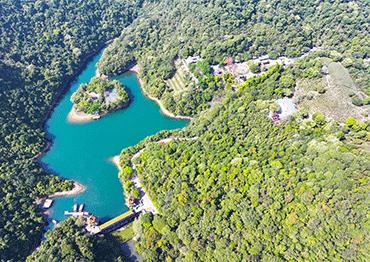
ocated in Zhaoqing, Guangdong Province, Dinghushan National Nature Reserve is a rare oasis within the desert-dominated belt along the Tropic of Cancer.
While most regions at this latitude feature arid conditions, sparse vegetation, deserts and savannas, Dinghushan hosts a well-developed climax community of south subtropical evergreen broad-leaved forest that has largely escaped large-scale human disturbance for nearly 400 years. With 98 percent forest cover, the mountain reserve sustains abundant and distinctive biological resources. Aptly named the "Green Pearl on the Tropic of Cancer," it functions as a vital species repository and gene bank for southern China.
Spanning 11.33 square kilometers, this mountain landscape supports diverse vegetation and fully intact ecosystems, sheltering rare and endangered plant and animal species. It serves as a natural laboratory for studying south subtropical forest succession, ecological restoration and biodiversity conservation.
Founded in 1956, Dinghushan represents the birthplace of China's protected area system, kickstarting the country's modern conservation endeavors. Before then, China lacked formal on-site conservation institutions or reserves. Conceived by pioneering biologists, the site evolved China's practice of land-based protection to preserve intact native ecosystems for scientific research.
In 1979, it became one of China's earliest sites under the UNESCO Man and the Biosphere (MAB) Program, emerging as a key Chinese platform for global biodiversity cooperation and the pursuit of harmony between humanity and nature.
Over seven decades, China's protected area framework has evolved from an early nature reserve centered model into a comprehensive system comprising national parks, nature reserves and natural parks.
As the original prototype for China's protected area network, Dinghushan's long-term ecological monitoring and biosphere reserve practice produced early domestic models for conservation, scientific research and community co-management. It bears witness to China's shift from basic enclosure style protection toward modern, multi-objective ecological governance. Its development reflects the gradual evolution of China's ecological preservation efforts, while it laid the groundwork for the national protected area system, demonstrating the effectiveness of locally rooted conservation approaches.
Cao Honglin, a researcher at the South China Botanical Garden, Chinese Academy of Sciences (CAS), specializes in vegetation, conservation and restoration ecology. He spoke with China News Service about Dinghushan's accomplishments and China's contributions of homegrown solutions to global biodiversity conservation.
China News Service: What historical context and original mission shaped the establishment of Dinghushan Nature Reserve, and why did China's modern nature conservation movement originate here?
Cao Honglin: The discussion about Dinghushan Nature Reserve started with Academician Chen Huanyong (Woon-Young Chun), a founding figure of modern plant taxonomy in China. Born in Hong Kong and [with his family] originally from Xinhui, Guangdong, Chen came to China [from the US] in 1919 after graduating with a master's degree from Harvard University. He taught at several top Chinese universities and founded the Sun Yat-sen University Institute of Agriculture and Forestry Botany in 1929, the predecessor of today's South China Botanical Garden, CAS, and pioneered the development of modern botanical research in China.
In 1956, during the Third Session of the First National People's Congress, Chen, along with a group of distinguished scientists, submitted Proposal No. 92, which advocated establishing nationwide no-logging zones for natural forests and launching the country's first formal nature reserves. Earlier that year, Chen put forward two landmark initiatives: the creation of the South China Botanical Garden in Guangzhou's Longyandong area for off-site plant conservation, and the founding of Dinghushan Arboretum in Zhaoqing for on-site plant protection. Both proposals were officially approved by CAS and the Guangdong Provincial Party Committee.
A total of 1,155 hectares of forestland from the former Gaoyao Forest Farm was designated as the site of Dinghushan Arboretum, now the Dinghushan Nature Reserve, under the administration of the South China Institute of Botany. Founded on June 30, 1956, it remains the only nature reserve directly affiliated with CAS. In 1979, it was formally designated a UNESCO World Biosphere Reserve.
CNS: Over the past seven decades, what lessons has Dinghushan National Nature Reserve offered for building China's nature reserve system, and what results has it delivered?
CH: Dinghushan protects the south-subtropics' zonal forest vegetation, the monsoon evergreen broad-leaved forest (alternatively called south subtropical evergreen broad-leaved forest) with its full suite of biodiversity. Today the reserve retains 98 percent forest cover and conserves eight distinct natural forest vegetation types. It provides on-site protection for 1,948 species of wild higher plants, making up 30 percent of Guangdong's total higher plant flora. Surveys within its borders have documented 43 mammals, 277 birds, 59 reptiles and 23 amphibian species. Remarkably, 44 species carry the taxonomic epithet dinghu, which denotes their connection to Dinghushan.
From the beginning, Dinghushan functioned as a vital research hub for scientists from CAS's South China Institute of Botany, alongside plant-science specialists at home and abroad. More than 2,200 scholarly papers have stemmed from work carried out on-site, many published in high-impact, internationally peer reviewed journals.
As early as 1992, Dinghushan set up permanent long term biodiversity monitoring plots, and data generated from these sites shapes and improves the reserve's management approaches. It also pioneered China-wide theoretical and applied research on ecotourism within protected area settings.
Seventy years of on the ground practice at Dinghushan confirms that nature reserves constitute the most effective tool for conserving natural resources and ecological environments, establishing a benchmark for nature reserve advancement throughout China.
CNS: What developmental trajectory has China's nature reserve system followed over the past 70 years?
CH: China's nature reserve development can be divided into four distinct phases.
The first was the initial founding stage (1956-1978). Following the establishment of Dinghushan Nature Reserve, a series of new reserves were set up across the country, including Tianmushan in Zhejiang Province, Jianfengling in Hainan Province and Huaping in Guangxi Zhuang Autonomous Region. By the end of 1978, China had established 34 nature reserves.
The second phase (1979-1993) featured steady expansion. Driven by rapid socioeconomic growth amid reform and opening-up, China promulgated and enforced the Measures for the Administration of Nature Reserves of Forest and Wildlife Types in 1985, the nation's first official regulation on the establishment and management of nature reserves. By 1993, 763 nature reserves of diverse types had been built nationwide.
The third phase brought accelerated development (1994-2009). The Regulations of the People's Republic of China on Nature Reserves took effect in 1994, launching a dual governance framework that integrates unified oversight with sector-specific administration. Starting in 1999, China launched flagship ecological initiatives, including the Natural Forest Protection Program and the Grain for Green Project. The official rollout of the National Wildlife Conservation and Nature Reserve Construction Program in 2001 accelerated the growth of China's nature reserve system.
The fourth phase is consolidation and systematic improvement (2010-present). During the 12th Five-Year Plan (2011-2015), targeted special funds were deployed to support ecological incentives and compensation mechanisms for nature reserves. This financial backing strengthened management capacity building at national-level reserves and supported wetland conservation and restoration projects, ushering the system into a refined, consolidated developmental stage.
To date, China has built more than 2,600 nature reserves across all administrative levels, effectively protecting 90 percent of the country's terrestrial ecosystem types and 74 percent of its nationally key-protected wild flora and fauna populations.
CNS: From early era single species conservation to the emerging new-generation protected area systems centered on national parks, what unique features define China's nature reserve development?
CH: Traditional Chinese culture embraces the philosophy of "harmony between humanity and nature," a principle that permeates China's nature reserve endeavors. The so-called feng shui forests preserved in ancient mountain villages across southern China constitute the country's earliest form of forest stewardship.
On Dinghushan, one of Guangdong's four renowned mountains, behind Qingyun Temple stands a 400-year-old zonal climax monsoon evergreen broad leaved forest spanning roughly 66.67 hectares. Historically, this woodland served as a temple-guarded feng shui forest. Centuries ago, sacred sites such as Dinghushan drew Western missionaries and botanical specimen collectors for field sampling work.
In China, forest land belongs to the State or rural collectives. This institutional underpinning makes top-down strategic planning feasible, allowing biodiversity hotspots across the nation to be safeguarded through protected area designation.
Across seven decades, China's conservation model has transformed. Site-based protection, first exemplified by Dinghushan, gave way to a new paradigm since the beginning of the 21st century: priorities shifted from merely forbidding ecological destruction toward active ecological restoration. Nature reserve development has progressed from scattered, isolated sites to interconnected networks. Ecological corridors connect individual reserves to their neighbors, greatly improving conservation effectiveness. The 2015 initiative to construct an on-site conservation system anchored by national parks has further advanced this reserve network.
CNS: How can China's nature reserve development continue to provide solutions for global biodiversity conservation in the future?
CH: Moving ahead, China should finalize the integration and optimization of its protected area system. Provinces like Guangdong, home to large numbers of highly varied protected areas and burdened with substantial historical legacies, require top-level spatial planning for reserve layouts informed by specialist researchers representing diverse biological groups.
Sites of low ecological value and little endemic biodiversity may be redesignated from nature reserves to natural parks. Meanwhile, new nature reserves should be promptly established in biodiversity hotspots that still suffer protection gaps.
In addition, functional zoning inside protected areas requires improvement. For core zones and general control zones that still hold human settlements for historical reasons, adding dedicated production living zones is recommended to better realize the philosophy of harmonious coexistence between humans and nature.
Nature reserves need to strike a sound balance between strict conservation and rational use. (China's nature reserves are divided into three functional zones: the ‘core zone' for strict protection, the ‘buffer zone' for limited non-destructive activities and the ‘general control zone' permitting regulated rational use under ecological prerequisites.) Within general control zones, ecotourism, rewilding and breeding trials for rare species, together with suitable public outreach and science education programs, ought to be promoted.
 Old Version