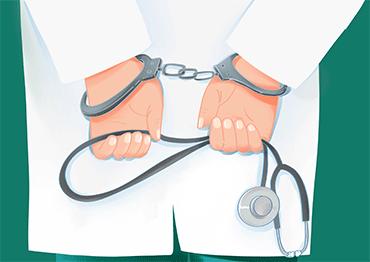
Dr Han Jie walked out of a Fuzhou, Jiangxi Province detention center in June, having served a year in prison over the death of a toddler.
The boy died in 2024 after succumbing to complications from acute intestinal issues that ultimately saw Han, in his 30s, charged with criminal negligence. He was also barred from practicing for three years.
But he does not consider the case over. On August 25, Han filed an appeal at Fuzhou Intermediate People's Court, arguing that his mistakes did not amount to the "gross negligence" required for a criminal conviction.
"I acknowledge the omissions in my diagnosis, but I do not accept I was grossly negligent," Han told NewsChina. The ruling has left him with a criminal record and no desire to return to medicine, he said.
In a separate civil case filed by the boy's family, the court found his hospital largely at fault and ordered it to pay 1.46 million yuan (US$217,600) in compensation. Han's supervising physician, who took over the boy's care hours before his death, was also suspended but never criminally charged.
Because the child was cremated before the family pursued legal action, there was no autopsy. The family has been reluctant to speak about the case, leaving gaps in the public record about decisions they made at crucial moments.
Han's appeal not only asks the court to reconsider whether the evidence was enough to justify his punishment, it also raises debate over a longstanding tension between doctors and patients in China, where families demand accountability and doctors fear that a bad outcome can turn into a personal liability.
The case began late on February 16, 2024. The 30-month-old boy began vomiting and was initially taken to Fuzhou Municipal Hospital, where he was diagnosed with stomach flu and discharged, reported Jianwen Consultancy, a healthcare-focused WeChat account.
But when he started vomiting blood at around 3 am, his family rushed him to the emergency room at Fuzhou Jianqiang Fifth Hospital, a smaller private hospital closer to their home. Han was working the night shift.
Han ordered an abdominal X-ray and began conservative treatment, including an IV drip, antibiotics and drugs to protect his stomach lining.
His medical records described the child's condition as serious and listed several possible diagnoses, including dead intestinal wall tissue, hernia, septic shock and intussusception, where a segment of the intestine slides inside an adjacent one, like a retractable telescope.
But Han did not examine the child's groin, order an ultrasound or request a surgical consultation. Those omissions would later become central to the criminal case.
At around 8 am, the hospital's department director, Luo Gang, took over the day shift and joined Han on ward rounds. The treatment plan remained unchanged, and Han left work around 11 am.
By around 1 pm, the child's condition had deteriorated. He was pale, had blood at the corner of his mouth and a swollen abdomen.
According to Jianwen Consultancy, the family said they could not find a doctor on duty and decided to drive him themselves to Jiangxi Provincial Children's Hospital in Nanchang, roughly two hours away.
The boy went into cardiac arrest on the way. At 4:20 pm, emergency room staff in Nanchang found no pulse.
Cause of death was identified as incarcerated inguinal hernia, where part of the intestine pushes through a weak spot in the abdominal wall into the groin and becomes trapped. It requires urgent treatment but is rarely fatal if caught in time.
The first official findings after the death did not single out Han. On June 13, 2024, the Fuzhou Medical Association judged the case as a "medical accident in the first degree," which is similar to criminal malpractice, and placed primary responsibility on the hospital.
In October 2024, the hospital received a warning from the local health commission. Both Han and Luo were suspended from practicing for six months.
That same month, the family filed a civil suit against the hospital at a Fuzhou district court. In January 2025, a court-ordered forensic appraisal found that the hospital's errors were directly related to the child's death.
That March, the court held the hospital "85 percent responsible" and ordered it to pay 1.46 million yuan (US$217,600) in compensation to the family.
With this ruling and the doctors' suspensions, the family then went to police to pursue criminal charges, Jianwen Consultancy reported. Fuzhou authorities opened a criminal investigation and took Han into custody on June 18 that year.
Four months later, a Fuzhou district court convicted him under Criminal Law, which applies when medical personnel are deemed to have been "grossly negligent" and their conduct causes a patient's death or serious injury.
Han appealed from prison, but Fuzhou Intermediate People's Court upheld the conviction in late May this year. Two weeks later, Han was released.
In their ruling, the court pointed to a 2004 edition of the Clinical Guidelines for Pediatric Surgery, which states that a doctor must examine the groin area of a child reporting acute abdominal pain.
Prosecutors also presented hospital records showing that Han had previously treated children with intestinal obstruction. The court described him as having five years of pediatric experience.
But Han says this is misleading. He obtained his medical license only in September 2023 and had been formally practicing pediatrics for about four months when the boy died.
He does not deny that he missed the hernia, but said that a wrong diagnosis is not automatically criminal negligence.
An incarcerated hernia can sometimes reduce spontaneously and become difficult to detect, he argued. The examination also took place at 3 am, when the hospital's ultrasound department had no one on duty. He pointed out that the doctors who took over the case after him failed to detect the hernia and did not change the treatment plan.
The handover to Luo Gang is one of the most contentious parts of the case.
Han's defense said he should be responsible for the child's treatment only from roughly 3 am until 8 am, when Luo took over the day shift. After that point, his lawyers argue that responsibility for reassessing the child and seeking a surgical consultation rested with Luo.
But the court ruled that Han, as both the first diagnosing and attending physician, remained accountable for the course of care and that the handover did not erase his initial failure.
Liu Xin, a professor at China University of Political Science and Law who studies medical malpractice cases, told NewsChina that Han's responsibility should be assessed for the period before the handover, and Luo for what happened afterward.
Why only Han was charged and not Luo is a question that no one has yet answered.
Based on medical records and witness statements, forensic experts concluded that the boy most likely died from intestinal obstruction and the resulting acid buildup in his system.
But determining the medical cause of death is not the same as proving criminal responsibility for it. Zhang Yongquan, a lawyer quoted by the Xinmin Weekly, said that forensic scientists are generally reluctant to conclude that medical treatment was primarily responsible for a death when there is no autopsy, because the underlying condition itself cannot be completely ruled out as the cause.
He called the missing autopsy the "primary trigger" for the case's slide into criminal proceedings.
However, Deng Liqiang, deputy chairman of the Chinese Hospital Association's medical law committee, disagrees. He told NewsChina that a missing autopsy does not necessarily make the cause of death impossible to establish when medical records and other circumstantial evidence corroborate it.
Medical malpractice was added to the Criminal Law for the first time in 1997, making "gross negligence" a criminal offense.
But prosecutions remain relatively rare. A 2023 report in newspaper Health Times identified only 21 convictions for malpractice since 2017. Notably, more than 90 percent of the doctors involved worked at smaller county-level or township hospitals.
A study of 80 cases published in journal Medicine & Philosophy in 2024 found that 39.8 percent resulted in prison sentences, 38.6 percent in suspended sentences, 11.4 percent in convictions without punishment and 10.2 percent in acquittals.
The cases point to a legal shift from focusing on the cause of a medical accident to its consequences. China's legal framework once distinguished between accidents caused by professional misconduct and those arising from technical limitations. That distinction was later abandoned in 2002 in favor of classifying medical accidents largely by the severity of the harm.
Wang Yue, a professor in the Department of Medical Ethics and Law at Peking University's School of Health Humanities, told NewsChina that the change left courts, not medical experts, to determine whether a doctor's error represented negligence or simply limited professional ability.
The comparison cases cut both ways. Li Jianxue, an obstetrician in Fujian Province, spent eight years fighting a medical accident charge before being acquitted in 2020. Wen Hong, a pediatrician in Xiamen, Fujian, was acquitted in 2023 after seven years.
For doctors, the question is not simply whether a patient was harmed, but when a medical error becomes a crime.
The medical community's response has been fear. Gao Jiechun, director of the Hospital Management Institute at Fudan University, has followed medical accident cases for nearly a decade. In 2018, he called for greater caution in applying the crime. Now he is suggesting that it be abolished.
China could instead handle the most extreme cases under existing criminal law, Gao said in an interview with healthcare industry platform Yixuejie in August, rather than keeping a separate offense whose boundaries he considers vague and confusing.
He describes this concern as having a "chilling effect." If doctors believe a diagnostic mistake could result in prison, they may respond defensively by ordering excessive numbers of tests, refusing high-risk patients or referring cases to higher-level hospitals rather than treating them themselves.
Liu Lili, a 47-year-old physician at a major hospital in Beijing's Shunyi District, told NewsChina in early September that medical liability should be assessed primarily by medical professionals rather than judges, lawyers or public opinion.
She said she understood the family's grief but worried that doctors protecting themselves from liability could increasingly refuse difficult patients, deepening the longstanding distrust between doctors and patients in China.
This is why there is a lot of sympathy for Han on social media, as anyone can end up as a patient who may face either excessive tests or a reluctant doctor.
But Deng said that when a patient shows clear danger signs and a doctor seriously violates professional standards with severe consequences, criminal law has a role to play in protecting patients and maintaining medical order.
Much of the public discourse has centered on Han's conviction, the medical evidence and the threat that criminal liability may pose to doctors. But behind those arguments is a family that lost a child and sought accountability through the courts.
Han's account of the night, including his claim that the boy's father initially resisted the X-ray, was disputed on social media by an account operated by the child's mother.
The posts were later deleted. The family did not respond to NewsChina's request for an interview.
Their perspective, especially circumstances surrounding the child's final hours, remains largely absent from the debate.
That absence leaves the case caught between families' fears that the medical system offers them too little accountability when things go wrong, and doctors who worry that a poor outcome can make them personally responsible for it.
For Han, the consequences are painfully clear. "I don't want to be a doctor anymore," he told Jianwen Consultancy: "Those who haven't been through this are just watching from the sidelines. Only those who have been through it know what it's like."
 Old Version