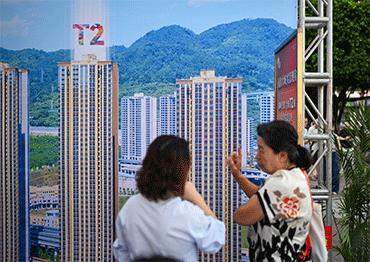
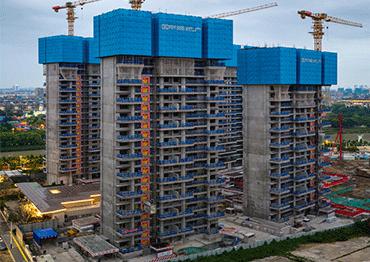
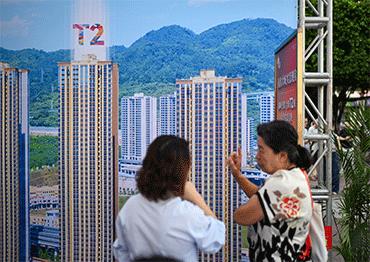
For more than 30 years, home-buyers have been purchasing apartments that existed only on plans and showroom models, trusting developers to complete them on schedule.
As their customers waited, developers leveraged their deposits and mortgage payments to finance new construction projects. This "presale system" helped fuel one of the fastest periods of urbanization in modern history.
But on August 28, five of China's key financial and housing regulators announced measures aimed at establishing a "new model of real estate development" where buyers can see the actual homes they are paying for.
Under the new guidelines, a project's foundation, concrete floors and roof must be completed before it can be put on the market. Buyer funds, which were once handed almost directly to developers, will instead be held in government-managed escrow accounts and released once construction phases are completed.
China introduced the presale system in the 1990s to serve its severe housing shortage amid rapid urbanization. Developers needed a way to bankroll construction in markets that were expanding faster than traditional financing could keep up.
Under the presale system, developers had immediate access to deposits and mortgage payments, allowing them to take on much more leverage than traditional arrangements would permit.
But as economic growth and urbanization slowed, the presale model strained under the very leverage that fueled China's property boom.
When authorities tightened financing rules for developers in 2020 to rein in excessive borrowing, many developers struggled to meet their obligations. Most notably, Evergrande, once China's largest developer, defaulted on roughly 2.4 trillion yuan (US$300b) in debt in December 2021 and was ultimately ordered into liquidation by a Hong Kong court in January 2024.
Many projects were delayed or left unfinished, leaving hundreds of thousands of homebuyers paying mortgages on properties they could not yet occupy. The resulting loss of confidence further weakened sales, creating a vicious cycle of falling demand and deteriorating liquidity that has continued to weigh on China's economic recovery.
On August 20, just days before the new housing rules were unveiled, Evergrande founder Xu Jiayin was sentenced by a Shenzhen court to life in prison for financial crimes including fraud, embezzlement and bribery. Evergrande Group and its real estate arm were also fined a combined 15.82 billion yuan (US$2.4b).
Xu's downfall and Evergrande's collapse have come to symbolize the end of the debt-fueled property boom that the new reforms are designed to prevent from returning.
The reform aims to restore confidence in the housing market by putting the risks homebuyers were left shouldering back on developers.
One of the eight documents, titled "Notice on Improving the Commercial Housing Sales System," explicitly pledged to "vigorously and methodically advance the sale of completed, ready-to-move-in commercial housing," with the goal of achieving "what you see is what you get."
"This will reduce disputes over housing delivery, fundamentally guard against delivery risk, protect homebuyers' lawful rights and interests, and accelerate the development of a new model for the real estate sector," the document says.
But the reforms do not eliminate presales altogether. Under the new guidelines, apartment buildings will generally have to be structurally complete before developers can presell them.
More importantly, down payments and mortgage funds will be placed in escrow and released only after the project has been completed and approved. Projects that secured planning permits before the new rules took effect will be grandfathered in.
Citing an unnamed official, the Xinhua News Agency reported on August 28 that the reform is intended to break the "high debt, high leverage, high turnover" model, overhaul home sales, strengthen oversight of presale funds and encourage developers to scale their operations to match their financial strength.
For many analysts, the reform reflects the new reality of China's property market. Wu Jing, director of Tsinghua University's Real Estate Research Center, said today's homebuyers are mostly owner-occupiers, particularly those upgrading to better housing, who tend to commit only after carefully weighing their options.
Selling completed homes makes that comparison more tangible, he said, turning "wanting to buy" into "daring to buy" and helping stabilize a housing market that has begun to recover.
In an article published on sina.com on September 7, Li Cong, an analyst at China Jianyin Investment, noted that the nationwide share of completed homes in commercial housing sales rose from 12.7 percent in 2020 to 35.9 percent in 2025, as buyers "voted with their feet" for a "what you see is what you get" model.
The reform, Li said, effectively formalizes a shift that the market had already begun making on its own.
The new rules, however, come with a major challenge for developers. In the days after their release, developer-focused indexes in the Chinese mainland and Hong Kong fell sharply as investors worried that the measures, while offering greater protection for homebuyers, could cut off developers' largest source of funding.
Deposits, advance receipts and mortgage proceeds accounted for 44.6 percent of developer funding from January through July this year, according to the National Bureau of Statistics. Moving that money further back in the construction cycle means developers will need to rely more heavily on their own capital and development loans to make up the gap.
To support developers' financing needs, the central bank, securities regulators and other government departments have rolled out coordinated measures. These include extending the maximum term for individual home loans from 30 to 40 years and establishing a "lead-bank system," where one primary bank manages the entire loan process for projects.
While the old model of borrowing against buyers' upfront payments is being phased out, the policy package is opening several alternative and more targeted channels of financing, Li Jinbo, deputy director of the Department of Regional and Industrial Economic Research at the China Center for International Economic Exchanges, said in a People's Daily article on September 3.
One key measure is long-term lending for rental housing. New loan categories with terms of up to 30 years will support developers, industrial parks and other entities that build or convert properties into long-term rental housing, including through bulk purchases of unsold or vacant units.
A separate loan category for urban renewal provides financing for renovation projects involving old neighborhoods, urban villages and underused factories, with repayment terms matched to their slower cash flows. That fills a longstanding gap, as these projects were often too slow moving and low margin to qualify for conventional development loans.
The reform also aims to help developers turn their existing real estate assets into sources of funding rather than relying solely on new borrowing, Li said.
Regulators are allowing qualified rental housing and urban renewal projects to be listed as real estate investment trusts (REITs), which let investors buy shares in a pool of income-generating properties.
These measures give developers a way to turn completed, income-generating properties into cash that can then be reinvested elsewhere.
Listed developers are also being given more ways to acquire projects and other assets from financially troubled companies, Li said. They can raise money by issuing new shares or use shares, convertible bonds or cash to fund acquisitions. The same rules apply to State-owned and private developers.
Together, Li said, these channels are intended to help stronger companies absorb weaker ones while gaining access to longer-term, more stable sources of capital.
While it remains to be seen how the reforms will be implemented at the local level, China's real estate sector has shifted focus from new builds to managing and improving its enormous stock of housing that already exists.
Preowned home sales exceeded new-home sales nationwide for the first time this year, marking a turning point for the property sector.
According to data released by the Ministry of Housing and Urban-Rural Development, preowned homes accounted for 50.4 percent of residential sales in the first half of 2026.
The shift has been even more pronounced in major cities. In Shanghai, preowned sales were nearly five times the volume of new-home sales. In Beijing, the ratio was about 3.6 times.
Across 20 key cities, the ratio of preowned to new-home transactions rose from roughly equal in 2023 to 1.5 times in 2024, 1.9 times in 2025 and 2.3 times as of July this year.
"It is now clear that China's urbanization is shifting from a period of rapid growth to a period of stable development, and urban development is moving from an era of large-scale incremental expansion to one centered on improving the quality and efficiency of existing stock," Li said.
 Old Version