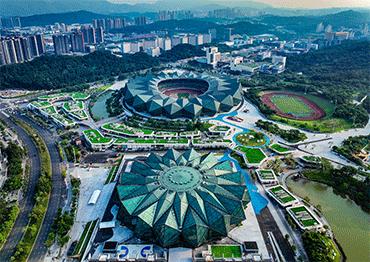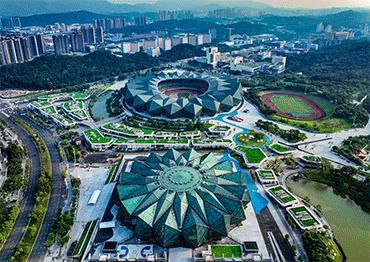
The Shenzhen Universiade Center, the main stadium of the 26th Summer Universiade in 2011, Longgang District, Shenzhen, Guangdong Province (Photo courtesy of Longgang government)
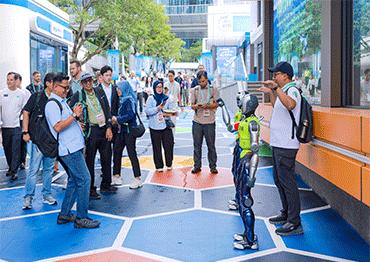
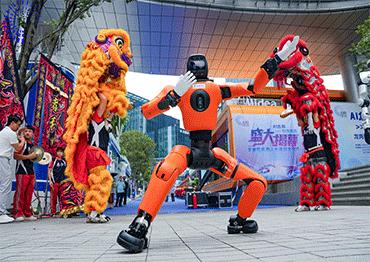
Offcials attending the 2026 APEC Ministerial Meeting on Forestry interact with robots on China’s frst “robot block,” which includes a robot theater, testing grounds and an industrial park, Longgang District, Shenzhen, Guangdong Province, July 28, 2026 (Photo courtesy of Longgang government)
The future rarely arrives fully formed. It is tested, adjusted and tested again. In Longgang, a sprawling district in northeastern Shenzhen, Guangdong Province, home to 4.8 million people, that process is happening in plain sight.
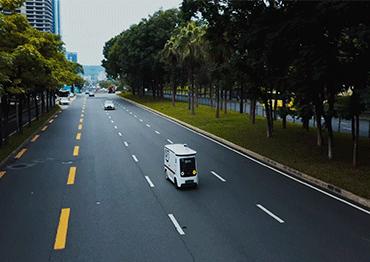
Sidewalks have become proving grounds for technologies not yet ready for mass production. Sanitation robots, typically confined to sterile factory floors, now navigate real-world streets, dodging delivery drivers, splashing through puddles after sudden downpours and weaving through the morning rush.
Borrowed from manufacturing, the term "pilot-scale testing" describes the critical, often brutal stage between a lab prototype and full-scale production. In Longgang, local officials have applied that industrial concept to the entire urban ecosystem. Rather than simply building a smart city, they are turning the city itself into a massive real-world testing ground.
"We don't just procure technology. We provide an environment that de-risks innovation," a local official explained while outlining the district's economic strategy. "We treat our entire jurisdiction as a launchpad for new tech. We offer scenarios, data and regulatory space to help companies turn promising ideas into viable products."
Longgang government operates less like a traditional bureaucracy and more like the systems architect of a giant machine. Rather than conducting adhoc technology trials, authorities have established a standardized process for matching technologies with real-world applications.
The numbers illustrate the scale. Over the past year, the district has cataloged more than 1,900 technological capabilities developed by local enterprises. More importantly, it identified 677 specific urban challenges where those technologies could be deployed. So far, those matches have resulted in 218 fully operational projects, generating approximately 3 billion yuan (US$420m) in local commercial contracts.
The goal is not simply efficiency but a continuous feedback loop. When a security robot at a sports complex, which can serve up to 200,000 visitors during peak periods, struggles to recognize faces in harsh backlighting, the failure becomes a data point. That information flows back to engineers, who can recalibrate the algorithm.
The city then provides the conditions for the next version of the product to be built and tested.
The planners' approach is perhaps most visible in the district's adoption of its latest AI operating system. Longgang is effectively turning itself into a physical testing environment for the technology.
At a recent tech conference, officials outlined their ambition to become an "All-in-AI District," an urban model in which humans and machines interact seamlessly. The idea is to embed software not only in smartphones and computers but throughout the city's physical infrastructure.
In one residential compound, China's first AI-powered secondary water-supply pump room autonomously regulates pressure and monitors water quality. Officials say the system has reduced energy consumption by 10 percent and hardware costs by 5 percent.
At the Longgang International Art Center, near-field communication (NFC), a short-range wireless technology found in most smartphones that lets two electronic devices share data, allows visitors to pass through gates without stopping to scan tickets. Integrated energy-management systems have reduced the building's annual carbon emissions by roughly 100 tons.
Even law enforcement has gone high-tech. The district recently deployed what it describes as the nation's first police vehicle equipped with the AI system, creating a mobile command center on wheels capable of providing round-the-clock security.
"The vitality of this initiative comes from the continuous expansion of application scenarios," a Longgang official said at a public briefing. "Only when technology is validated in complex, real-world settings can it truly integrate into the daily rhythm of the city."
A city that treats itself as a laboratory raises an obvious question: Does such efficiency come at the expense of human dignity?
Longgang's leadership appears conscious of that concern. Officials argue that a high-intensity innovation environment also requires infrastructure designed to reduce stress and prevent burnout.
This has led to what local planners call "nourishing infrastructure," a pragmatic response to the cognitive demands placed on young migrant workers. The district, for example, has invested heavily in a Slow Space Network, an urban initiative designed to provide moments of rest and respite, which its planners call "micro-restoration."
Pocket parks feature vegetation selected to buffer traffic noise, while pedestrian walkways are physically separated from views of construction cranes.
Healthcare is also part of the experiment. Moving beyond purely reactive care, the district has embedded "health nodes" in office buildings and residential complexes. The facilities focus on preventive monitoring, including blood-pressure checks and mental-health resources.
At the local maternal health and children's hospital, this blend of technology and tradition takes a more unusual form: a robotic arm hovers over three dozen traditional clay pots, precisely managing the ancient process of brewing Chinese herbal medicine. Patients can scan a QR code to trace their herbs from "farm to bowl."
As the 33rd APEC Economic Leaders' Meeting in Shenzhen approaches, Longgang offers international business leaders a case study in a very different approach to innovation.
Silicon Valley's familiar ethos is often summed up as "move fast and break things." Longgang's model is closer to "iterate steadily and refine at scale."
The district suggests that the future of innovation may not reside solely in California's intellectual-property labs or Southeast Asia's low-cost factories. Instead, it may depend on the ability to connect those stages within a single, sophisticated real-world environment.
In Longgang, the future is not something that simply arrives. It is something the city is actively and methodically testing, with robot-patrolled streets, optimized sensors and mass-produced hydrogen fuel cells as evidence of what that process can produce.
China's Longgang offers the world an imperfect but illuminating blueprint for the 21st-century city: a place where the boundary between the laboratory and the sidewalk is becoming increasingly difficult to see.
 Old Version