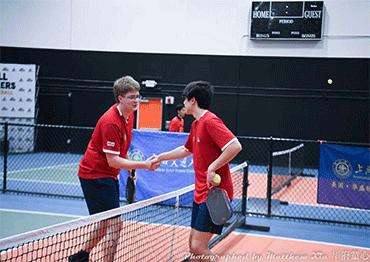
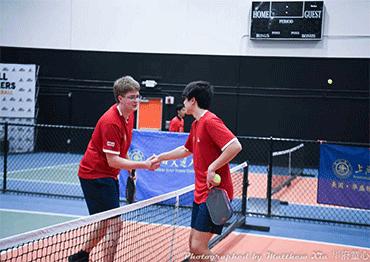
ifty-five years after Ping-Pong Diplomacy helped break the ice between China and the US in April 1971, pickleball is now writing the next chapter of bilateral people-to-people exchange between the two countries. In February, Jeffrey Sullivan, systemwide athletics director for Montgomery County Public Schools in Maryland, US, led a 45-member youth pickleball delegation to China during the Spring Festival, traveling from Shenzhen, South China's Guangdong Province, to Beijing, experiencing authentic Chinese culture along the way. In April 2025, Sullivan led a pickleball delegation of 44 teachers and students from 13 US schools to China for the first time, under Chinese President Xi Jinping's "50,000 in Five Years" initiative that aims to bring 50,000 young Americans to China for exchange and study programs over five years.
Pickleball is a fast-paced sport, but easy to learn, according to the USA Pickleball website. It is played indoors or outside on a badminton-sized court, in singles or doubles, using a paddle and plastic ball with holes in.
After visiting Shanghai, Shenzhen and Beijing, the delegation sent a letter to Xi, expressing their gratitude for the initiative. In his reply in early July 2025, Xi said he was pleased to see that pickleball has become a new bond for youth exchanges between China and the US. In return, young Chinese students from Shenzhen and Shanghai visited Montgomery and several other places in the US, including Boston, New York, Philadelphia and Washington, DC, in 2025 and 2026 to continue the friendship of young people from the two countries on and off pickleball courts.
Sullivan has frequently described his Chinese trips as "life-changing" for the students and himself. Recently, Sullivan told China News Service (CNS) how pickleball can boost people-to-people exchange between the two countries and continue the bilateral connection formed by Ping-Pong Diplomacy more than five decades ago.
Sullivan stressed that cultural exchanges have made their visits "more than a trip," noting that more than a year since their first trip, students from the US and China are still communicating through WeChat. All those friendships and experiences are "genuine," and that's the "cool part of it," he said.
China News Service: What was your impression from the two visits to China?
Jeffrey Sullivan: My understanding and my experiences in China have been incredible. I've used the word "magical" before. The hospitality we received on both of our trips was amazing.
On our first trip, going to Shanghai, Shenzhen and Beijing, pickleball diplomacy was really born. The connections that were made, the friendships that last to this day and will continue, and the ability to embrace Chinese culture really made a strong impact on us in that first trip.
The second trip, returning to Shenzhen and having smaller city experiences like Shangyou (Jiangxi Province) and Hebi (Henan Province), and returning to Beijing, was just next level because we visited during the Spring Festival. Being able to celebrate that holiday in China was simply out of this world.
What really said home for us was how many Chinese people, at every stop, during a time when they were supposed to be resting, relaxing and spending time with their own families, were making us feel at home and feel like family.
My experience in China has been incredible, and I'm very excited to return there soon.
CNS: Was there a particular moment in China that touched you?
JS: I don't know if there was one particular moment. I think it was watching the countless friendships between our student ambassadors and their friends in China every step of the way.
That started immediately when we got off the bus at the first stop on both trips. Watching that happen, I was overwhelmed with joy.
Being on the Great Wall of China with my daughter is a moment I'll remember for the rest of my life. She grabbed me by the shoulders at one point and said, "Dad, close your eyes." I closed my eyes, and she said, "We're on the Great Wall of China. I don't want you to ever forget this moment."
I had tears in my eyes.
There are a lot of memories on the trips, but I think the hospitality and the welcome we got in every location have been incredible. It's something that has set the stage for pickleball diplomacy to continue to be successful.
CNS: What makes an experience like this so powerful that you've described these trips many times as "life-changing?"
JS: I think it's traveling around the world to a new country that, for most of our ambassadors, including me - last April was my first time in China - and embracing another culture and learning.
And for me, it's not just about the trip. What's made our initiative so successful is the lead-up to each of these trips, the preparation. It's no different from preparing for a big game in sports, all the practices and the preparation. When it comes time for the game, you play well. In addition to pickleball events, the most important part was the cultural learning sessions that we had and the preparation for the trip. Those activities created a third thing - relationships, and building a family among our delegation. That created strong bonds between our [student] ambassadors and between the adults and me as well. And when we arrived in China, we were able to focus solely on building relationships, embracing culture and being part of a life-changing experience.
CNS: Why do you think firsthand experiences like these are so important?
JS: Because the experiences are genuine, so you're able to see people. Despite the differences in cultures, politics and all the things between countries, the roots are the people. Having that people-to-people connection and building those relationships and understanding culture and taking an intentional interest in learning someone else's culture is a powerful thing. It's a life skill that doesn't just apply to the US and China. It applies to here at home in your school, in your community, with friends and with co-workers.
Those are life skills about taking an intentional interest in someone else's culture who may be different. How do you build a relationship? And how do you identify similarities and build bridges? I believe that through pickleball diplomacy, we're embracing those life skills and the mindset that has allowed our student ambassadors to change and grow.
I've heard the phrase "life-changing" being used countless times with our student ambassadors and with their parents, and with me. This experience has changed my life and my outlook on a lot of things. I want to continue to make those life changing experiences for our student ambassadors and for countless people.
CNS: What is the biggest challenge your students face when they are trying to understand China?
JS: I think initially it's more of not knowing, not understanding the history, of the culture of China and learning that piece of it. I think it's more of unknown versus a negative perception.
What we look for in our [student] ambassadors is the willingness to learn about culture and about China. So that's been part of our preparation for our trips.
CNS: Of all the possible ways to connect young people, what makes sports, pickleball in particular, so effective?
JS: Sports bring people together. They bring countries together. You can see that on the grandest stage, the Olympics, where nations come together every four years to compete and join together. That's the international level. You can also see here at the high school level how sports play an important role in school culture in bringing the school communities and the schools together to compete.
I believe in the power of sports to bring people together and showcase the ability to learn, to celebrate wins and to handle defeat with dignity.
So you learn all the lessons in sports in teamwork. That plays into a sport like pickleball. One of the things about sports is that people are afraid to fail. Or sports sometimes can be hard to pick up and master. Pickleball is a sport that's easy to pick up. Because of that quick entry point, the ability to quickly pick up a paddle and experience success, most people can get through that anxiety period rather quickly.
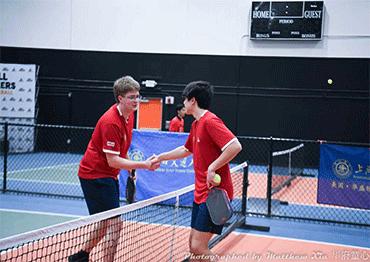
We've had [student] ambassadors on both trips who had never played pickleball before. But they picked up a paddle and said "I like this. This is cool." And the sport itself plays out perfectly for something like what we're doing, because a doubles team plays a doubles team - Chinese and Americans play side by side. They play in this team and they compete on the court. And what we see is instantaneously the teamwork, the sportsmanship, the special handshakes, the tapping of the paddles. And they communicate on the court, like who's going to be on what side. All of that happened quickly. So pickleball emerged to be a great sport because of that. The competition occurred, and the friendships were still there.
For us, in Montgomery County Public Schools, we were the first school district in the US to have pickleball as our city sport. That's what initially brought attention to us and opened the door for pickleball diplomacy to happen.
CNS: What role do youth exchanges play in the future relationship between the two countries?
JS: I would 100 percent encourage more youth exchange programs. I think it provides an opportunity to learn, to grow, to build a shared understanding for the future. Our youth are the future.
Sports are one pathway. But there are also opportunities through the arts and music as well. There are a lot of ways to connect. I think the more we can connect, the better.
For us, in one small way, all the relationships we built are building bridges and building bonds. The world is a happier place when we are doing it. We're happy to be part of it.
CNS: Ping-Pong Diplomacy has lasted for 55 years. Looking 20 years into the future, what do you hope today's students on both sides will remember about their journeys?
JS: I hope all the friendships are continuing to grow and blossom.
I hope that they carry the memories that they have with them and also tell the stories. I think it's important to tell the story of what pickleball diplomacy was about. So my hope is, as I said at the airport after our first trip, "The trip may be over, but our legacy will live on."
Whatever that legacy is, I think it's been a positive one to this point of being an activity and an experience that builds bridges and bonds and friendships that are genuine.
Our students use the term "aura" all the time - the aura around you, the vibes of what you do. So we talk about the aura of pickleball diplomacy.
It's not just about pickleball, or diplomacy or about sport. It's the aura around. It's the connection and the feeling. So you live pickleball diplomacy. That's what we say and we believe our [student] ambassadors have brought that to life.
My role is to create the spaces for that to happen. I help lead and get out of the way to let our students do their thing. That's been the cool part of it.
It's gonna be cool to watch it and continue to build.
 Old Version