Old Version
Cover Story

Nest Eggs

China now boasts over 340,000 birdwatchers and wildlife photographers, and people in birding hotspots are eschewing hunting for conservation-led tourism

By Wang Yan Updated Oct.1

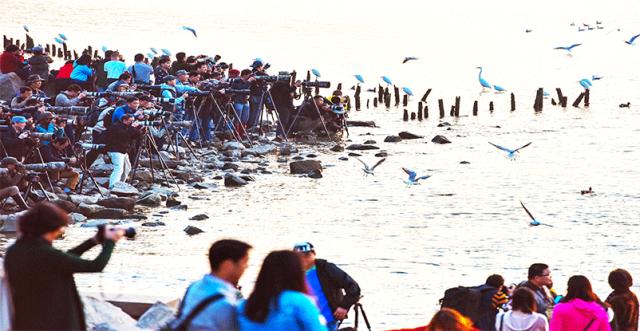
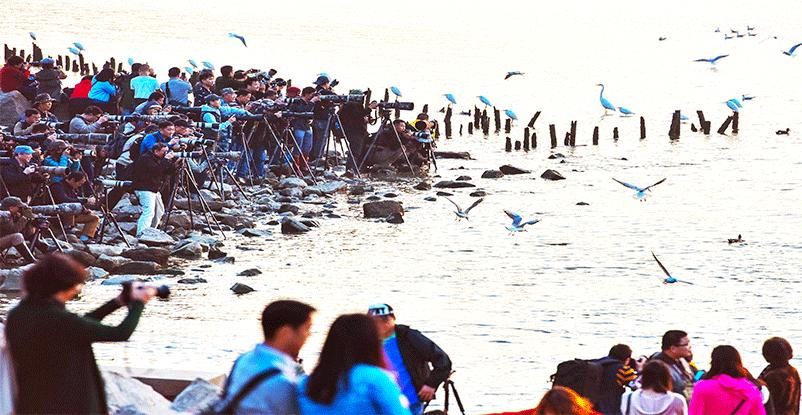
Birders and photographers gather at Shenzhen Bay Park, Guangdong Province, to view sea birds early on January 1, 2018 (Photo by VCG)

Huang Zhiqiang scoops a handful of mealworms from a plastic bucket and walks toward a bird hide. Placing the worms into grooves on bamboo poles above a man-made pond, he blows a whistle. Before long, a variety of wild birds appear. 

A chestnut-capped babbler was the first to land. It ate cautiously, and soon flew away. Next came a red-whiskered bulbul, which landed with bright chirps, yet took flight after only a few pecks, yielding its spot to a pair of shamas. 

"The chestnut-capped babbler is extremely timid. Locals here in Guangxi traditionally call it the ‘ghost bird.' It has a beautiful song, but you can hardly ever spot it. Chestnut-capped babblers are intimidated by red-whiskered bulbuls, so they fly off as soon as bulbuls turn up. When shamas arrive, especially male shamas, the bulbuls get scared, as shamas are far more aggressive," Huang said, sitting in a hide five meters from the pond. 

Huang, 43, has become an expert on bird behavior. He lives in Nonggang Village in the karst landscapes of southwest Guangxi Zhuang Autonomous Region. Famous among ornithologists and birders worldwide as the site where the Nonggang babbler, a bird endemic to China, was first identified, the village and nearby nature reserve is a sought-after birdwatching destination. Most Hvillagers have benefited from birdwatching tourism, building ponds and hides among farmlands and woodlands. Huang is among some 40 local professional guides. 

In spring and summer, there is abundant natural food, so wild birds do not require supplementary feeding. Even so, Huang often rides his electric scooter to his bird pond. Sometimes he sits quietly in a chair, occasionally putting out a handful of feed and blowing his whistle. "I just want to see whether the birds will come and what time they arrive." 

Apart from common resident species, Huang's pond is known for chestnut-capped babblers and yellow-eyed babblers, attracting wildlife photographers between September and March. 

Su Shangzhu, Party secretary of Zhubu Township, which administers Nonggang, told NewsChina that the village has laid out more than 30 birdwatching ponds, with 12 trails that cover a range of habitats and species. Ten villages participate in birdwatching tourism, benefiting 344 households with 1,422 residents. Families can earn on average 20,000 yuan (US$3,000) more a year, with some earning more than 100,000 yuan (US$14,800).

Taking Flight
Nonggang's birdwatching boom began with the discovery of a new species. In 2005, ecologist Jiang Aiwu from Guangxi University's College of Forestry and his supervisor, renowned ornithologist Zhou Fang, found an unknown babbler population in the seasonal rainforest of Nonggang National Nature Reserve. Formally documented and named the Nonggang babbler (Stachyris nonggangensis), it is one of the rare bird species independently discovered, described and named by Chinese ornithologists after 1949. 

Located in southwest Guangxi and established in 1979, Nonggang National Nature Reserve covers over 10,000 hectares. It is China's sole protected zone dedicated to seasonal rainforests in its northern tropical limestone region, sheltering rare flora and fauna including white-headed langurs, François' langurs, Nonggang babblers, Parashorea chinensis, an endangered evergreen tree, cycads and golden camellias. 

Researchers have recorded vascular plant species and 429 vertebrates, including 66 mammals, 66 reptiles, 31 amphibians and 266 birds, accounting for 36 percent of Guangxi's total bird species. "Out of the 266 documented bird species, only dozens appear regularly. About 10 are really sought-after by birders," Nong Zhengquan, chief of the reserve's Forestry Administration and Resources Protection Section, told NewsChina in early July. 

Jiang noted that the Zhuang ethnic group who live in the area possess knowledge that was crucial to finding the Nonggang babbler, and often had their own names for species. "Rangers shared bird descriptions with me - for example, a curved-beaked bird that spends most of its time on the ground,' he said. Nong Weihong, a former ranger, pioneer bird guide and founder of Nonggang's first birdwatching homestay, spoke of a species called "swing bird," named for its hanging treetop nests, which Jiang later identified as the long-tailed broadbill. 

After Jiang's research confirmed Nonggang babblers lived in and around Nonggang Reserve, birders from home and abroad flocked there. It led to the development of community-led birdwatching tourism outside the reserve's boundaries. 

"Liuzhou Birdwatching Society from Guangxi was crucial in the industry's early phase. I first took its members into mountains searching for the Nonggang babbler. Recognizing Nonggang's birdwatching potential, they backed Nong Weihong to convert buildings into visitor accommodation," Jiang said. Around 2015, farmers began building artificial feeding ponds to attract wild birds. 

"Nong Weihong created photography hides using kapok blossoms and mealworms. Photographers paid around 80 yuan (US$11.8) each. A single hide could hold over a dozen people, generating steady daily revenue." Jiang said birdwatching has lifted incomes and boosted wildlife conservation awareness. He never anticipated discovering a new bird would transform livelihoods in this remote mountain region. 

News of the Nonggang babbler rippled across the global birdwatching community. Visitors soon discovered other targets: the Indochinese green magpie, brown-breasted hill partridge, white-browed piculet, blue-backed pitta and long-tailed broadbill. 

Huang Zhiqiang started working as a guide around 2008. Before that, his family earned 30,000 yuan (US$4,443) annually growing sugarcane. "I knew nothing about birds. I learned from training sessions hosted by the township government and nature reserve, featuring lectures from invited experts." 

Today he runs Nonggang Bird Lodge, a three-story homestay completed in 2014, which can host 30 guests. Birdwatching has two peak seasons: late September to March for pond photography, and April to late June for the breeding season, ideal for nest shots. During these seasons, Nonggang's 15 homestays are usually fully booked. 

Huang Haipeng used to work in neighboring Guangdong Province. Lured by birdwatching opportunities, he returned home around 2014 to become a bird guide. After years of accumulating capital, he invested 800,000 yuan (US$118,500) to open Xiaopeng Inn in 2022. The inn has 14 rooms, and his family manages two ponds known for Indochinese green magpie sightings. 

According to Huang Haipeng, combined revenue from homestays, photography hides, transport and guiding brings his family at least 100,000 yuan (US$14,800) annually, far more than his salary in Guangdong. 

Local communities have formed clear systems for labor division and profit sharing. Homestay operators provide lodging, meals and transport, while revenue from photography hides belongs to pond owners. During breeding season, if stable nesting sites are located, photography fees are paid to the pond owner who first found the nest.

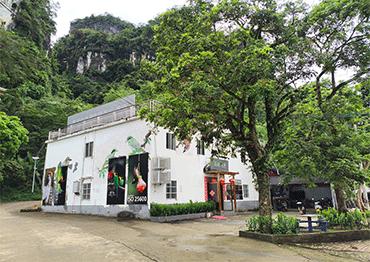
Nonggang Bird Lodge, July 4, 2026 (Photo by CNS)

Beak Practice
Villagers once relied on mountain resources for survival, with hunting and trapping wild birds long entrenched. Poaching created sharp friction between villagers and staff in Nonggang Reserve. 

Zhao Wenqing, president of Longzhou Birdwatching Society, said the illegal trade in wild birds was rife in the 1980s and 90s, driving some species almost to extinction. 

In the 1980s to 1990s when the nature reserve was newly set up, household income was low, and some felled trees illegally. "Whenever our staff halted such illegal activities by law, villagers grew resentful. Many believed conservation undermined their livelihoods and resisted our work. This rift persisted for years and proved extremely difficult to resolve," Nong Zhengquan said. 

The arrival of birdwatching ecotourism helped villagers recognize wild birds' long-term value, and they began protecting birds, enabling gradual population recovery. Former bird trappers became professional guides, homestay operators and eco-tourism service providers. 

The reserve, in partnership with Longzhou Birdwatching Society, helped villagers design nature trails, build ponds and set prices. The economic benefits they derive encourage them to safeguard forests and prevent logging and poaching, as well as boost conservation cooperation between communities and wildlife officials. 

Nong Zhengquan emphasized that the selection of viewing sites must be based on species' natural behaviors. 

"Reserve researchers conduct longterm bird surveys to map activity zones, while villagers observe wildlife year-round in the mountains. We combine both datasets to select suitable locations. Observation sites and targeted luring activities are only approved once we confirm regular presence of [certain] species," he said. 

But, he added, attracting birds through artificial means is controversial, as feeding and photography can disturb birds. 

"For this reason, authorities have introduced formal regulations. Approval for nest photography requires on-site assessment led by Longzhou Birdwatching Society, weighing risks such as nest abandonment or disturbance to fledglings," he said. 

This means hides are not close to nests and are rotated every year, with no activity allowed around nest building and hatching. "Everyone understands persistent disruption can drive parent birds to abandon nests, eliminating future observation opportunities," Nong said. 

Nonggang's birdwatching sector relies on coordinated support from local government, the nature reserve, research institutions and civic stakeholders. In the beginning there were steep obstacles, such as rudimentary infrastructure, poor accessibility and inadequate sanitation, with no previous foundation for the niche sector. 

The reserve and local administrators held discussions in villages to identify priorities. The roadmap they developed called to upgrade basic infrastructure first before making quality improvements. Road surfacing, power grid renovation and full network coverage topped the agenda, while parking, vocational training and village beautification were longer term goals. As more villagers joined in planning and governance, money was allocated to deliver the projects. 

From 2017 to 2019, Longzhou County invested over 20 million yuan (US$2.96m) in infrastructure upgrades, including paved roads, kitchen and toilet renovations, drainage systems and parking lots. Guangxi's first dedicated birdwatching hub, Nonggang Ecological Birdwatching Popular Science Base, was launched. 

Villagers were the prime beneficiaries, with better living conditions and more income streams. Some built bird ponds and homestays, while others offer tourist shuttles and photography support. Nearly every household has one or two members working in birdwatching tourism. 

The reserve directed funding into vocational training for bird guiding, botanical outreach, amphibian and reptile observation, nature journaling, wildlife photography and catering. More than 100 people, mostly young and returning migrants, participated. Officials visited other birdwatching hubs to observe best practices.

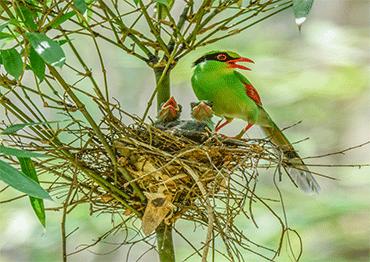
An Indochinese green magpie with chicks tends to her nest, Nonggang, May 3, 2021 (Photo by VCG)

Pecking Order
In some parts of China, unregulated expansion of bird ponds has triggered overbuilding, homogenous offerings and cutthroat competition. While individual ponds create limited ecological disruption, concentrated unplanned development accumulates environmental pressure. Uneven profit distribution has sparked internal conflicts. Excluded villagers have damaged facilities and disrupted operations, pushing promising eco-industries toward collapse. 

"In the early phase, we shared negative cases of poorly managed birdwatching industries with local stakeholders, repeatedly urging Longzhou to avoid malpractice like unethical bird luring for photos, ruinous price wars, habitat damage through arbitrary tree trimming, and conflicts over exclusive photography spots," Zhong Jia, honorary chairperson of the China Birdwatching Network Alliance, told NewsChina. 

County and township governments carried out door-to-door outreach, hosted forums bringing together academics, officials and villagers, and rolled out multi-level management regulations. 

"A viable replicable birdwatching economy requires inclusive benefitsharing and institutional governance. If only a small group profits from natural resources, impressive short-term gains do not amount to a successful development model," Zhong emphasized. 

Zhao Wenqing said there is one inviolable rule for photography management: human activity must never disrupt animals' natural behavior. "We do sustained early-stage monitoring to evaluate risks of breeding disturbance and strictly ban trimming vegetation around nests. Any guide altering habitats against regulations will have the site suspended," he said. 

A widely accepted set of norms has taken root locally. Whoever discovers a bird nest holds priority to operate the site and earn associated revenue. Simple photography hides require minimal investment, roughly 100-200 yuan (US$15-30) for ground levelling and shade netting.
 
Globally, supplementary feeding at bird ponds remains controversial. Longterm artificial provision of food may alter avian migration and breeding cycles, shift interspecies competition and increase bird aggregation, raising risks of pathogen transmission. 

Professor Jiang Aiwu takes a nuanced stance on bird-pond feeding. "Supplementary feeding in Nonggang mainly runs in the October to February dry season when food and water is scarce. During breeding seasons, birds rarely rely on artificial supplies and retain wild foraging skills. Fixed feeding reduces starvation risks in dry months, with only small periodic portions provided. In addition, visiting birds are not permanent groups, so dependency does not develop," Jiang said. 

"There are risks, as permanent feeding spots attract predators such as snakes and raptors. Overall, Nonggang's bird pond model delivers net benefits under current conditions, though consistent standardized management is critical." 

Jiang told NewsChina his research team has long monitored the ecological effects of bird ponds and nest photography, sharing data with authorities to advance sustainable industry growth. Long-term monitoring shows Nonggang babbler numbers within the reserve are rising. 

Zhao Wenqing regularly leads nationwide birdwatching groups to Nonggang. Before visitors arrive, guides design detailed photography schedules based on recent bird activity data. The itineraries target five to six key species through morning, midday and afternoon sites. The focus now is mostly on spring tours. 

"Spring coincides with resident birds' breeding season and migratory bird passage, lifting overall sighting diversity. We've extended routes to Mount Daqing on the China-Vietnam border, Longzhou's highest terrain, offering sightings of migrants and unique highland species," Zhao said. 

Li Weidong, a 55-year-old bridge engineer and wildlife photographer from Kunming, Yunnan Province, has visited Nonggang four times. "I've traveled to major bird pond photography sites nationwide, most showing obvious signs of heavy human intervention. Nonggang preserves far more natural habitats, and I consider its birdwatching experience among China's finest," he said.
 
Guangxi birdwatcher Lai Liping visited Nonggang in June, and told NewsChina she was impressed with the local guides' knowledge. "They know exactly when birds leave nests to feed chicks, feeding frequencies, primary prey and feeding intervals. delivering an excellent visitor experience," Lai said, adding that accommodation and guiding prices are reasonable."

Sky's the Limit
Across China's karst birdwatching destinations, Nonggang ranks among the finest. Most established birdwatching areas lie in Yunnan, which rely on year-round fixed bird ponds. Nonggang pioneered regulated breeding-season nest photography in China. 

Bird pond visits run September to March, leaving villagers with an off-season income gap. Launched in 2019, nest photography fills the March-June void and delivers year-round earnings. They are developing nature education programs like night birdwatching and insect observation to cover July through September. But most remain small-scale initiatives organized by conservation volunteers, and there are no partnerships with big travel agencies. 

Nonggang Village employs 25 full-time professional bird guides, alongside seasonal amateur guides such as villagers who discover wild bird nests. While the discoverer manages the site, Longzhou Birdwatching Society specialists monitor it to avoid disrupting incubation. 

Nong Qijian, 58, located a redheaded trogon nest in May and built a basic viewing hide. He usually hosts over a dozen photographers daily, but only earned 1,000 yuan (US$148) that breeding season, as trogon chicks fledge in 10 days. Some nests are in difficult terrain, so casual guides face highly unstable incomes. 

Nong Qijian's annual household income is around 50,000 yuan (US$7,400), putting his family in the village's lower-middle income tier, but it is not enough to build his own homestay, although there is demand for more lodging. 

Jiang Aiwu believes in making sure the whole community benefits. At present, homestay owners and bird guides receive most birdwatching revenue, excluding other villagers, who do not make enough from regular agriculture. He favors Yunnan's collective template where village communities share the benefits, while some skilled operators can earn more. 

Visitor Lai Liping feels positive about Nonggang's development path: "The bird pond model suppresses bird trapping and the wildlife trade, allowing villagers to profit sustainably from conservation. I hope the model can be replicated to encourage broader wild bird protection."

Print