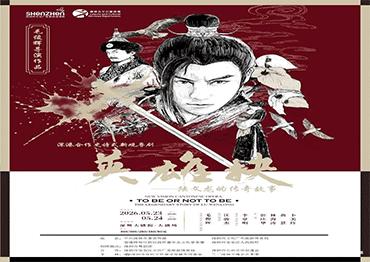
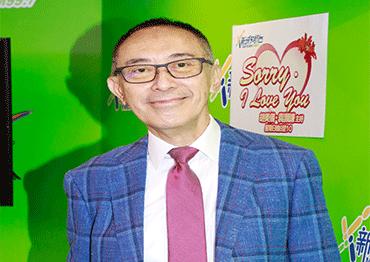
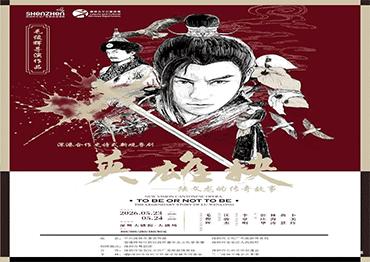
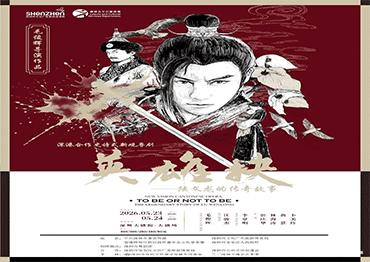
For Hong Kong director Fredric Mao Chun-fai, the answer lies in reimagining tradition. His latest Cantonese opera, To Be or Not to Be - The Legendary Story of Lu Wenlong, which premiered in Hong Kong in June as a joint Hong Kong-Shenzhen production, revisits a classic tale through a contemporary lens.
The son of a Song Dynasty (960- 1279) general, Lu's parents were killed in a battle with the invading northern rival Jin Dynasty (1115-1234). He was taken in by the Jin army commander, only to eventually struggle with remaining loyal to his adoptive Jin father or to his homeland.
Rather than focusing solely on battlefield heroics, the production explores its protagonist's inner conflict, moral choices and search for identity, while pairing traditional Cantonese opera with modern stage aesthetics.
The production reflects Mao's longstanding approach to theater. Throughout his career, he has blended traditional Chinese performing arts with contemporary storytelling and theatrical techniques, while preserving their cultural essence.
A veteran dramatist, director and educator, Mao has spent decades bridging Chinese and Western theater. Among his triumphs is New Love in a Fallen City (2006), a musical adapted from Eileen Chang's classic novel of the same name that tells a tangled love story set against the wartime collapse of Hong Kong.
After performing on Broadway and leading the Hong Kong Repertory Theater as its first artistic director, he has become one of Hong Kong's most influential advocates for innovation in Cantonese opera.
In an interview with China News Service, Mao discusses how Cantonese opera can remain relevant to modern audiences, Hong Kong's role as a cultural bridge between China and the world, and why human creativity will remain irreplaceable in the age of AI.
CNS: Your new Cantonese opera To Be or Not to Be - The Legendary Story of Lu Wenlong explores patriotism and heroism. What do you hope modern audiences will take from it?
MC: The classic tale of Lu Wenlong has long been performed in Cantonese opera and many other forms of Chinese opera. Our new production, viewed through a modern lens, explores how the protagonist discovers his true self and defines what kind of hero he wants to be amid conflict and moral dilemmas.
It also reflects my understanding of Chinese theater today: besides telling a compelling story, opera should inspire audiences to think deeply.
According to The Great Learning, one of the Four Books of Confucianism: "The purpose of great learning lies in manifesting a virtuous character and cultivating people to pursue the ultimate good." I hope this opera conveys that a hero's conscience, values and moral character are what matter most.
CNS: What first inspired your passion for theater?
MC: I have been fascinated with Chinese theater since childhood. I was born in Shanghai and moved to Hong Kong when I was 10.
While living in Shanghai, I watched traditional Chinese operas performed by renowned masters, including Peking Opera master Zhou Xinfang, who portrayed Prime Minister Wang and Bao Zheng in the classic opera Qin Xianglian. Both Shanghai Yue Opera and Cantonese opera left a profound impression on me and nurtured my lifelong passion for traditional theater.
In the late 1960s, I earned a master's in theater arts in the US. My first professional stage performance was in 1971 at the Berkeley Repertory Theater in California. I worked with the Napa Valley Theater Company between 1972 and 1976, first as an actor and later as a director. I also served as artistic director of the company. From 1983 to 1984, I served as deputy director of the New Asian American Theater in New York. These experiences greatly shaped my teaching and creative work after I returned to Hong Kong.
In 1980, renowned playwright Cao Yu [Wan Jiabao] visited the US, where Columbia University staged an English-language production of his play Peking Man in his honor.
I was fortunate to perform in the production. Through expressing Chinese cultural heritage on stage, my performance won praise from both Chinese and Western media. I realized that this stemmed from my deep-rooted Chinese cultural identity, and the production marked the pinnacle of my acting career.
Two years later, I visited the Chinese mainland as a representative of the New Dramatists [a nonprofit incubator for emerging playwrights based in New York], where I met theater professionals in Beijing, Wuhan and Shanghai to better understand the future direction of Chinese theater. Soon afterward, I received an invitation to teach in Hong Kong and decided to return to my cultural roots.
CNS: As Hong Kong seeks to brand itself as an international hub for cultural exchange, where does theater come into play?
MC: The Hong Kong Academy for Performing Arts, Hong Kong's first professional performing arts institution, was founded in 1984 and officially opened in 1985. I was honored to serve as head of acting at its School of Theater and helped design its curriculum.
Hong Kong theater has a unique advantage: it brings together Chinese and Western cultures while maintaining strong local characteristics. Although I gained valuable experience in the US, I knew we could not simply copy the American training system. Teaching must be tailored to local students. Rather than focusing heavily on theory, I often used sensory training and improvisational exercises to help students understand and apply theatrical skills. It is equally important that young performers stay rooted in their own culture.
Adapting and staging translated plays is another strength of Hong Kong theater because the city can quickly absorb and reinterpret the essence of Western theater. The central government expects Hong Kong to become a hub for cultural and artistic exchanges between China and the world, and we should fully leverage this advantage while embracing the present era.
Hong Kong needs to cultivate its own cultural identity by integrating Eastern and Western traditions. Young people, many of whom have had limited exposure to traditional Chinese culture, should deepen their understanding of that heritage while incorporating the best elements of Western theater. Hong Kong theater should preserve its local identity, inherit Chinese cultural traditions, and serve as a bridge between Chinese and foreign cultures.
CNS: You have brought local productions to audiences on the Chinese mainland and overseas. What does Chinese theater need to succeed internationally?
MC: The original musical Sweet and Sour Hong Kong (2003), which I coproduced and directed, blends Broadway style with Hong Kong characteristics. I invited two legendary Hong Kong musicians, James Wong (Wong Jum-sum, 1941-2004) and Joseph Koo (Koo Kar-fai, 1931-2023) to compose the music, while adapting the script from renowned playwright He Jiping's One Moon, Not Two Homelands. Its performances in Shanghai gave Chinese mainland audiences an opportunity to experience Hong Kong musical theater.
When directing New Love in a Fallen City (2006), I created the roles of a storyteller and a singer to reflect on and interpret the story, echoing the inner thoughts of the protagonist Bai Liusu while expressing my own understanding of Chang's original novel. The production also showcases both Hong Kong and Shanghai cultural characteristics.
We were invited to perform New Love in a Fallen City at the See You in Beijing Art Festival in 2006. During the first half of the performance, the audience remained completely silent, which made the cast very nervous. We worried that Beijing audiences did not appreciate the production, unlike the enthusiastic reception we had received in Hong Kong and Shanghai. However, when the curtain fell, the audience responded with warm applause. I believe their silence reflected how deeply absorbed they were in the performance.
Chinese theater faces many challenges in going global, but the effort is worthwhile. The key is to identify our unique cultural identity and integrate it into our productions.
CNS: You have devoted many years to revitalizing Cantonese opera. How can theater continue to preserve its human spirit in the age of AI?
MC: Cantonese opera is inscribed on UNESCO's Representative List of the Intangible Cultural Heritage of Humanity. Although it enjoys support from the Hong Kong government and a loyal audience, it still suffers from insufficient innovation and repetitive productions. That is why I have focused on researching and revitalizing Cantonese opera in recent years.
Funded by the Hong Kong Jockey Club, my adapted version of Pavilion of a Hundred Flowers (a traditional Cantonese opera set in the Yuan Dynasty (1271- 1368) about love and political intrigue) was staged at two consecutive Hong Kong Arts Festivals and later toured the Chinese mainland. Its success demonstrates that audiences have both an appetite and demand for innovative interpretations of traditional opera.
AI certainly poses challenges to theatrical creation. In recent years, some productions have mechanically incorporated fashionable new elements. When performers simply execute fixed requirements, they risk losing their individuality and becoming replaceable by AI. Theater is a collaborative art, and a performer's interpretation lies at its heart. AI can deliver standardized and programmed performances, but it can never replicate theater's true soul: the unique artistic insight of creators and performers, and the emotional connection forged through live interaction with audiences.
Young theater artists should learn from both Eastern and Western traditions in a thoughtful and rational way, rather than blindly imitating either one. Innovation must be rooted in tradition. Only by preserving the essence of traditional Chinese culture can we maintain our cultural identity and confidence. True innovation is not about piling on fashionable elements, but about revitalizing enduring traditions through modern perspectives and creative techniques to expand the possibilities of performance.
 Old Version