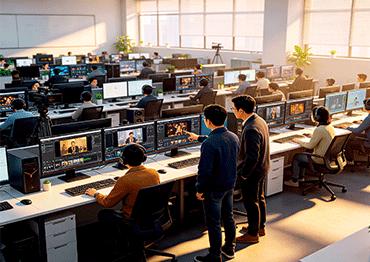
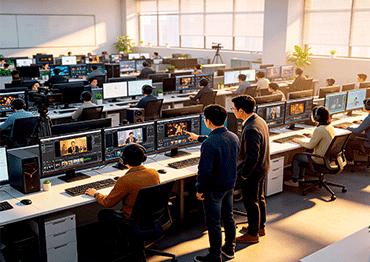
The first day on his new job, Yao Guoli was handed a script and assigned to direct an AI production.
Yao had previously produced live-action microdramas in Xi'an. Early in the year, he accepted an offer from a leading production company. Eight days later, he was informed his would-be department had been dissolved.
The only offer left came from a new AI-based studio making animated dramas. "After seeing where the industry was heading, I decided to switch to AI," Yao told NewsChina.
Now instead of coordinating actors, equipment and locations, Yao sits at a workstation with multiple AI tools. His work involves converting scripts into storyboards, collaborating with artists to generate dozens of 15-second AI video clips and handing them over to editors for assembly.
The microdrama market peaked at over 100 billion yuan (US$14.7b) in 2025, with viewership reaching nearly 700 million, according to the NRTA. Around 137,000 actors registered with the Hengdian World Studios Actors Guild, nine times the number of the previous year.
Much of that boom was driven by a generous incentive model: Platforms opened their script libraries to independent studios to pick and choose which to shoot, guaranteeing them up to 350,000 yuan (US$51,500) for completed productions.
Yao said the model allowed production companies to increase profit margins by controlling costs, which fueled industry expansion.
But that changed in early January, when platforms cut their minimum guarantees. Suddenly, many studios were facing uncertain revenue streams, suspended orders and canceled productions. This lines up with AI-generated dramas entering the picture.
AI live-action microdrama Zhan Xian Tai (Execution Ground for Immortals) surpassed 100 million views within six days of its release in January. According to tech media outlet Blue Whale Technology, the project only required a crew of 12 and around 100,000 yuan (US$14,700) in computing costs over a 30-day production period, roughly one-quarter of the total budget for a similar live-action microdrama production.
Yang Miao, president of Xi'an Qiuyuan Pictures, one of China's leading microdrama studios, said the company fully restructured in March, cutting its staff of around 200 by half. Those who remain work in both live-action and AI productions.
Yang said a live-action microdrama typically costs 600,000-1 million yuan (US$88,300-147,100) and takes more than a month to complete. By comparison, an AI production can be finished in 10 to 15 days for just 80,000 to 100,000 yuan (US$11,800-14,700).
But so far, lower costs have not translated into higher profits. "We might earn up to 400,000 yuan (US$58,850) from producing three AI dramas in a month," Yang said. "Previously, a single live-action drama could generate 700,000- 800,000 yuan (US$103,100-110,500)."
Animated AI drama production peaked in March 2026. According to DataEye, about 180,000 AI dramas were streaming across major platforms by March, including roughly 50,000 new releases that month alone.
"Animated AI dramas are currently the easiest and fastest field for ordinary creators to transition into," Zhou Tong, head of an AI drama studio in Henan Province, told NewsChina.
Notably, the vast majority of this year's AI productions are animated, which are not only cheaper to make but cheaper to watch. Looking at the top 100 paid titles on microdrama platform Hongguo, animated AI productions average between 0.5-1 yuan (US$0.07-0.14) per episode. according to industry tracker DataEye. By comparison, AI-generated live-action series are priced similarly to traditional microdramas, between 0.8-2 yuan (US$0.10-0.28), but usually require lower budgets.
Although AI-generated productions now account for most new releases, they have yet to win over mainstream audiences. According to the NFTA, live-action productions accounted for only about one-fiftieth of new releases during the 2026 Spring Festival period but drew 25 times more viewers than AI dramas.
Industry data from DataEye paints a similar picture. By the end of February, more than 127,000 AI dramas were available online, but fewer than 150 had gotten more than 100 million views, just over 0.1 percent of the total hitting this benchmark.
 Old Version