Old Version
Cover Story

Expansion Drive

The ongoing energy crisis has accelerated the global reach of Chinese automakers, particularly electric vehicle makers. Can they build lasting businesses overseas to mitigate global headwinds?

By Chen Weishan and Yu Xiaodong Updated Sept.1

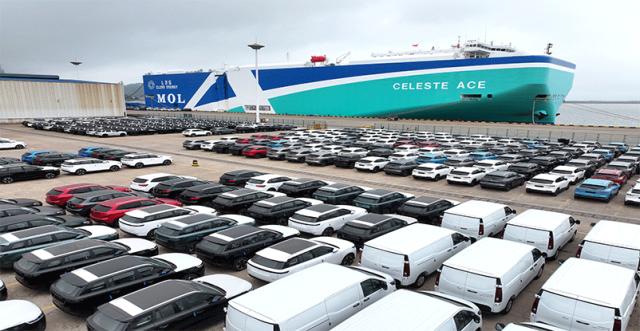
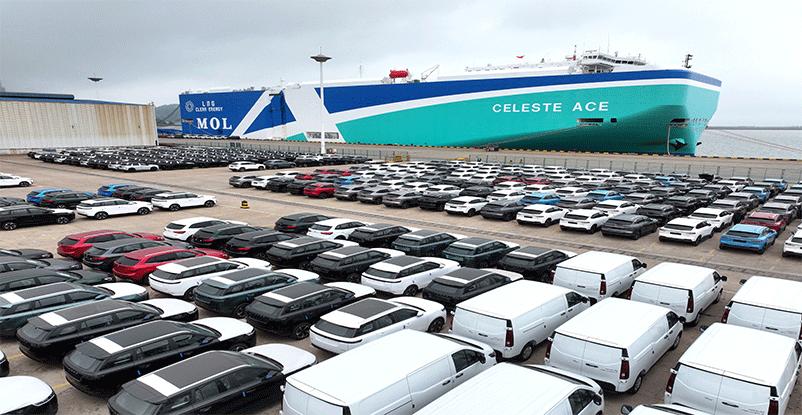
A ship berths to load EVs for export at a terminal of Dongfang Port, Lianyungang Port, East China’s Jiangsu Province, May 15, 2026 (Photo by VCG)

On June 2, BYD's vessel Zhengzhou arrived at Melbourne Port, completing its maiden voyage to Australia. Operated directly by the Chinese automaker, the ship delivered 4,809 BYD new-energy vehicles (NEV), setting a new record for the largest single shipment of NEVs imported into the Australian market.   

Departing from Shanghai, the vessel covered approximately 9,756 kilometers over 14 days. It is one of eight customized roll-on-roll-off (RoRo) ships in BYD's expanding maritime fleet. The shipment also marked the company's first use of its own carrier to deliver vehicles directly to Australia.

Local BYD dealer Wang Hua in Melbourne said customers had been closely tracking the shipment, with delivery wait times for BYD vehicles in Australia typically stretching from six to eight weeks. 

BYD's footprint in Australia has expanded rapidly over the past two years. In the first six month of 2026, the Chinese automaker became the country's second-best-selling car brand, behind Toyota. It is targeting 30,000 deliveries in the third quarter and nearly 100,000 units in annual sales this year, almost double its 2025 total. 

BYD's overseas expansion reflects a wider rise of Chinese automakers, particularly in the NEV sector. Data from the China Association of Automobile Manufacturers (CAAM) shows that in the first six months of 2026, China's automobile exports rose to 5.07 million units, up 65.3 percent year-on-year, while NEV exports, including electric and plug-in hybrid models, totaled 2.36 million units, up 120 percent from a year earlier, accounting for 46.2 percent of all auto exports. 

Chery led Chinese automakers in exports in the first half of the year, with 943,800 vehicles shipped overseas, up 71.5 percent year-on-year. It was followed by BYD and SAIC Group, which posted overseas sales of roughly 789,400 and 734,700 units respectively, including both exports and locally produced vehicles, representing annual growth of 70.5 percent and 48.7 percent. Neither company breaks out export-only figures separately. Geely Auto, meanwhile, exported 474,200 vehicles over the period, up 158 percent year-on-year, the fastest growth among major Chinese brands. 

More importantly, Chinese auto brands are not only shipping more vehicles overseas, but building a more visible presence, including operating directly controlled dealerships and after-sale services and establishing factories. 

As Cui Dongshu, secretary-general of the China Passenger Car Market Information Association, noted in an article he posted on his WeChat account in February, China's auto industry has been shifting from products going overseas to supply chains going overseas.

New Energy
A key driver behind the surge of Chinese NEV exports has been soaring fuel prices amid heightened tensions in the Middle East. 

In Australia, as gasoline prices rose by roughly 40 percent in March, battery-electric vehicles' share in the new car market increased to 14.6 percent, with Chinese-made vehicles, including Tesla models produced in Shanghai, capturing roughly 80 percent of NEV sales. In the month, BYD entered Australia's top three brands for the first time, recording monthly sales of 7,217 vehicles and growth of around 50 percent. 

According to Wang, NEV owners in Australia can reduce operating costs by 30 to 40 percent compared with traditional gasoline vehicles. "The energy crisis has acted as a catalyst," he said. "Previously, families often hesitated between gasoline and electric vehicles. Now more consumers are actively choosing NEVs to escape rising fuel costs." 

The Australian market is following a global surge in electric vehicle adoption. According to S&P Global Mobility, 28 of 150 countries with available data, including Australia and the UK, posted record monthly electric vehicle (EV) sales in March, while nine nations, among them Brazil and the Philippines, set new highs in April. Over the two-month period, EV sales surpassed year-earlier levels in 91 percent of all markets tracked. This was the first time since April 2023 that more than 90 percent of countries recorded year-on-year growth. 

In Europe, data from the European Automobile Manufacturers' Association showed that registrations of battery-electric vehicles, plug-in hybrid-electric vehicles and hybrid-electric vehicles across the 31 markets comprising the EU, the European Free Trade Association and the UK rose by 39.1 percent, 13.2 percent and 8.2 percent year-on-year, respectively, in May. 

In a Bloomberg opinion piece published on May 26, columnist David Fickling argued that just like the 1970s oil crisis reshaped the global auto industry by undermining large, fuel-inefficient vehicles and accelerating the rise of smaller, more fuel-efficient Japanese cars, today's geopolitical tensions in the Middle East could have a similar effect on electric vehicles, potentially sustaining their adoption even after conditions stabilize, as more consumers switch to EVs and experience their benefits firsthand. 

Given China's leading position in the EV sector, many believe that the current energy crisis could push Chinese EVs to replicate Japan's success, transforming a temporary demand shock into a lasting structural shift. 

The transformation is already underway, with Chinese EV makers in a position to capture the market. In Australia, Chinese automakers overtook Japan in February to become the largest source of newly sold vehicles, bringing an end to nearly three decades of Japanese dominance. 

In Singapore, the shift has been even more striking. BYD surpassed Toyota as the country's best-selling car brand in 2025 and widened its lead in 2026. Data from Singapore's Land Transport Authority showed that BYD accounted for 26 percent of all new car registrations during the first five months of 2026, more than the combined 21.2 percent share of Toyota, Honda, Mazda and Nissan. 

Also in May, Chinese passenger car brands overtook their Japanese counterparts across the 31 European countries in monthly new registrations for the first time, capturing a 12.01 percent market share, compared with 11.32 percent for Japanese brands. 

Besides mature economies, Chinese automakers are actively exploring emerging markets. In the past few years, Uzbekistan has become a new battleground for Chinese carmakers. With a population of more than 36 million, the country is the largest and fastest-growing automobile market in Central Asia. Demand has more than doubled since 2021, with new vehicle sales exceeding 461,000 units in 2025. 

For decades, the country's auto market was centered around one manufacturer, Chevrolet, which has a near monopoly with market share of over 90 percent through its local joint venture UzAuto Motors. But as Chinese automakers are entering the market, Chevrolet's dominance is declining. 

In 2025, Chevrolet's market share dropped to 83.2 percent from 87.9 percent in 2024, while BYD, Chery and Haval, the top Chinese brands in the country, secured a market share of 10.3 percent. In the first quarter of 2026, Chevrolet's market share declined to 79.3 percent, while BYD's share surged to 8.6 percent.

Tougher Road
However, unlike Japanese automakers in the 1970s and 1980s, and South Korean manufacturers in the decades that followed, which expanded abroad during an era of accelerating globalization and relatively open markets, Chinese carmakers are entering a global arena marked by higher tariffs, trade investigations, supply chain realignments and intensifying geopolitical tension. 

Chinese carmakers' success in Australia is an exception rather than the rule among developed Western markets, due to the free trade agreement between the two countries. The US, the world's second-largest automobile market, has imposed a 100 percent tariff on Chinese EVs, effectively closing its market to Chinese brands. 

In the EU, the world's third-largest auto market, China-made EVs are subject to anti-subsidy duties of up to 35.3 percent, in addition to the bloc's standard 10 percent import tariff. While Chinese carmakers have continued to gain ground in the EU, raising their market share to about 10.5 percent in May, further expansion, particularly through exports, could become increasingly difficult amid persistent trade tensions between Beijing and Brussels. It is recently reported that the European Commission is considering extending its anti-subsidy duties to Chinese-made plug-in hybrids. 

Chinese automakers also face a steep learning curve in building overseas sales networks, after-sales service systems and localized operations. With relatively small domestic markets, Japanese and South Korean automakers had to internationalize early and build their business models around exports and overseas production. Chinese carmakers, by contrast, matured in the world's largest automotive market and are only now making the transition from domestic champions to global competitors. 

Without established overseas sales and service networks, many Chinese automakers initially relied on local distributors to market and sell their vehicles. While this strategy enabled rapid market entry, it often came at the expense of long-term brand building. Focused primarily on boosting sales, some distributors failed to provide adequate after-sales service and technical support, leaving customer complaints unresolved and, in some cases, damaging the reputation of Chinese brands. 

Li Wei, who manages Jetour's first company-owned dealership in Uzbekistan, said the brand learned this lesson firsthand. Jetour, an independent marque under Chery, initially relied on local distributors, but many customers struggled to access reliable maintenance and repair services. The experience prompted the company to establish its own dealership network in the country to strengthen after-sales support and rebuild consumer confidence. 

Pei Ruijie, Nio's national distributor in Uzbekistan, has been importing and selling Chinese vehicles in the country since 2022. He argues that exporting cars alone is not enough to build a lasting presence overseas. 

"Automobiles are durable goods. Building a successful brand requires an entire ecosystem, including after-sales service, marketing, technical support and local operations," he told NewsChina. "Simply selling cars does little to establish a brand." 

The experience has underscored a broader shift taking place across China's auto industry. Having gained a foothold overseas through exports and local distributors, leading Chinese carmakers are now moving into a new phase by building their own distribution networks, service infrastructure and localized operations. 

When BYD entered the Australian market in 2022, it relied on local automotive retailer Eagers Automotive as its exclusive importer, distributor and retail partner. Three years later, BYD revoked Eagers' exclusive rights, ended the distributorship of its former local partner, EVDirect, and took direct control of its sales and distribution in Australia

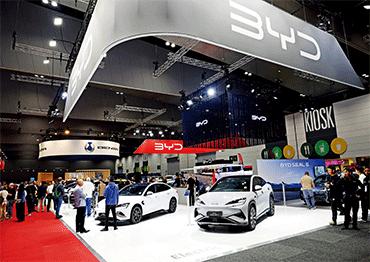
People visit exhibition zones for several Chinese automakers at Melbourne Motor Show in Australia, April 10, 2026 (Photo by VCG)

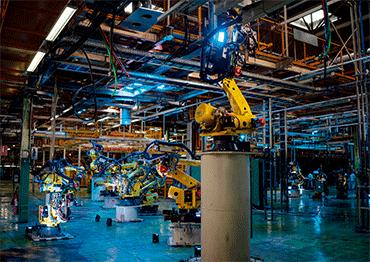
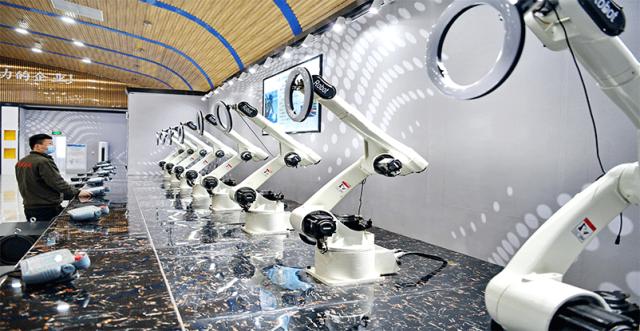
Robots at a factory belonging to China’s Chery Automobile and Spain’s Ebro-EV Motors in Barcelona, Spain, November 23, 2023 (Photo by VCG)

Localization Imperative
After learning how to sell cars overseas, Chinese automakers are now learning how to build businesses overseas. The trajectory mirrors that of Japanese and South Korean automakers, which also evolved from exporting vehicles through local distributors to establishing their own sales networks, manufacturing plants and supplier bases as they became global brands. 

According to an executive at a Chinese automaker, the industry's globalization strategy typically unfolds in three stages. It begins with vehicle exports, followed by the establishment of overseas sales and marketing subsidiaries. Today, the industry has entered a third phase of deeper localization, with automakers investing in manufacturing, supply chains and other core operations while taking greater control of their overseas businesses. 

BYD has emerged as one of the clearest examples of this strategy. In July 2024, the company opened its first wholly owned overseas passenger vehicle plant in Rayong, Thailand, a 150,000-unit facility serving as its manufacturing hub for Southeast Asia. 

It has also established a joint venture in Uzbekistan to produce NEVs for the Central Asian market. In Latin America, BYD is investing about US$550 million to transform a former Ford plant in Camaçari, Brazil into a production base capable of producing 150,000 vehicles annually. 

Europe, however, presents a different challenge. Faced with rising tariffs and higher production costs, Chinese automakers are pursuing a combination of greenfield investments and partnerships with established manufacturers. BYD is building its first European passenger vehicle plant in Szeged, Hungary, and has announced a second factory in Manisa, Turkey, both designed to supply the European market. 

Building new factories is only one route to localization. Yang Yanding, general manager of strategic planning at Dongfeng Motor, argues that Europe's underutilized manufacturing base offers Chinese automakers an opportunity to expand more efficiently. 

"Many overseas automakers are grappling with excess capacity, with some factories operating at only around 50 percent utilization. That gives Chinese companies an opportunity to make more efficient use of existing manufacturing resources," Yang told reporters at this year's Beijing Auto Show. 

Rather than constructing new plants, he said, automakers can localize production through joint ventures, production-capacity leasing or equity partnerships, depending on their business strategies. 

That model is already taking shape. On May 20, Stellantis and Dongfeng signed a preliminary deal to establish a Europe-based joint venture covering sales, distribution, manufacturing, purchasing and engineering. The venture, which will be 51 percent owned by Stellantis, is expected to produce Dongfeng's Voyah-branded electric vehicles at Stellantis' underutilized plant in Rennes, France. 

The agreement follows Stellantis' expanding partnership with China's Leapmotor. Initially focused on distribution, the two companies announced in May that they would extend their collaboration to manufacturing, with plans to produce Leapmotor vehicles at Stellantis' plant in Spain. 

Together with the Dongfeng venture, the partnership signals a new phase in the globalization of China's auto industry. Rather than simply exporting vehicles, Chinese automakers are increasingly embedding themselves in overseas industrial ecosystems through local manufacturing and strategic partnerships. 

For Chinese automakers, building factories overseas is only the beginning. Their long-term success will depend on how well they integrate into local economies by creating jobs, developing supplier networks and adapting to local regulations and market conditions. Ultimately, the transition from exporting cars to building global businesses will determine whether they can establish themselves as lasting players in the global auto industry.
Print