Old Version
Cover Story

Code Switch

As China’s robot manufacturers move beyond price wars and tech to brand building, they must increasingly rewire their strategies for localization, reliable service and earning consumer confidence

By Li Mingzi , Xu Ming Updated Sept.1

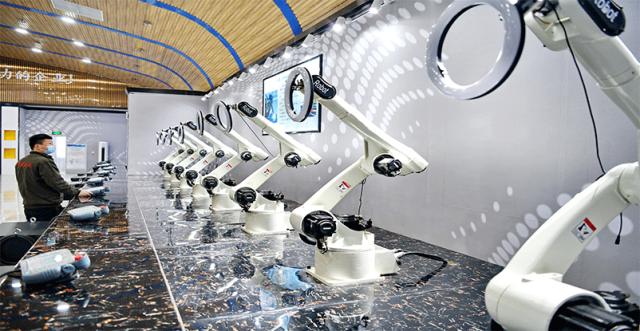
Workers create parts for exported industrial robots at a robotics company based in Ganzhou, Jiangxi Province, February 20, 2022 (Photo by VCG)

From hospitals to supermarkets, Chinese-made robots are rapidly expanding their presence overseas. 

In mid-June, Shanghai-based Fourier Intelligence deployed its robots at a physical therapy center run by Malaysia's Social Security Organization (Perkeso), where they support rehabilitation alongside human therapists for people recovering from workplace injuries and accidents. 

The multi-million-yuan project marks a milestone for Chinese robotics companies in the global healthcare market. 

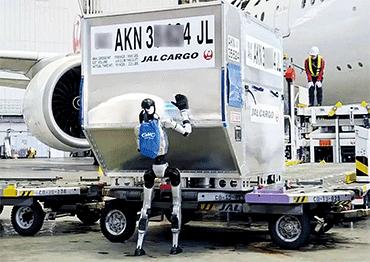
A month earlier, 1.3-meter-tall Unitree robots were photographed loading luggage onto conveyor belts at Haneda International Airport in Tokyo, Japan. They have been assisting with tasks since May, including aircraft towing and cargo loading, alongside Shenzhen-based UBTech's Walker E robot. 

The industry has come a long way since China exported its first complete robot in 2007. Annual robot sales totaled just 9,738 units in 2014. In 2025, China's humanoid robot shipments had reached about 14,400 units, accounting for 84.7 percent of the global total, according to a report by the China Center for Information Industry Development and China Electronics News. 

Exports of both humanoid and industrial robots entered a period of rapid growth in 2025, with industrial robot exports rising 48.7 percent year-on-year. In Q1 2026, exports of robots designed to clean floors, windows and pools reached 7.75 billion yuan (US$1.1b), or 68.5 percent of China's total robot export value, with shipments reaching 148 countries and regions. 

Behind the export boom is a shift in strategy, especially among smaller firms. 

"Rather than relying on low prices, Chinese companies are creating value overseas through integrated products and services, supported by a complete industrial supply chain," Li Zhiwei, who heads the international market division at Yunji Technology, a delivery robot manufacturer based in Beijing, told NewsChina. 

But to gain staying power in these markets, companies still face challenges like regulatory compliance, customer trust and long-term product reliability. "Technology is only the admission ticket," Li added.

‘No Longer Optional'
Wang Kecheng, founder of construction robotics company Patner, landed his first overseas order in France after exhibiting at a trade show in 2024. 

Their tile-laying robot was featured by local media, which caught the attention of a major construction company dealing with persistent labor shortages. 

Patner only makes a tile-laying robot and a system that lays out survey lines to map out construction sites. Wang says this is a deliberate choice. 

"They're both difficult products to develop, but they solve high-value problems in specific construction scenarios," Wang said. These conditions include covering large areas with simple perimeters. 

The company claims their tile-laying robot works five to six times faster than a human worker while reducing overall construction costs by about 60 percent. By the end of 2025, Patner had received more than 10 million yuan (US$1.5m) in orders, with overseas markets accounting for 55 percent. 

Labor shortages continue to drive demand, Wang said. In parts of Europe and the US, where building codes are strict, skilled tradespeople command high wages. Tile installers in the US average around US$25 an hour, and for custom work demand US$75 or more. 

Landscaping is another growth area, and Shenzhen-based robotics company Mammotion is looking to cut in. The firm entered the robotic lawn mower market in 2022, competing against long-established European names like Husqvarna in Sweden and Germany's Bosch. 

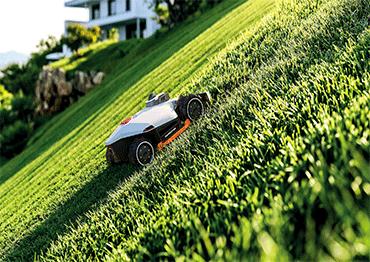
Most conventional robotic mowers require burying perimeter wires around property lines, making installation labor-intensive. Mammotion eliminated that step by adapting high-precision positioning technology originally developed for drones. 

The innovation propelled the company to become the world's best-selling wire-free robotic lawn mower brand between July 2024 and June 2025, according to Frost & Sullivan. Its products are now sold in more than 30 countries and regions, serving over 400,000 homes. 

Its wire-free mowers retail for US$2,599-4,999, roughly 50 percent more than conventional models. 

"The higher price gives us room to keep investing in new technologies," said a Mammotion employee who works in developing international markets. Instead of competing through price cuts, the company is positioning itself as a premium brand before expanding market share. He described the company's strategy as "taking technology around the world to find scenarios where customers are willing to pay." 

This approach appears to be reshaping the market. China's lawn mower exports reached 13.2 billion yuan (US$1.9b) in the first seven months of 2025, up 56.6 percent year-on-year, with wire-free models driving much of the growth. 

"Global customers are under increasing pressure to reduce costs and improve efficiency," Xie Kaixuan, marketing director at Dobot Robotics, told China Business Journal in May. "Chinese manufacturers benefit from deeply integrated supply chains that allow us to move quickly from order to delivery." 

The Shenzhen-based company has established branches and R&D centers in more than 12 countries and regions. Its robots are used in over 200 applications across 15 industries, from auto manufacturing to medical surgery and retail. 

"For many emerging robotics companies, going global is no longer optional," said Fan Yazhou, head of marketing at Wuhan-based Creatulize, which makes robotic mattress-cleaning systems. He noted that the company's founding team consists almost entirely of engineers born in the 1990s and 2000s, several having studied or worked overseas. 

An industry insider with 12 years of international business experience told NewsChina that geopolitical tensions have changed how robotics startups expand. 

"A decade ago, companies like [drone maker] DJI could focus on building great products before expanding overseas," he said. "Today's startups have to think about tariffs, export controls and data compliance from day one. If you wait until you've succeeded at home, the window may already have closed." 

China's manufacturing base has made that possible. 

Zhou Jian, founder and CEO of UBTech, previously told NewsChina that when the company was established 18 years ago, it relied on imported servo drives for consumer robots. Today, nearly every precision component can be sourced domestically from suppliers in the Pearl and Yangtze river deltas. 

"Young entrepreneurs no longer have to build supply chains from scratch," Zhou said. "Even small production runs are affordable. They're building on top of an industrial ecosystem that already exists."
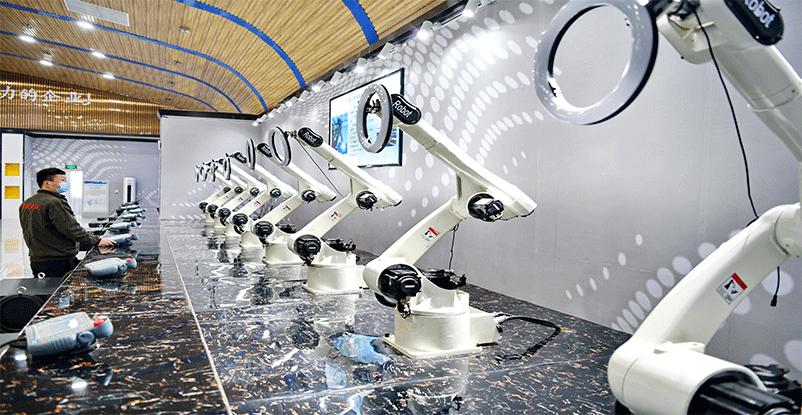

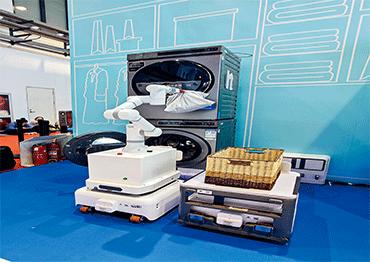
A laundry robot manufactured by Yunji Technology demonstrates its abilities at the World Robot Conference, Beijing, August 11, 2025 (Photo by VCG)

Brand Conscious
In recent years, crowdfunding has become an important launchpad for China's emerging robotics companies, providing an early testing ground for global demand and a way to build brand recognition. 

In May 2022, Mammotion raised US$3.37 million on Kickstarter for its first wire-free robotic lawn mower, Luba. 

"It wasn't just about raising money," said the Mammotion employee. Feedback from their backers helped refine the product, pushing the engineering team before mass production. "Those customers proved we'd solved a real problem," he said. 

According to Kickstarter, the platform handled US$9.3 billion in pledges as of November 2025. Chinese creators accounted for 8.4 billion yuan (US$1.2b) of that total, making it the largest group outside the US. 

"Chinese companies aren't just becoming better storytellers. They're becoming better brand builders," Henri Peng, Kickstarter China's chief strategy representative, told cross-border e-commerce platform Yuguo in late 2025. 

After fulfilling its Kickstarter orders, Mammotion shifted its marketing strategy. Instead of focusing on engineering details, its advertising highlighted convenience, time savings and everyday use. They also worked with lifestyle influencers, who posted about using their products in homes and gardens. 

"If any part of the process fails, delivery, storytelling or after-sales service, you'll lose far more than you raised through crowdfunding," said Fan Yazhou with Creatulize. 

He said that while crowdfunding allows startups to enter overseas markets without immediately investing in warehouses or distribution networks, long-term success ultimately depends on building reliable service capabilities.

Going Local
Winning a contract overseas rarely happens overnight. 

Fourier Intelligence's partnership with Malaysia began in 2022. According to founder and CEO Gu Jie, the relationship evolved gradually, starting with supplying individual products and R&D. 

Localization was key to their strategy. Speaking to financial outlet Yicai, Gu said they added landmarks such as the Petronas Twin Towers and local street scenes in their robot-assisted physical therapy simulators for patients preparing to return to work and everyday life. 

"Our advantages lie in our complete industrial chain, extensive real-world deployment experience and willingness to invest deeply in local markets," Gu said. 

Several interviewees said that in developed markets, companies typically need two to three years before seeing meaningful returns. That commitment is even more crucial for younger companies still establishing their reputations. 

Rather than relying on distributors, Mammotion established subsidiaries in the US and Germany, allowing it to respond more quickly to customer needs and provide localized after-sales services. 
Shenzhen-based iKitbot has taken a similar approach in Japan. 

Since entering the market in 2024, the commercial cleaning robot manufacturer has spent two years adapting its products to meet Japanese building standards. 

Li Jianuo, president of iKitbot Japan, said Japan presents greater challenges than other major markets. "Japanese business culture is highly risk averse," she said. "Building trust takes time. But once you've earned it, you're very difficult to replace." 

She added that success in Japan also strengthens credibility elsewhere. 

Recognizing severe labor shortages and an underserved market for midsized commercial cleaning robots, iKitbot conducted a two-month proof-of-concept trial at major commercial properties before formally entering the market. 

The trial revealed numerous design challenges. Japan's flame-retardant flooring absorbs water while remaining highly sensitive to heavy equipment, requiring substantially lighter robots. Highly reflective black floor tiles in high-end office buildings interfered with navigation systems, while dense floor markings complicated machine vision. 

Meeting consumer expectations was equally demanding. To compete in the Japanese market, robots had to recover at least 95 percent of the water used to reduce slipping accidents, while making no more noise than an ordinary vacuum cleaner. 

This required redesigning everything from hardware to algorithms, efforts that paid off. The company has since secured orders worth hundreds of millions of yen, expanding from luxury hotels into hospitals, retail chains and exhibition centers. 

Today, about 90 percent of iKitbot's revenue comes from overseas markets, with Japan accounting for nearly half. The company is now applying the standards it developed there to expand into German-speaking countries and northern Europe. 

"Trust isn't built with PowerPoint presentations," Li said. "It's earned by solving the hardest real-world problems."

Beyond Hardware
In a hospital in Bangkok, Yunji Technology's delivery robots navigate busy corridors, delivering medicines and laboratory samples with precision. 

The company began by supplying delivery robots to hotels but is now expanding into more complex environments. "What customers care about is reliability and return on investment," Li Zhiwei said. "They don't care what the robots look like." 

As competition intensifies, Yunji is moving toward AI-powered management systems. Revenue from its AI platform rose 57.3 percent year-on-year in 2025, accounting for nearly 30 percent of the company's total revenue. 

This reflects a broader shift, as companies increasingly set up overseas subsidiaries and R&D centers to provide end-to-end solutions. 

Dobot Robotics in Shenzhen, for example, offers customers services from site planning and systems integration to employee training and after-sales support. "The value is no longer just the robot itself," Xie Kaixuan of Dobot told China Business Journal in May. 

As more Chinese companies expand overseas, competition is also ramping up. The interviewed Mammotion employee said customer acquisition costs have doubled since 2022. 

"We're still growing the market together," he said. "But the next stage of competition will be defined by differentiated services, stronger brands and technological innovation." Features once considered premium, such as four-wheel drive in robotic lawn mowers, have already become standard, he said.

A screenshot of a Unitree robot working at a luggage conveyor belt at Haneda International Airport, Tokyo, Japan, May 2026

A robot lawn mower produced by Mammotion cuts grass (Photo Courtesy of the interviewee)

‘No Shortcuts'
Despite rapid growth, companies expanding overseas face increasingly complex regulatory hurdles. One of the biggest is data compliance. 

As robots become more connected and software-driven, protecting customer data and complying with local privacy regulations have become as important as hardware, Li said. 

The EU's General Data Protection Regulation, for example, strictly limits transferring personal data outside the bloc unless specific legal safeguards are in place. 

As many companies can no longer rely on China-based cloud platforms, they must build computing and data-storage infrastructure locally, further increasing overhead. 

That has forced companies to prioritize privacy and security and tailor compliance for different markets. 

At Yunji, for example, they partner with local operators in countries with strong data privacy laws, such as Japan and the US, who manage systems that prevent cross-border data transfers altogether. 

Xie said operating, maintenance and after-sales service standards vary widely from country to country. In some markets, Chinese brands also continue to face stigma for producing low-end, cheap goods that can only be overcome through consistent product quality and reliable service. 

"There are no shortcuts," Xie said. "We earn trust through every delivery, every day of reliable operation and every day of quality service."

Print