Old Version
Politics

Creative Release

Introducing art rehabilitation programs into prisons are proving effective in transforming inmates and reducing recidivism

By Wang Yan , Xie Xuewei Updated Sept.1

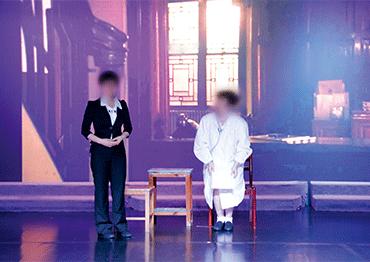
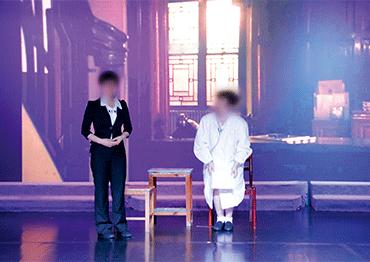
Female inmates perform in a play held at the Chinese Women’s Prison in Shanghai (Photo Courtesy of the Chinese Women’s Prison in Shanghai)

Released from Shanghai's Qingpu Prison in November 2020 after serving nearly 10 years, 34-year-old Wang Bin opened a jade carving studio using skills he learned in prison. 

Convicted of home invasion robbery in 2012, he joined the prison's art rehabilitation program taught by veteran artisans, mostly volunteers from outside the jail, at the in-house Qingliu Jade Carving Studio. 

He began sketching and soon immersed himself in art, drawing nightly in his cell to develop his own minimalist style. Training daily in the carving workshop, he mastered his craft, creating jade gourds, plants, birds and flowers, all the while regaining his confidence. His early work was flawed: the carving was uneven and initial replicas were only 40 to 50 percent accurate. He also made up to 30 draft ox sculptures for a single final piece. 

With family funding, Wang invested over 3 million yuan (US$443,000) to launch his multi-service studio in late 2020. It offers jade carving, bamboo engraving, pigment painting and tea sales, and undertakes all the outdoor mural projects across Shanghai's Chongming Island.

Blank Slate
Thirty years ago, Shanghai prison authorities launched a pioneering art therapy rehabilitation program. The new Qingpu Prison mainly held long-term violent offenders who had issues with impulse control and anger management. They were prone to fights and assaults. To aid their rehabilitation and social reintegration, the prison introduced jade carving training. 

Jade holds a unique sacred and cultural place in China's civilization. Originating from ancient rituals, it is far more than decoration, embodying traditional ethics, beliefs and aesthetics. Jade carving requires sustained focus and careful polishing, and traditional jade culture reshapes inmates' values. Jade culture promotes gentleness, tolerance and modesty, which helps people regain self-control and stability. 

A Tongji University graduate in gemstone craft, prison officer Ni Lili joined the jade carving workshop to lead the art rehabilitation program. Having majored in jewelry production, Ni told NewsChina that inmates struggle through two tough stages: New arrivals feel lost about the future, while those nearing release live in severe anxiety. Art therapy can ease both transitions. 

A valued intangible cultural heritage, jade carving shapes rough stone into exquisite art through meticulous craftsmanship. Transforming untrained inmates into skilled carvers once seemed unachievable. Initially struggling with the tools, they were gradually able to focus on the craft, guided by prison staff. 

The program became more professional after officer Ni joined in March 2013. That year, inmate works won silver and excellence awards at Shanghai's Jade Dragon Award, a national jade carving contest hosted by the Shanghai Gem & Jade Industry Association. Over the next decade, the prison's Qingliu Jade Carving Workshop earned many honors. In 2024, two creations from the workshop titled Heart's Meditation and Good Tidings took gold and silver at the 16th edition of the awards, the first national gold prize earned by a Chinese prison art program. 

While still incarcerated in 2018, Wang Bin's jade pendant Two Dragons Chasing a Pearl took bronze at the awards. Judges commended its balanced symmetry and fine openwork, as well as his skill at creating rich depth on ultra-thin jade slabs. 

The Qingliu workshop stands out not only for jade carving training but also for its people-centered rehabilitation that combines empathy, guidance, discipline and counseling. According to Shanghai Prison Administration Bureau in August 2024, staff view inmates as flawed fine jade: Just as artisans assess raw jade, they explore each inmate's background and values to help them reshape themselves. 

Most instructors are volunteers, supported by art-trained prison officers. All jade works are made to commercial order. 

On a February morning, the reporter witnessed over 30 inmates begin work, grinding jade and refining sketches in the workshop. Guest master craftsmen reviewed and revised designs. Training follows a strict schedule: carving practice in the morning, error correction in the afternoon and sketching practice in cells each evening. Weekly assessments require all unsatisfactory pieces to be reworked.

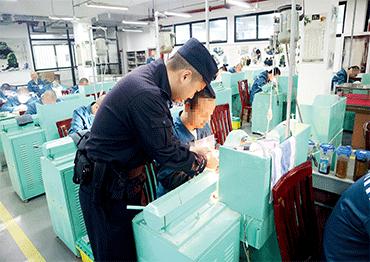
Ni Lili, a correctional offcer at Shanghai’s Qingpu Prison, teaches an inmate jade carving techniques as part of an art rehabilitation program (Photo Courtesy of Shanghai Qingpu Prison)

Artistic Effect
Qingpu Prison offers diverse art rehabilitation and cultural courses. Since 2011, it has launched training in jade carving, bamboo engraving, embroidery, paper cutting, model making, calligraphy, shadow puppetry and oil painting, adopting a work-study-employment model to help inmates learn new skills during their sentences. 

Art rehabilitation has spread across Shanghai's prisons. Tilanqiao Prison runs 14 programs including tai chi, folk music, cloisonné and various carving crafts. Baoshan Prison in Shanghai's Baoshan District introduced purple clay teapot making in 2015 and from 2023 to 2025, 14 inmates earned national ceramic firing technician certifications, boosting their employment prospects after release. 

Nationwide, prisons in Hunan, Liaoning, Fujian and Henan provinces have also rolled out similar initiatives, offering instruction in performing comedy skits, Peking opera, paper cutting, calligraphy and painting. 

Global research proves art therapy helps inmates regulate their moods, build social skills and problem-solving. Australian art therapy practitioner Sarah Tucker writes in Therapeutic Prison Art Interventions that prison art eases emotional distress, fosters self-awareness and resilience, rebuilds dignity and identity, and is effective in breaking the cycle of reoffending. 

A Chinese researcher based in Guangxi Zhuang Autonomous Region, who asked for anonymity, conducted a review of 25 international studies from 1995 to 2017, which found that art rehabilitation enhances vocational training, cuts in-prison misbehavior and reduces recidivism. 

Qingpu Prison's three-decade jade carving program has achieved a zero reoffending rate among participants. Shanghai prison official Yang Guoqiang told NewsChina that there are clear gaps in recidivism rates between participants and non-participants, calling for wider adoption of effective art rehabilitation programs. 

Ni Lili said that none of Qingpu's over 300 trained former inmates have reoffended. Over 80 percent work in jade carving and related fields, with several opening their own studios and shops.

Shaped Expertise
Many people mistakenly view art rehabilitation as hobby classes. According to criminologist Su Mingyue, art rehabilitation is a standardized management program governed by strict selection criteria, phased goals, rules and assessments. 

Cai Xiaoling, director of education and rehabilitation at Shanghai Prison Administration Bureau, told NewsChina that participation in art programs never lowers prison management standards. All inmates abide by identical supervision, labor and daily conduct rules, and art activities are primarily arranged during their spare time. 

Ni Lili serves as supervisor of Qingliu Jade Carving Workshop. He earned his degree in gem materials and technology from Tongji University in Shanghai in 2011 and passed the civil service exam the following year to become a prison officer. He used to worry his professional expertise would go to waste behind prison walls until he learned about Qingpu Prison's jade carving rehabilitation program. 

Launched in 1994, this initiative was the first of its kind across China's prison system, and Ni's arrival greatly boosted its development. He learned from senior officers, veteran carvers and even skilled inmate artisans to refine his own jade carving techniques. 

In its early days, the workshop only handled basic jade processing, and its works gained little market recognition. While honing his own craft, Ni taught inmates professional jade carving theory. He also invited university lecturers and master carvers to deliver on-site lectures. Under his guidance, inmates developed exquisite craftsmanship, creating works defined by fine details, elegant aesthetics and simple, pure styles. 

"Jade carving demands total dedication, patience and perseverance to produce fine pieces," Ni Lili said in an August 2025 interview with the Legal Daily. "Inmates are at the lowest point of their lives, often with distorted views of right and wrong, honor and disgrace. Carving jade is ultimately about rebuilding one's inner self." He added that working with noble jade every day helps troubled inmates clear their minds and find a new life direction. 

The workshop now has 34 trainees. Ni has helped them overcome technical challenges, secured its membership in the Shanghai Gem & Jade Trade Association, and partnered with leading industry firms to introduce advanced techniques and sustain stable production, raising the profile of the prison's jade artworks. 

In 2025, Ni and one inmate were awarded the title of Shanghai-style Jade Carving Master by the Shanghai-style Jade Carving Culture Association. More than 20 inmates have obtained the same title. Their transformation is a remarkable achievement for China's prison art rehabilitation work. 
A collaborative award-winning piece titled Mindful Thoughts, created by Ni and an inmate surnamed Li, is displayed at the workshop entrance. Yet Ni does not regard it as his finest work. "To me, the true masterpieces are the released inmates who have turned over a new leaf," he said. 

Selecting suitable participants remains a major practical challenge for art rehabilitation programs. Cai Xiaoling said that such initiatives pursue two core objectives: stabilizing the mental state of long-term inmates and equipping them with employable skills. Painting and carving help build focus and self-discipline, while mural painting, which is easier to learn and has more demand, can help released inmates find jobs more easily. 

Besides voluntary applications, prison staff screen inmates based on their background, daily performance, sentence and offense type. Young, outgoing inmates can join performance teams, while violent and long-term offenders take up carving training. A peer mentorship system sees experienced participants guide new arrivals. Those lacking talent or interest may opt out. 

Overall, art rehabilitation represents an advanced approach to inmate correction. While upholding strict prison safety rules, it gives inmates a chance to restart their lives. As criminologist Su Mingyue points out, officers leading art programs are first and foremost prison personnel proficient in law enforcement and supervision. Art is simply a tool to facilitate inmate education and rehabilitation. 

For Su, the more pressing challenge is the shortage of qualified professionals. Only a small number of prison officers have formal art education backgrounds, so most prisons rely heavily on external professionals to run these programs, most of them volunteers. 

An official from the education and rehabilitation division of Hunan Provincial Prison Administration told NewsChina that outside instructors usually work on a temporary basis, making long-term program continuity hard to guarantee. In contrast, full-time prison officers with art expertise engage in daily management and rehabilitation work year-round. They are better positioned to observe inmates' behavior, monitor their mental conditions and deliver targeted guidance. 

Another fundamental problem is social stigma. Prison staff say social organizations are generally reluctant to participate, forcing prisons to take the initiative to seek external support. This hesitation stems from risk concerns as well as deep-seated public prejudice against offenders. Low social acceptance, and even superstitious resistance to products made by inmates, create further barriers for exoffenders seeking employment. 

To expand vocational training, Qingpu Prison has extended its programs beyond craft workshops to include an art troupe, media studio, high-end garment workshop and modern agricultural entrepreneurship park, while actively engaging social partners. 

In January 2021, the prison signed cooperation agreements with five organizations across different fields, marking deeper integration with the community. 

Li Qiang, Party secretary and warden of Qingpu Prison, said the work-study-employment rehabilitation model serves social stability by linking inmate reformation, social reintegration and post-release employment. 

Production work encourages inmates to earn an honest living through labor. Systematic study and training motivates active learning and broadens their horizons. For employment support, the prison helps released inmates assess their strengths and weaknesses, access job and entrepreneurship guidance and develop rational career plans.

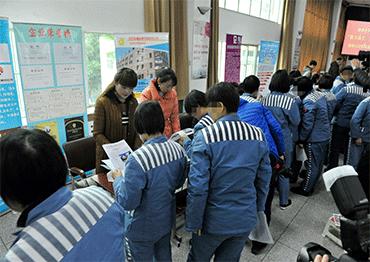
Female inmates search for job opportunities at recruitment booths at Shaanxi Women’s Prison, Xi’an, Shaanxi Province, November 26, 2019. More than 20 enterprises joined the job fair held for over 300 prisoners nearing the end of their sentences (Photo by VCG)

Carving Out
In April, the 22nd meeting of the 14th National People's Congress Standing Committee conducted the third review of the revised Prison Law draft. Key revisions focus on strengthening inmate education and rehabilitation, and advancing the cause toward greater professionalism and social participation. Against this backdrop, prisons nationwide have rolled out recruitment drives targeting arts majors this year, attracting broader public attention. Hunan Province's prison system has advertised 18 positions for arts graduates, while Shandong, Anhui, Guangdong, Gansu and other provinces have launched similar recruitment initiatives. The recruits will primarily still work as prison officers. 

Anhui Women's Prison noted in its 2026 recruitment notice that frontline roles cover prison cultural development, inmate education, rehabilitation and logistical support. Jinan Jiteng Prison in Shandong further specified required majors including musicology, music and dance performance in its 2025 recruitment plan. 

Hunan took the lead in hiring arts professionals for correctional work as early as 2004. While law and medicine remain core recruitment majors, arts-related positions are flexibly allocated by individual prisons based on operational needs, primarily to deliver art rehabilitation programs. Prison officer Hu Yan, who works in the Hunan prison system, told NewsChina that newly recruited arts graduates must complete around two years of training in police work, law and correctional management before applying their professional skills on the job. 

Prison officers and criminology scholars told NewsChina that modern prison governance adheres to the principle of combining punishment with rehabilitation. Art activities guide inmates to engage in self-reflection and correct their conduct, ultimately helping them rejoin society as law-abiding citizens. 

In a July 2021 interview with The Paper, Wang Bin said he wanted to pass on his carving skills. 
He employs rehabilitated ex-offenders and people with disabilities, requiring all staff to stay away from gambling and other vices. Li Fei, a former inmate who now lives in Shanghai, assists with studio management, volunteer work and resource coordination. He has taken on a 28-year-old ex-inmate as an apprentice. Wang expects consistent mentorship over three to five years to attract more budding craftsmen. 

"The past is beyond remedy, but we can still strive for a better future," Wang Bin told The Paper.

Print