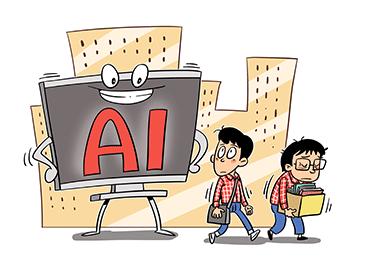
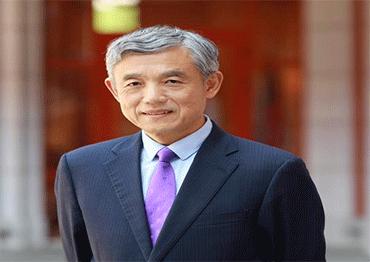
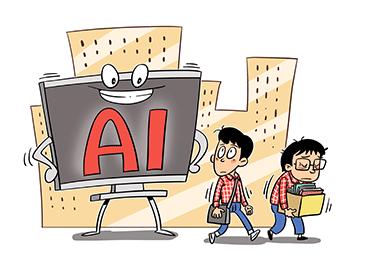
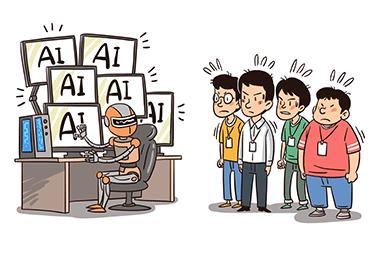
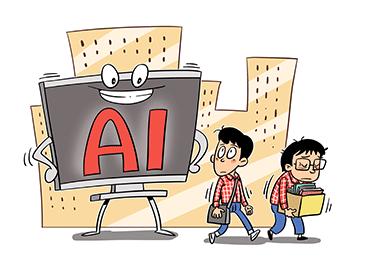
"Young workers' entry-level skills risk becoming obsolete, while older workers face a widening digital divide. These two groups are bearing the brunt of AI's impact on employment. From this perspective, AI is not creating an entirely new employment shock but intensifying long-standing structural challenges in the labor market."
Cai Fang, member of the Chinese Academy of Social Sciences and chairman of CF40's Academic Committee, writing for CF40 in June
"China-EU relations today are defined by a coexistence of ice and fire. Rising tariff barriers and expanding protectionist legislation represent thickening ice, while sustained foreign direct investment in China, the urgent need for a green transition and a shared commitment to the multilateral system form an underlying warm current. Despite persistent structural challenges, the two sides remain deeply bound by common interests. The real question is not whether to cooperate, but in which areas and under what rules."
Huang Yiping, dean of the National School of Development, Peking University, at a seminar on China-EU trade and industrial cooperation hosted by China Finance 40 Forum (CF40) on May 31
"Chinese companies' global expansion is now characterized by unprecedented diversity in participating firms and destination markets, broad-based expansion across industries and large-scale overseas deployment of clustered industrial supply chains."
Liu Xiaochun, vice president of the Shanghai Finance Institute, at a forum on China's role amid global industrial restructuring hosted by CF40 on June 12.
"We should give researchers an environment where they can explore nature and pursue scholarship out of genuine curiosity, allowing them to stay true to their original aspirations. Young scholars should not spend their careers chasing academic titles, election to academies or Nobel Prizes. The true purpose of scholarship is to discover the truth and beauty of nature."
Shing-Tung Yau, renowned mathematician and Chinese Academy of Sciences scholar, in a June interview with news portal The Paper
"Should there be an option to pause the development of AI once it reaches a certain stage? In the life sciences, ethical boundaries are already well established. For example, there is broad international consensus on research involving human embryo editing and cloning, and many countries have set clear ethical limits. Should AI be subject to similar ethical red lines?"
Xue Lan, member of the State Council, dean of Tsinghua University's Institute for International Governance of Artificial Intelligence and China Institute for Science and Technology Policy, writing for the academic series Development and Governance of Digital Economy
"Some argue that China is only capable of scaling existing innovations and falls short when it comes to original breakthroughs. Yet I believe such incremental advances are just as important, and China has excelled at making them. More importantly, we are also seeing China generating original innovation through real-world applications. If innovation can happen by discovering new opportunities and developing original capabilities in the process of applying technology, then it offers a path that contrasts with the traditional Western paradigms of innovation and scaling that could be described as reverse innovation."
Zhang Jun, dean of the School of Economics at Fudan University in Shanghai, in a June interview with news portal The Paper
"The rise of middle powers does not automatically deliver a fair and rational new global order. Those nations hold divergent and conflicting interests. Some pursue strategic autonomy, while some others leverage major powers for maximum gains. Yet, their emergence proves that the world is shifting from being ruled by a handful of great powers toward the one where all nations engage in collective consultation."
Dai Weilai, professor at the China Institute, Fudan University on political commentary program China Now by Shanghai-based Dragon TV on June 16
"If Korean ‘feel-good' dramas confront reality head-on, their Chinese counterparts choose to escape it. Most Chinese productions are set in fictional worlds, whether they revolve around aristocratic family intrigue, palace politics or monster hunting. Creators tend to set stories far removed from contemporary life. While this formula delivers quick emotional gratification, it also distances the stories from reality. No matter how satisfying the plot, how ruthless the protagonist's revenge or how spectacular their meteoric rise, audiences struggle to genuinely relate to their experiences."
Zhao Qianhe, commentator at news portal The Paper in a June 26 article
 Old Version