Today, Yuegang exists as a quiet historical quarter within Zhangzhou, a city in Fujian Province. Blessed with a natural crescent-shaped estuary ideal for navigation, it was China's only open coastal trading port during this period and the critical Chinese terminal for the Manila Galleon trade.
During the mid-16th century, China's ruling Ming Dynasty (1368-1644) relaxed its long-standing seagoing ban for Yuegang, officially permitting merchants to sail from the port into global waters. From the port's wharves, the arteries of trade carried Chinese silks and porcelain to distant markets, while a lifeblood of silver flowed back, profoundly reshaping the Ming empire's economy.
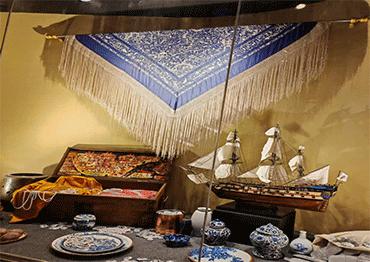
The junks from Yuegang made their first port of call at Manila, where cargo was transferred to Manila Galleons. These massive ships then embarked on a perilous voyage of up to six months across the Pacific to Acapulco on Mexico's west coast. The cargo was sold at trade fairs in Acapulco, then transported by mule across Mexico, before it was traded to the rest of Latin America and Europe.
On return trips, the ships brought silver coins from Spain's American colonies to Manila to be exchanged for luxury goods like silk, porcelain and jade from China via Yuegang, completing the trade loop between the old and new worlds. Yuegang thus became the essential linchpin in this exchange, connecting Chinese production to global markets. "Through this exchange, humanity achieved the first truly global trading network in history," Jiang Bo, director of Shandong University's Maritime Archaeology Research Center, told NewsChina.
The commodities exported from Yuegang to the Americas were predominantly high-end luxury items, particularly silk and porcelain. Possessing the dual advantages of being light weight and of premium value, Chinese silk occupied a dominant position in the trans-Pacific trade. Its superior quality and competitive edge over local textiles secured widespread popularity among American aristocrats, who incorporated it into daily noble costumes, religious decorative art and wedding rituals. The prevalence of Chinese silk profoundly reshaped local fashion aesthetics, leaving behind a tangible cultural heritage - the iconic China Poblana costume in Mexico.
The China Poblana is one of Mexico's most celebrated traditional costumes, often tied to the story of Catarina de San Juan. Most sources agree she was born in Mughal India around 1606, kidnapped as child, before being transported to Manila from where she was sold into slavery again. At the time, people in Mexico generally referred to all people of Asian origin as being "Chinese."
According to biographies written about her after she died, Mirra was sold at a slave market in Manila in 1614, and taken by a Spanish captain to Mexico. She was freed when he died and adopted by a general in Puebla and given the Christian name Catarina de San Juan. Renowned for lifelong benevolence and devout faith, often claiming she had religious visions, it was said she was often clad in refined red embroidered gowns imbued with distinctive Oriental flair.
Retaining her original style, the costume absorbed Spanish and Native American clothing craftsmanship over generations, embodying both Mexican identify and cultural integration in the early age of globalization. A standard set includes a finely stitched white top and a richly decorated red-green long skirt adorned with beads and embroidery. The dress was called China Poblana, although the name only gained widespread popularity in the 1900s.
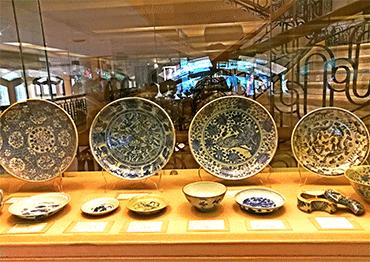
The Manila Galleon trade fueled the large-scale export of Chinese porcelain to the Americas. As early as 1573, more than 20,000 pieces of Chinese porcelain crossed the Pacific. Owning fine porcelain produced in Jingdezhen, East China's Jiangxi Province and Dehua in Fujian grew into prized status symbols for American aristocrats.
Chinese craftsmen even created tailormade ceramic works for American consumers. A notable example is the jícaras, a type of ceramic cup specially designed for drinking hot chocolate. Infused with traditional Chinese decorative art and production techniques, these custom ceramics seamlessly aligned with the refined tastes of elite American society.

 Old Version