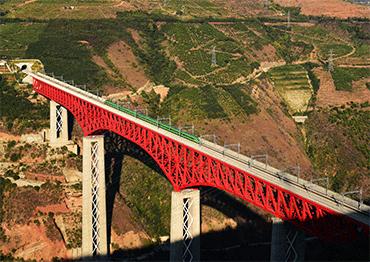
In December 2021, the international train afficionado community were all abuzz when the China-Laos railway first opened. Although initially only for freight, cross-border passenger services started in April 2023 between Kunming, capital of Southwest China's Yunnan Province and Vientiane, capital of Laos.
Why the excitement? This new high-speed line would allow the world's longest passenger rail journey by filling in the missing rail gap in land-locked Laos. For the first time, slow-travel purists could potentially travel from Singapore via Malaysia, Thailand, Laos, China, Mongolia, Russia and thence through Europe to Lagos in southern Portugal. I say potentially, because the trip is impossible due to continued suspension of some cross-border rail services between China and Russia and Kazakhstan. Cue much correcting of breathless media articles by passionate rail-riding nerds (I am one), who pointed out that while the trip is theoretically possible, it isn't yet.
But you can travel all the way from Singapore to Beijing by rail, if you so desire, making use of the passenger cross-border high-speed railway from Laos to China (or vice versa), which just celebrated its three-year anniversary, with increased numbers of daily trains and seat capacity. Since 2023, there have been some 840,000 international passenger trips on the line, Chinese media reported. Destinations in Southwest China and Laos are certainly reaping the benefits, with more tourists and commerce flowing in what was previously fairly inaccessible mountainous country, criss-crossed by the Ancient Tea Horse Trail, which is also seeing a tourism renaissance.
I've been wanting to take this international train for some time. This route is even more appealing as it stops at major tourist cities on both sides of the border, while traversing scenic regions with multi-ethnic groups, unique cultures and biodiversity, plus great food.
While it's your choice which way you'd like to travel along the 1,035-kilometer line, how you buy tickets is different. If you travel either a domestic or international leg in or from Laos, you can buy tickets from agents in the country, or in advance, through an online ticketing agent like Baolau or 12go.Asia, or the official Lao Railway app, LCR. This worked well for me, by putting my email address in, not your phone number, and linking it to a Visa card. You can book domestic tickets one week in advance, or two weeks in advance for an international trip. But, while the QR card on the app was sufficient for the domestic trip I took in Laos, for the international trip, you must go to the ticket office at the station and get a real paper ticket before checking in for the train.
On the China side, you can book through the China Railways official app, Railway 12306, but you must validate your identity at a train station before the first time you travel using it. If not, online agency Trip. com is a convenient option, and sometimes works better. You can also only book tickets in China two weeks in advance. An example fare is a very reasonable 413 yuan (US$61) for a ticket from Kunming South Station to Luang Prabang in second class (carriages have five seats across, in a three plus two configuration), or 658 yuan (US$97) in first class, with wider seats, only four across, which are more spacious and plush. For me, it's worth the extra expense.
I first went to Laos in 1995, right after the country first opened up to individual foreign tourists. Before that, you had to be in a group. There wasn't much information to be had about accommodation, internal travel or even sightseeing. Travel from Vientiane, which was a very sleepy town at the time, to Luang Prabang was uncertain. You might get a truck ride for 12 hours, possibly more, and run the risk of bandits. We tried to find an alleged bus to Vang Vieng, famed for its karst scenery much like southern China, but failed. In the end, we flew, on a rickety small plane to Luang Prabang, a somewhat scary trip.
Travel now couldn't be easier. Trains travel up to 160 kilometers per hour in Laos, and up to 200 kilometers per hour in the China section. Boarding is easy and orderly, seats are comfortable, and announcements come in Chinese, Lao and English.
This means Vang Vieng is only an hour or so from Vientiane, and the quickest trains take only 1 hour 46 minutes from the capital to Luang Prabang. But be warned, the stations are quite far out of town, and while in Vientiane there are buses, there is no public transport yet at Luang Prabang. Laos has its own version of the ubiquitous Grab taxi app, called Loca. Sign up in advance, and you can either link a card, or opt to pay in cash. You should allow up to an hour to get to Vientiane station - and choose the right one, as the other one, Khamsavath Station, also new and modern, serves only slow trains across the border to Thailand.
The app worked well, until I arrived at Luang Prabang, where chaos reigned. The train was full of tour groups, it was raining, and we were all disgorged directly outside. I ordered a car on the app, but just could not find it, there were so many minivans. Eventually, I agreed a fare with a random driver. But the city itself is as delightful as it was before, with its chilled-out vibe, except at 4 pm every afternoon when novice monks come out to the many, many temples to beat drums and bang gongs. Climb Phousi Hill to see sunset over the Mekong River, and stroll around the night market.
Leaving the former Lao capital by international train, while convenient (and scenic), does require some waiting around at borders. There are timetabled stops of 52 minutes at Boten, on the Lao side, where passengers get off the train with all their luggage to pass Lao immigration. Then there's a wait before reboarding. Ten kilometers later, at Mohan, you pass through Chinese immigration, which somehow was a lot busier, and also had a timetabled halt of 52 minutes. These areas both have duty free shops, toilets, and on the China side, a place to grab some snacks.
Back on the train, it now speeds through the tropical southwest of China, a region known for its elephants, bananas and tea. There's a last glimpse of the Mekong, now known as the Lancang River amid the plantations and paddies. While many stay in Xishuangbanna to visit tropical rainforests and botanical gardens, I decided to stop further up the line, in Pu'er, a city famous for its black tea, sold in round, hard cakes. This is only slightly strange, because I hate tea. If I had time, I would have liked to visit the monument for the Tropic of Cancer in Mojiang Hani Autonomous County, some two hours drive from downtown Pu'er, but having only a morning, I went to the "newly built ancient Tea Horse town" or Chama Ancient Town. This is an area of Pu'er dedicated to commemorating the Tea Horse caravan culture, with eateries, statues, shops, and of course tea houses. Behind is a much more interesting park, where you can see tea terraces and wander among lakes and trees.
Finally, it was back to the well-organized Pu'er Station for the last link of the LCR Railway, to Kunming South Station, and a connection to another holy grail of the train nerd, the overnight high-speed sleeper train to Beijing, the longest in the world at 2,600 kilometers.

 Old Version