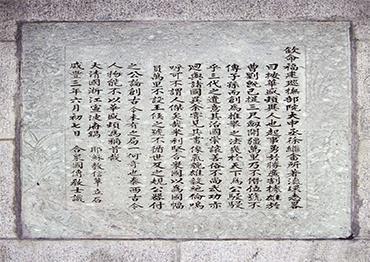
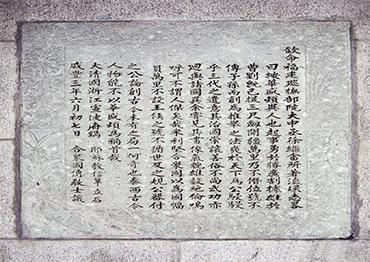
Once the text was approved by the local missionary community, a grassroots effort began in Ningbo to create the tablet and prepare it for its long voyage. The project was entirely private, supported by missionaries, local Christian communities and educated Chinese.
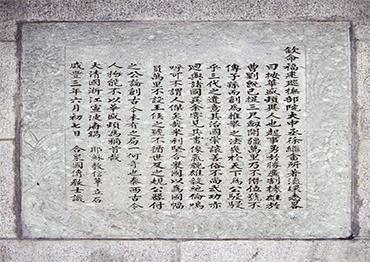
They chose high‑quality granite, an ideal material for a permanent monument. Master craftsmen carved the characters in neat script, adding traditional illuminations such as winding dragons and delicate floral scrolls, alongside standing warrior figures and seated religious figures. The carving took months, with multiple rounds of checks to prevent errors.
Standing 1.6 meters tall and 1.2 meters wide, the tablet was completed in the summer of 1853. It was inscribed "Carved in Ningbo, Zhejiang, Great Qing Empire."
Official US records list the donor simply as "American Mission, Ningpo, China," confirming the tablet as not a state gift. "Ningpo" is now spelled as "Ningbo."
In the second half of 1853, the tablet was carefully crated and loaded onto a merchant vessel at Ningbo Port. Its crossing of the Pacific was slow and turbulent. Storms, shifting cargo and humidity threatened to damage the tablet, but the protective packaging held. After months at sea, it arrived in Washington and was delivered to the monument construction site.
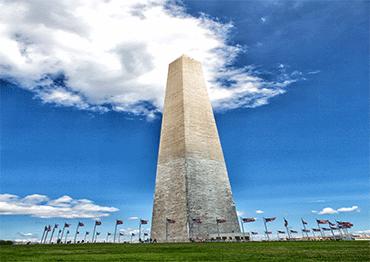
Workers installed the tablet on the west wall of the monument's 10th floor without ceremony - a token of Chinese scholarly esteem that had found a permanent home within a US national landmark.
In the years that followed, the inscription was translated into English, allowing more visitors to appreciate the tribute from a senior Chinese official that reflected how Washington's reputation had long reached intellectual circles in East Asia.
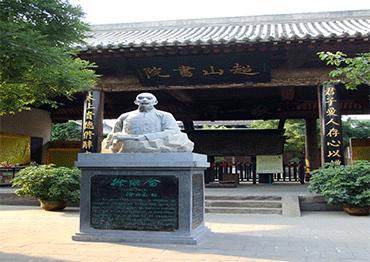
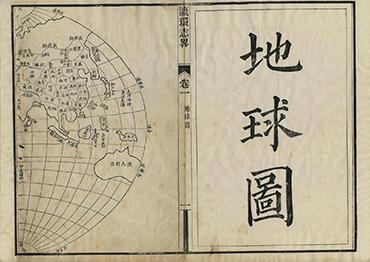
Meanwhile, Xu faced political hardship at home. His book was not initially popular and his views drew criticism from conservative officials. Amid political disputes, he was dismissed from office and lived in retirement for more than a decade.
But his reputation and influence gradually recovered. When China began its modernization movement in the 1860s, Xu's intellectual legacy gained attention among reformist thinkers and statesmen. His forward‑looking vision not only earned him respect among generations of Chinese elites but also helped direct China's early modernization.
In 1865, Xu was appointed to the Qing foreign ministry, serving as one of the several officials assisting its presiding prince. His return to public service was a clear sign that the Qing was moving to embrace reform and modernization.
In 1867, he took on another important role: superintendent of Tongwen Guan, the first Chinese government school established to teach foreign languages and Western learning. This school merged in 1902 with the Imperial University of Peking, the predecessor of today's Peking University.
Also in 1867, Anson Burlingame, a senior US diplomat to China under President Andrew Johnson, presented a portrait of Washington to Xu in a formal ceremony, honoring his thoughtful and objective portrayal of the US founding father.
The event was widely covered in US newspapers. On March 29, 1868, The New York Times hailed Xu as "the Galileo of the East," a bold thinker who challenged traditional orthodoxy and helped revolutionize China's understanding of the world.
Xu, however, did not live to see the Washington Monument fully completed in 1884, by which time the Chinese tablet had rested quietly in place for more than 30 years.
 Old Version