Old Version
Economy

In for the Longer Haul

Extending older drivers' careers may ease the trucking industry's growing labor shortage, but experts say stronger policies are still needed to improve working conditions and get the next generation behind the wheel

By Xie Ying , Zhou Qunfeng Updated Jul.1

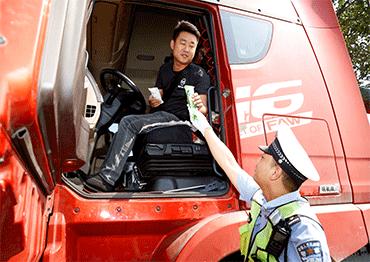
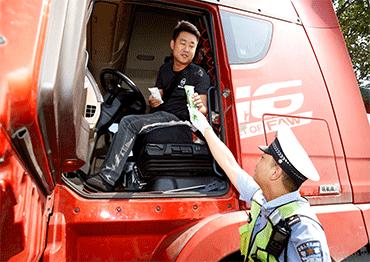
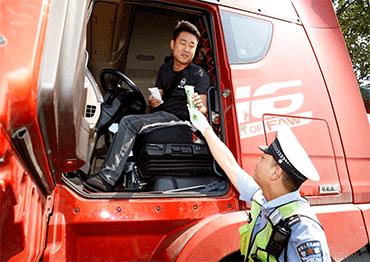
A traffic police officer gives popsicles to a truck driver, Weinan, Shaanxi Province, August 15, 2023 (Photo by VCG)

Qu Li, 42, has been a longhaul truck driver for 20 years. She starts her workday long before dawn, and sees most cities only at night through her truck window. 

When she was younger, she loved the freedom of the road and rarely felt tired, even when working around the clock. But lately, she has been suffering from back pain and persistent fatigue. 

She wonders how much longer she can keep on driving. China's Ministry of Transport (MoT) provided a partial answer on March 20, raising the upper age limit for freight truck drivers from 60 to 63. The adjustment is widely seen as a response to China's shrinking truck driver workforce. 

China has 38 million truck drivers, according to a report released by the China Federation of Logistics & Purchasing (CFLP) in July 2025. More than 84 percent are aged 36 to 55, with the number of drivers under 35 continuing to decline and the proportion aged 56 and above rising slightly. 

While fully autonomous trucking for long, established routes may be around the corner, drivers are still needed to navigate the expanse of China's vast road network. Thanks to the revised regulation, some older drivers are once again eligible to keep trucking on. Yet many face a dilemma, weighing their livelihood against their health. 

Trucks in China generally fall into four gross-weight categories. Mediumand heavy-duty trucks, which weigh 4.5-12 tons and above, typically require higher-standard driving licenses involving specialized training and exams. 

While competition is cutthroat among drivers for mini and light-duty trucks (under 4.5 tons), especially as online platforms have lowered barriers to entry, heavy-duty trucking faces an acute shortage of qualified drivers, despite the higher pay. 

Xie Xiaowen, a special researcher at the China Society of Logistics and an advisor to the China Communications and Transportation Association, describes this as a "structural labor shortage." 

"There is a surplus of low-threshold light truck drivers with C licenses, whereas heavy-duty and hazardous goods transport require extensive experience," he told NewsChina. "The revised regulation directly targets the shortage of skilled drivers, especially those holding A2 licenses," he added. This is the highest-level license required for heavy-duty trucks. 

"Keeping skilled and experienced drivers on the road helps stabilize industry capacity and prevents the sudden loss of qualified workers due to rigid age limits," he said, noting that few young people are willing to enter the trade. 

His view is echoed by Guo Zhaoming, deputy secretary-general of the CFLP and director of its education and training department. He warned at the 2021 two sessions, China's annual meetings for legislative and political advisory bodies, that very few truck drivers working today are born after 1990. 

"This severe age gap has created a shortage of nearly 10 million truck drivers. As drivers born after 1970 gradually retire over the next five to 10 years, the shortfall will only worsen," he said.

Out of Gear
Experts attribute young people's reluctance to enter the industry to the difficulty of obtaining an A2 license, heavy workloads and minimal rest time. 

The CFLP's 2025 report said that nearly 40 percent of truck drivers work more than 26 days a month, and over one-third of truck drivers work more than 12 hours a day. According to another survey on truck drivers' employment and lives released by the Renmin University of China in August 2025, drivers average just 3.54 days off per month. Nearly 89 percent drive alone, with only 1.96 percent working with an assistant. 

In a report by the Peninsula Metropolis Daily in May 2025, 25-year-old Li Weihang of Qingdao, Shandong Province, revealed he quit a job at a State-owned enterprise in 2024 and shifted to longhaul trucking for more freedom. Although he earned over 10,000 yuan (US$1,462) a month, he saw truck driving as a temporary or transitional job while he sought a better one. 

In July 2025, Shandong's State-run news outlet dzwww.com reported that 33-year-old Cui Weizheng, a former truck driver, switched to driving a taxi after six months behind the wheel of a 9.6-meter truck. At that time, he hauled loads over the 4,100 kilometers between Guangzhou in southern Guangdong Province and Urumqi, Northwest China's Xinjiang Uygur Autonomous Region, once staying on the road for three weeks straight. 

"I had no stable income back then, and my family constantly worried about my safety," he said. 
"Allowing healthy older drivers to work three extra years will ease the pressure on companies struggling to find skilled workers, and won't significantly increase capacity, which could intensify already fierce competition from oversupply [in lighter trucking]," Xie said. 

"Although the revised regulation cannot fully solve the aging workforce problem, it does unlock some existing human resources," he added.

‘First to Break Down'
Xie's assessment lines up with the Ministry of Transport's explanation for the rule change: to fully unleash the dividends of the delayed retirement policy and address concerns within the trucking industry. 

Li Chengwen, 54, welcomes the policy. His vehicle, a 6.8-meter flatbed, is nearing the end of its service life. But he wants to continue working to help support his son's family. 

Originally, Li planned to switch to mini-truck driving, which requires only a C1 license and has no upper age limit. The new regulation changed his mind. He now intends to buy a new truck and work until the revised age ceiling. 

Yet a poll conducted by trucking information website 360che.com found that 35 percent of Chinese truck drivers oppose raising the age limit. 

"My monthly income is even lower than it was 10 years ago," said Shen Hai, a company-employed truck driver. Since the pandemic, his employer has only covered up to one-third of his toll fees as a cost-cutting measure. Many drivers avoid toll roads to save money, but alternative routes can often take much longer and are not well maintained, making them more exhausting to navigate. 

Several other drivers interviewed by NewsChina also complained about falling freight rates, rising fuel prices and shrinking earnings. 

Lan Senfeng, founder of the freight service platform Huochebao and an expert with the CFLP, told NewsChina that supporters of the age-limit increase are mainly professional drivers at large, regulated companies with stable jobs and access to assisted driving technology. Opposition comes primarily from self-employed drivers facing declining incomes and deteriorating health. 
Freight platforms have pushed down rates, Shen said, and companies are increasingly reluctant to hire full-time drivers. Self-employed drivers, who account for more than 60 percent of all truck drivers according to the CFLP's 2025 report, also have to bear the cost of vehicle scrappage. 

By law, semi-trailers have a 15-year service life (excluding hazardous goods carriers), and heavy-duty trucks that exceed 700,000 kilometers are subject to early retirement. In practice, heavy-duty trucks often wear out sooner. 

"Even company drivers may not have new trucks to operate. Companies don't lay them off, but they pay only the minimum statutory salary," Shen said. "In many cases, drivers retire when their trucks are scrapped." 

Health is another concern for older drivers, especially eyesight. Without reading glasses, many drivers over 50 can barely read navigation apps as their trucks jostle on bumpy roads. 
"They rely heavily on experience and memory," Lan said, revealing that some transport companies have adapted by providing older drivers with navigation apps that feature extra-large fonts. 
Long driving shifts, which are often more than 10 consecutive hours, force many drivers to quit between ages 50 and 55 due to chronic lower back, neck and stomach pain.
 
The CFLP's 2025 report shows that over 70 percent of truck drivers suffer from occupational diseases. Among them, more than 90 percent have hip or neck pain from prolonged sitting, nearly 70 percent have stomach problems due to irregular diets, and about 30 percent have other conditions such as hypertension or noise-induced hearing loss. 

A 2024 survey by the Transfar Charity Foundation in Zhejiang Province, which focuses on social responsibility, found that chronic pain and gastritis are widespread in the industry. Sleep deprivation affects nearly half of all truck drivers, reducing concentration and reaction time and increasing accident risk. 

To save money, many drivers, especially self-employed ones, do not pay for social medical insurance and avoid medical care unless severely ill. 

Qu Li said that even younger peers in chat groups complain of stiff lower backs after a day's work. Some feel drowsy once they grip the steering wheel, and short breaks or cigarettes offer little relief. Many eventually sell their trucks and quit. 

"Male or female, those who push themselves too hard are the first to break down," Qu said.
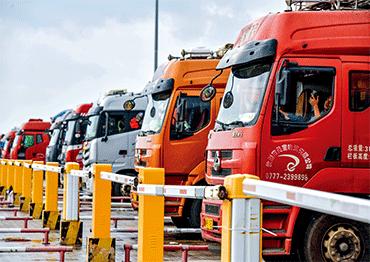
Truckers wait for their trucks to be loaded with goods, Xinhai Harbor, Haikou, Hainan Province, October 7, 2021 (Photo by CNS)

A driver rests in his truck to wait out a typhoon in Xuwen, Guangdong Province, September 5, 2024 (Photo by IC)

Roadmap Ahead
Authorities have taken steps to improve conditions. In 2021, 16 ministries and agencies issued a document to strengthen protections for truck drivers, calling for better working conditions, simplified license procedures, more rest areas and improved truck scrappage policies. 

In late 2024, authorities released another document focused on rest for drivers. By now, China has built more than 2,100 rest stops on highways nationwide. In 2025, authorities enhanced support policies for accident-injured drivers and introduced rules requiring mandatory breaks after four consecutive hours behind the wheel. Many local governments also offer free physical exams. 

Meanwhile, vehicle and software designers are exploring digital tools such as assisted driving to reduce fatigue. A study that tracked three professional heavy-duty truck drivers over 120 hours by He Dengbo, assistant professor at the Hong Kong University of Science and Technology Guangzhou branch, found that assisted driving lowers fatigue compared with fully manual operation. 

But cost remains a barrier. Assisted driving systems often cost several thousand to 10,000 yuan (US$1,462) per truck, too expensive for most self-employed drivers and some companies. Experts also question whether assisted driving can fully compensate for aging, as drivers must still take control in emergencies, and older drivers may respond slowly. 

He suggested that authorities create systems to monitor and assess older drivers' health and abilities, similar to approaches used in developed countries, to determine whether they can safely continue driving. 

A more fundamental solution is to attract young people to the industry. At the 2024 Chinese People's Political Consultative Conference, Yang Junri, director of the Social Contact Department of the All-China Federation of Trade Unions, proposed lowering entry barriers by expanding license categories for automatic trucks and offering more training. 

At this year's National People's Congress, Wang Jianqing, a chief automotive engineer at Dongfeng Commercial Vehicle and also a delegate to the National People's Congress, called for improving professional titles and clear promotion pathways so young workers can see future career development opportunities. 

"Many young people would rather work as a courier than as industrial workers, which reveals problems in labor matching," he said, "I suggest authorities set up a dynamic skill monitoring platform for industrial workers to better connect workers with suitable positions."

Print