Old Version
Cover Story

Passion Projects

American entrepreneur, traveler and writer Brian Linden has devoted himself to forging cultural bridges between China and the world for four decades with his Linden Centers and focus on education and communication

By Yi Ziyi Updated Jul.1

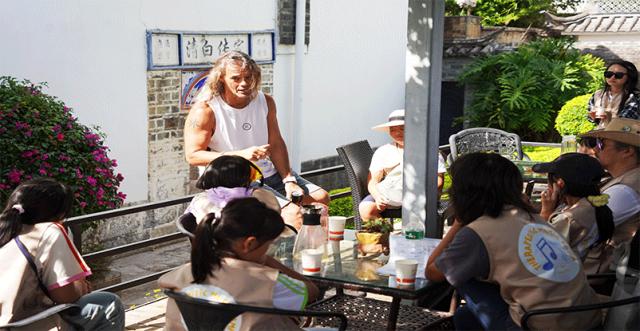
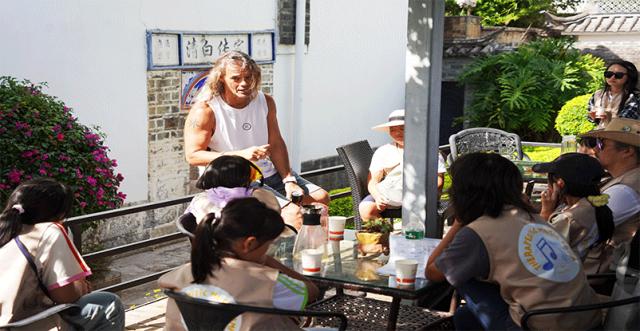
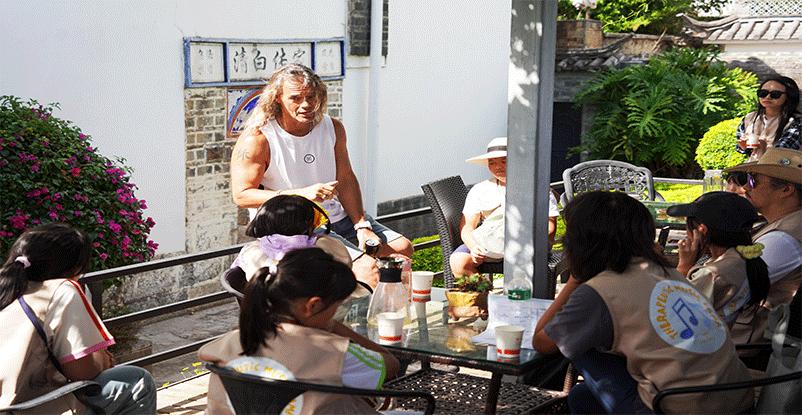
Brian Linden speaks with students at a music camp at the Linden Center in Xizhou, Dali, Yunnan Province, July 2024 (Photo courtesy of the interviewee)

Between the towering Cangshan Mountains and the shimmering Erhai Lake lies Xizhou, an ancient town in Southwest China's Yunnan Province. With a history spanning over a thousand years, the Bai ethnic town is renowned for its delicate architecture, tranquil landscapes and rich culture. 

In the heart of the town is a large rice paddy. In late April, the paddy shines with hues of green and gold. Nearby stands the castle-like Yang Pinxiang Mansion, a masterpiece of Bai architecture. Built in 1948 by prominent merchant Yang Pinxiang, the mansion features intricate wooden carvings, elegant upturned eaves, a meticulously crafted marble gateway and yellow six-meter walls. 

Any visitor to Xizhou is immediately drawn to the mansion's grandeur. Stepping into the main courtyard, they might come across a long-haired American man, greeting them with a smile, "Hey, you want some coffee?" That man is Brian Linden. 

In 1984, Linden, a Chicago native, received a scholarship and came to China alone, where he studied, played the lead in a film, traveled by train and worked as a photojournalist. In 2004, he sold his house in the US and moved back to China with his family with a goal - find a traditional Chinese building to create an Arcadian retreat for cross-cultural communication in rural China. 

In 2006, they found Xizhou. Linden used his entire savings to restore Yang Pinxiang Mansion and in 2008 established the first of six Linden Centers there, as a hub of experimental travel, cross-cultural exchange and international education. In two decades, transforming from laowai (foreigner) to laoxiang (fellow-villager), the 63-yearold adventurer has forged a cultural bridge between China and the world through his Linden Centers.

Origin Story
Linden's story begins in the workingclass neighborhoods of Chicago. Born in 1962 into a family of modest means, Linden spent his teenage years working odd jobs, from cleaning carpets to refurbishing furniture and selling ladies' shoes. He had to work 40 hours a week while balancing college courses and night school. 

Linden's family valued culture and art. His father, a telephone repairman who had to retire early after an accident, had a love for antique and art collecting. Once or twice a week, his parents took him to farm auctions and flea markets to search for treasures. 

"My parents gave me a broad understanding of the world through everything, such as antiques. I studied with them through everyday life," Linden told NewsChina. 

His life changed when an elderly professor hired him to clean his carpet. Having recently finished a trip in China, the professor asked Linden to locate Beijing on a map on his wall. Linden had no clue where China was, let alone Beijing. The professor gave him a cup of Chinese green tea and suggested, "If I were you, I would look abroad, explore the world... why not consider China?" 

The seed of curiosity took root when Linden saw a poster offering Chinese government scholarships. He applied and was successful. 

In 1984, 22-year-old Linden arrived in Beijing to study Chinese at Beijing Language and Culture University. His first day, he met a middle-aged teacher called Mrs. Wang, who suggested he should use the Chinese name "林登" (Lin Deng), a transliteration of his surname that literally means "climbing in the forests." 

Shortly after arriving, Linden was cast as the lead in a Chinese film, He Came from Across the Ocean, the first foreigner to star in a Chinese film. 

At the time, Linden recalled, there were not many places for foreigners and Chinese people to mix off campus. "I had to go to English corners in Taoranting (Park) and Beijing Zoo. They were held every Saturday," he said, "In the 1980s, people hadn't seen foreigners for a long time, and some of them never had. They were very curious and they would surround me when they saw me," Linden told NewsChina. 

Linden went on to work as a photojournalist for CBS News, interviewing politicians and documenting the nation's changes during its economic reform and opening-up. 

In 1987, he enrolled in the Nanjing University-Johns Hopkins University Center for Chinese and American Studies in Nanjing, Jiangsu Province, where he met his future wife, Jeanee, a Chinese American woman from San Francisco. They traveled across China by train, venturing to places as far afield as Xi'an, Shaanxi Province, Shanghai, Guilin in Guangxi Zhuang Autonomous Region, Dunhuang in Gansu Province, Yunnan and Xinjiang Uygur Autonomous Region in the far west, as well as many scenic areas that were not yet officially open to tourists. 

Linden returned to the US in 1988 for a PhD program in Oriental History at Stanford University, California, and later he spent nearly 15 years traveling the globe, working on international education projects in over 60 countries and traveling to more than 100 countries.

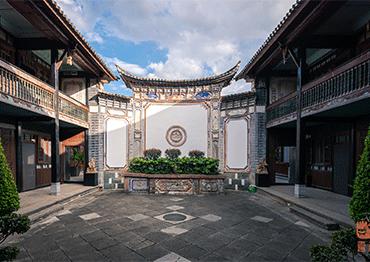
The main courtyard of the Linden Center (Yang Pinxiang Mansion) (Photo Courtesy of the Interviewee)

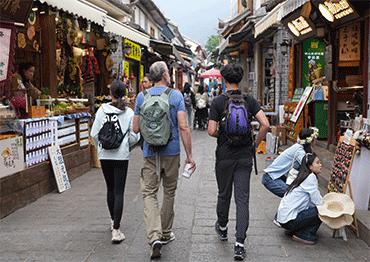
Mike Levy (center), a head of Presidio Knolls School, walks with students on the market street of Xizhou, Dali, Yunnan Province, April 2026 (Photo Courtesy of the Interviewee)

Taking Root
In 2004, Linden and his wife made a decision that their friends and family found astonishing: They sold their house in the US and moved to China with their two young sons, Shane and Bryce. 

This time, they were looking for a rural place that had not been homogenized by globalization to create "a center that would be a vehicle for real cultural and intellectual exchange," he wrote in his memoir One Village at a Time. 

The Linden family spent two years visiting rural towns across the country to look for a potential site. Finally, they arrived at Xizhou, near the tourist hotspot of Dali. 

"This was the very place we were looking for," Linden said. "People here were very warm, open and very tolerant. The local government was tolerant as well. And, in China, it was rare to find large, traditional pieces of architecture that still retained their integrity." 

Amid golden rice fields, Linden discovered a building that would become the centerpiece of his life's work: Yang Pinxiang Mansion. The 1,800-squaremeter mansion is laid out in traditional Bai architectural style: three square buildings with a screen wall, four adjoining courtyards and five skylights. Though listed in 2001 as national heritage site, the mansion had been neglected for years. 

Linden applied for permits to renovate it, putting up his life savings of about 6 million yuan (US$883,151). At the time, a foreigner volunteering to restore a national cultural relic was unprecedented in China. The local government approved him, and over the next 18 months, Linden poured all his money into the project, working with dozens of Bai craftsmen to restore the old mansion to its former glory. 

In 2008, the first Linden Center opened its doors. Linden and his team offered cultural activities like Bai dancing, music and handicraft workshops, as well as calligraphy classes, morning market tours and cooking lessons. 

One morning in late April, Wang Xia, a 35-year-old Bai woman from Xizhou, was wrapping up her morning market tour. On staff at the Linden Center, Wang is a guest manager, guide and organizes cultural activities. 

The morning market tour is one of the Linden Center's most popular activities. The guide leads visitors through the alleys of Xizhou to see vendors, many in traditional Bai clothing, selling foods like edible flowers, dry mushrooms and fresh blueberries. Also for sale are Yunnan specialties such as rushan (dried milk cake) and erkuai (rice noodle). Guests can buy ingredients for cooking classes back at the Center. 

"International guests are really drawn by this morning market tour and the Chinese cooking class," Wang said. 

The Linden Center puts a lot of effort into building a community. It holds a free cultural event once a month, hosting activities such as English corners, painting sessions and singing, Wang said. Around Christmas, they hold embroidery classes to teach children to make coasters. 

On January 29, Wang's two daughters joined a singing activity for children, where they were taught to sing John Denver's "Take Me Home, Country Roads." 

Now there are two more Linden Centers in Xizhou - Yangzhuoran International Education Base and Bao Chengfu. Linden Centers have also expanded to other towns, like Shaxi, an ancient town around 100 kilometers from Xizhou and Naada in Shangri-La, in the north of Yunnan Province. 

Cai Mengqi, former Asia-Pacific head of green finance at the UN Environment Program (UNEP), views Linden as a "super go-getter." Cai is the founder of Yunnan Zhengfei, a cultural tourism platform that started collaborating with Linden Centers in early 2026. 

"There's one big trait in Brian that everyone can probably feel - his passion. You can feel that passion in every word he says, in every interaction he has with people. I feel that people nowadays seem to be losing passion for things. But it's passion that gives life direction, and good luck may follow, because many people are drawn in by his passion," Cai told NewsChina.

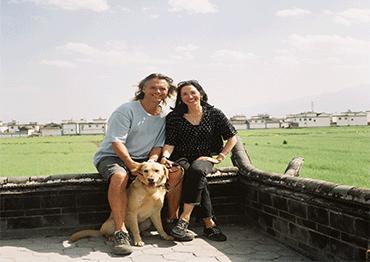
Brian Linden and his wife Jeanee on the terrace of the Linden Center (Yang Pinxiang Mansion) (Photo Courtesy of the Interviewee)

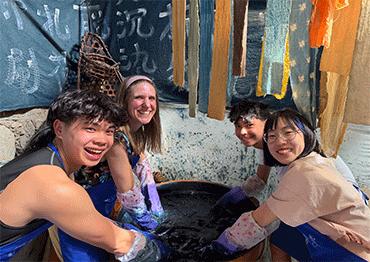
Students and teachers from Presidio Knolls School experience traditional Bai tie-dyeing at a workshop in Xizhou, Dali, Yunnan Province, April 23, 2026 (Photo Courtesy of the Interviewee)

Tell a Good Story
"To challenge minds" is a phrase that Linden repeatedly mentions when he talks about building Linden Centers. 

He has observed that many foreigners living in China for years seldom leave their comfort zones: They live in metropolises such as Beijing and Shanghai, buy groceries at international chain supermarkets, book international luxury hotels and frequent familiar cafes, bars and restaurants. 

"I wanted to challenge that paradigm," Linden said. "The soul of Chinese culture lies in rural China. We wanted to create a place where people can gather and be challenged to look at China with different eyes, to recognize the changes that occurred in this country and to acknowledge the openness of its people." 

Education is the core mission of the Linden Center. Founded in 2012, its Yangzhuoran International Education Base has launched micro-campus programs in partnership with schools and universities around the world, hosting thousands of students in immersive, place-based learning. 

Presidio Knolls School (PKS) is a progressive Chinese private school serving pre-kindergarten through eighth grade in San Francisco. Since 2018, PKS has organized annual trips for its eighth graders to the Linden Center in Xizhou, allowing them to immerse themselves in Bai culture and Chinese rural life. 

This April, a group of 22 PKS students visited the Yangzhuoran Education Base in Xizhou, participating in all the cultural activities on offer. 

The program required each student to create a short documentary about a local, such as a village artisan, vendor or musician. 

"It's pretty interesting to hear about how people live here," said 14-yearold Emerson Lau, who interviewed an elderly man he met at a temple on his first day. He was playing a traditional two-stringed violin called an erhu with other elderly musicians in a pavilion by the temple. 

"The man told me that when he was young, his first job was working on the railroads and later he became a car mechanic," Lau said. "But it's so cool that he has that other side of himself - he is an artist who has a lifelong hobby of playing the erhu." 

Lau called long-haired Linden a "really cool hippie." 

"It's so amazing how he just lets people understand Chinese culture and made places to let you get immersed in the whole Xizhou culture," he said.
 
Thirteen-year-old Lana Johnson was deeply impressed by the strong sense of community in Xizhou. "All the vendors know each other. Everyone here is so close and I think you don't really get that experience in big cities," she said. "It's super cool. And I love how people here really like to preserve their history." 

"I think the point of this program is to tell us not look at something from its surface," Johnson said. "Here I'm learning a lot more than I did in the classroom." 

Mike Levy, head of PKS middle school, said what Linden is doing is unique. "I don't think they really want to make money. I think they want to change people's thinking," Levy told NewsChina. "In some way, Brian's big mission is peacemaking between the place where he was born and the place where he lives." 

During our interview, Linden shared a touching story. On January 26, 2020, the day that NBA legend Kobe Bryant died, he met a 5-year-old boy in nearby Shilong Village who was sobbing over the death of his beloved idol. "An American had influenced a little Bai boy in a village on a mountain in China. That's the power of culture and the power of good storytelling," he said. 

As for China's cultural story in the global landscape, Linden hopes to make similar connections on its own terms. "I think Chinese culture already has its own charm and wisdom and it doesn't need to overly cater to foreign tastes. I was drawn here by Chinese culture itself," Linden said. 

"But maybe what we can do is to tell a good story with more passion to the outside world," he added.

Print