Finding myself one day at a dental hospital in Beijing, I realized I was right at the southern end of the Central Axis, a 7.8 kilometer north-south line bisecting the ancient center of the city, and its newest UNESCO World Heritage Site.
While perhaps not the most auspicious start to a day of sightseeing, having not visited the historic center for ages, I decided on a spontaneous stroll along the Axis to see how it was shaping up.
Now, to do the Axis and all its associated sites justice - many of which date from imperial times and are huge, or are associated with the founding of modern China post-1949 - certainly takes more than a day, and I ended up splitting the walk into two parts.
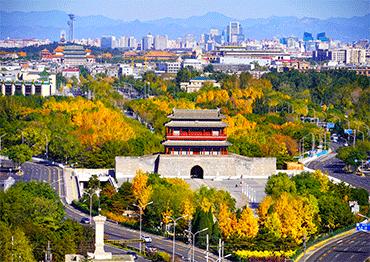
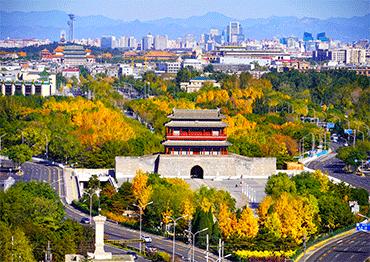
Starting at the southern end, the first monument you'll see is Yongdingmen, or Lasting Peace Gate, which used to be the southern entrance on the old outer city walls, sadly mostly destroyed to create roads as the city modernized and expanded in the 1950s. The original gate was built in 1553, and this gate was reconstructed in the 2000s.
In the southern portion, a long park has been created, and it's easy to walk right along the center line, separated from traffic, mostly passing regular neighborhoods. So it might be easy to miss the next major site, technically not on the Axis, but a bit east. If you want to add to your step count, the Temple of Heaven, my favorite of Beijing's royal landmarks, is worth a side trip - either to wander in the extensive parks and gardens, keeping an eye out for martial arts enthusiasts and cypress trees that outlived dynasties, or to walk along the Temple of Heaven's own axis, right up to the Hall of Prayer for Good Harvests, a 38-meter-tall wooden structure, and often used as the symbol for Beijing. This is where emperors from the Ming (1368-1644) and Qing (1644-1911) dynasties would make sacrificial visits to ensure a bountiful year ahead. The complex was first built from 1406- 1420 by the Ming Yongle Emperor, who also built the Forbidden City.
Having walked through the complex on an earlier dental-related visit and seen a magnificent sunset, (the park is open later than the historic sites), this time I pushed on. The next site is Zhushikou Church, a Methodist church dating from 1904, slightly marooned on the edge of a wide, busy street that you'll have to detour to the left or right to cross to access the southern end of one of old Beijing's most important streets, Qianmen. Now fully pedestrianized, there is a restored sightseeing tram that runs along the street.
When I first came to this street in the mid-90s, it was a bustling and traffic-clogged thoroughfare, with a peculiar amount of stores selling nails and screws. At the northern end still stands Beijing's oldest Peking duck restaurant, Quanjude, which seemingly hosted every visiting dignitary from overseas.
Today, you'll find the street lined by traditional snack stores, souvenir shops and milk tea shops. To get a flavor of what it used to be like, duck into the Dashilan area via the small alleys at the top left of the street. Here you'll find boutique stores, trendy coffee shops and restaurants nestled between old courtyard houses, as well as guild halls, many of which have been restored. These were where merchants from different parts of China stayed when they came to Beijing on business - close to the imperial city, but not inside.
By the end of the Qing Dynasty, Dashilan was one of the most important commercial and cultural districts in the capital, home to banks, silk stores, book stores and several important Peking Opera theaters. Today, you can still see Peking Opera performances in the Qianmen area, or catch a symphony, a Shakespeare play or folk music performance in the stunning National Center for the Performing Arts, affectionately dubbed the Egg (2007), a spherical glass dome on the south side of Beijing's most important east-west road, Chang'an Avenue.
For a cheap, filling snack to have on-the-go, seek out a neighborhood takeout joint for a traditional Beijing pancake, stuffed with veggies or meat, for less than a dollar.
Continuing to the top of Qianmen, you'll see Zhengyangmen, or Arrow Tower, at the southern end of Tiananmen Square. This gate was the southern entrance to the imperial city, and can be climbed for a view of the square. Turning east, you'll find Beijing Railway Museum, once the capital's first station serving routes to the north, but which closed in 1959.
This would be a good point to split the walk, as I had to the first time, as I hadn't made a reservation to enter Tiananmen Square early enough. Security around this area is very strict, and you must bring a passport and make a free reservation on a miniapp, which is now in English and relatively easy to use. You can also book through travel apps, such as Ctrip.
Completists and first-timers will certainly want to walk into the square, which dates from the Ming, but was significantly enlarged in the 1950s. It's surrounded by impressive monuments such as the Great Hall of the People and National Museum of China, built in 1959, and inside, landmarks such as the Chairman Mao Memorial Hall (1977), Monument to the People's Heroes, honoring revolutionary martyrs, and the National Flag, standing proud at the north end. This is where the twice-daily flag lowering and raising ceremony takes place at dawn and dusk. If you want to see this, book separately on the app.
Take the pass under Chang'an Avenue to reach the iconic Tiananmen - the Gate of Heavenly Peace - with the portrait of Chairman Mao atop the central arch, and scene of many selfies.To enter the Forbidden City, follow the central line through the gate. One last security check (book tickets on another miniapp), and you're in. If you split the walk, you can start again by entering through Nanchizi, a lovely park to the east of the complex, which costs only 2 yuan and leads directly to the entrance of the Palace Museum.
With more exhibition space opened up, as well as imperial buildings, courtyards and the garden to see, you could spend days in the Forbidden City. It's especially popular now with young people who dress in traditional costume, known as Hanfu. The day I went I saw a number of emperors and empresses, perhaps concubines or even eunuchs, posing in elaborate gowns and wigs.
Ushered out a little unceremoniously from the north gate, due to shorter winter opening hours, the next viewpoint is Jingshan Park, an imperial park constructed from earth excavated from the Forbidden City moat. Walk past the new Axis sightseeing bus stops, cross the street and enter the park from the east side. Climb the steps near the spot where the last Ming Emperor Chongzhen is said to have hanged himself from a tree as his dynasty collapsed in 1644. Popular at sunset, the topmost pavilion is great for a view of the whole Axis.
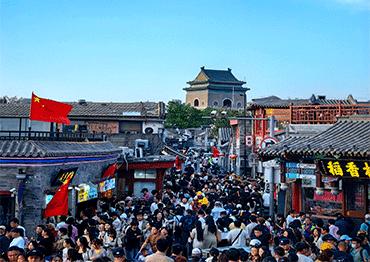
Finally, turning north once again, walk around the park to Dianmenwai Street. Halfway up, to the left, is the vibrant entertainment area of Houhai, centered around a lake, and the marble Wanning Bridge, dating from the Yuan Dynasty (1279-1368). At the top of the street are the last monuments of the walk, the Drum and Bell Towers, used to tell time from the Yuan to the Qing, standing tall.
And if you made it this far, take a well-earned break in one of the area's many bars, cafes or restaurants that spread in the alleys around the Drum Tower.
 Old Version