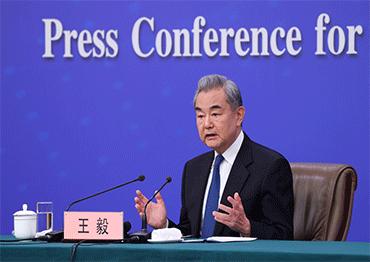
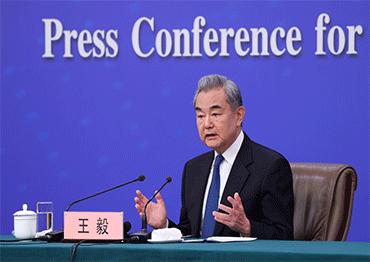
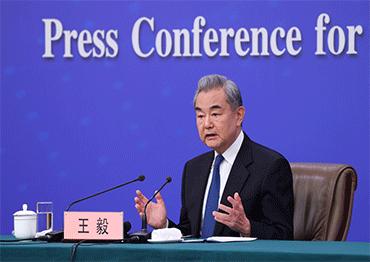
Addressing the war in the Middle East, Wang called for an immediate ceasefire and an end to hostilities. "This is a war that should not have happened, and it is a war that does no one any good," Wang said.
After Israeli and US forces launched surprise air strikes against Iran that killed Iran's supreme leader Ayatollah Ali Khamenei and some 40 senior leaders on February 28, China condemned the attack.
The "blatant attack and killing of a leader of a sovereign state and incitement to regime change are unacceptable," Wang said on March 1, adding that the strikes, which came as Washington and Tehran were in the process of negotiations, were in violation of international law.
In a phone call with his Iranian counterpart Abbas Araghchi on March 2, Wang said China supports Iran in "safeguarding its sovereignty, security, territorial integrity and national dignity and in upholding its legitimate and lawful rights and interests."
On March 5, Beijing announced that Zhai Jun, the Chinese government's special envoy on Middle East affairs, will soon visit the region to help ease tensions.
At the press conference, Wang again called for an immediate end to military operations to "avoid the spiraling escalation of the situation and prevent the conflict from spilling over and spreading." "Might does not make right. The law of the jungle must not return and rule the world. Willful use of force does not prove one's strength," Wang added.
On Europe, Wang said that China considers Europe "an important force underpinning the stability of the international order" and "a key partner" of China.
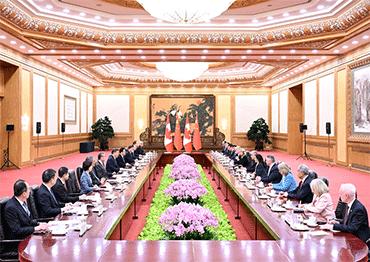
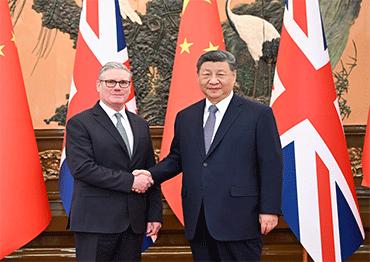
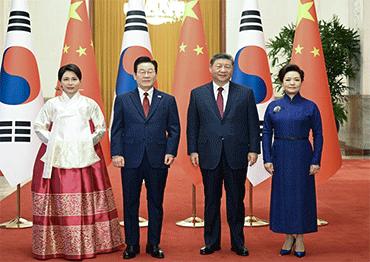
Highlighting the frequent high-level diplomatic interaction between China and European countries in 2025, Wang said China welcomes Europeans stepping out of the "small attic" of protectionism and walking into the "fitness club" of the Chinese market, where they can strengthen and enhance their competitiveness.
"While visits by European leaders to China reflect a shared willingness on both sides to improve relations, these high-level exchanges should not be an end in themselves. The ultimate success of such visits will depend on whether the two sides can effectively manage their differences and pragmatically deepen cooperation," Da Wei said.
Responding to a question about the increasing pressure the US put on Latin American and Caribbean countries (LAC) for their relations with China, Wang said that China-LAC cooperation is about mutual help and support between Global South countries, which does not target any third party and should not be subject to interference by any third party.
"We never engage in geopolitical schemes, nor interfere in other countries' internal affairs, nor ask others to pick sides," Wang said, adding that China stands ready to work with LAC countries, no matter how the situation evolves.
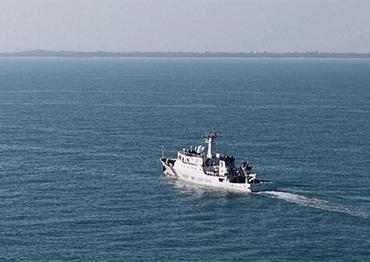
Wang told press that consultation on the Code of Conduct in the South China Sea (COC) has "reached crunch time" and all relevant parties expect to wrap it up within the year. The COC will provide "the golden rules for the parties to effectively manage differences, build trust and advance cooperation," he said.
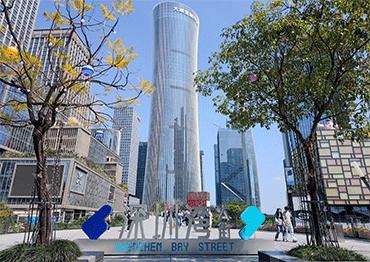
China will host the APEC Economic Leaders' Meeting in November in Shenzhen, Guangdong Province, after having hosted it in Shanghai in 2001 and Beijing in 2014. Wang revealed that under the theme "Building an Asia Pacific Community to Prosper Together," the meeting will "align different pathways toward the Free Trade Area of the Asia Pacific," and over 300 events would be held across the country throughout the year, with contributions from all APEC member economies.
Wang highlighted China's 15th Five-Year Plan (2026-2030), which he said offers a new blueprint for China's development and a new vision of win-win cooperation with the rest of the world. Wang said the 15th Five-Year Plan has three priorities to create a more favorable environment for China: promoting high-standard opening-up, expanding people-to-people exchanges and developing new windows of connectivity.
According to Professor Jin, as the world becomes more turbulent, China is facing an even more challenging international environment in 2026. "It is rather clear that the relatively predicable international order we once knew is vanishing, and the world is reverting to the logic of power politics," Jin said.
"In a new world environment where strength speaks first, China's top priority is to build both domestic and international capabilities so it can engage with the world from a position of confidence," Jin added.
 Old Version