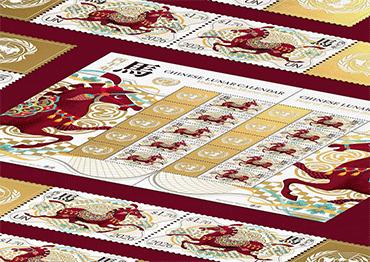
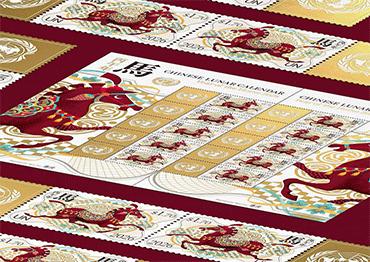
n January 16, the United Nations Postal Administration (UNPA) issued a special event sheet of 10 stamps in the denomination of US$1.7 to celebrate the Chinese Lunar Calendar – Year of the Horse, which begins on February 17, 2026 and lasts until February 5, 2027.
In Chinese culture, the horse is a symbol of strength, perseverance, courage and success. The horse on the new stamp is galloping with its mane in braids pointing upward, conveying a message of marching forward confidently. The background geometric patterns are inspired by the Buddhist Mogao Caves at Dunhuang in Gansu Province, particularly its caisson ceilings. A caisson is a sunken panel set into a ceiling in geometric shapes, and richly decorated. The stamp’s palette is also based on mineral pigments commonly found in Dunhuang’s murals.
The UNPA has issued stamps featuring Chinese zodiac animals annually to mark the Chinese lunar calendar year since 2010.
Chu Weiwei, Asia liaison office representative of the UNPA, told China News Service (CNS) that the UNPA has sought out designers with a deep understanding of Chinese culture and an international vision since the Asia office was set up in 2016. The UNPA aims to explore common global themes such as peace, the environment and UN goals and achievements. The stamps are only used at the UN Headquarters in New York and the UN offices in Geneva and Vienna, and are mainly collected by philatelists. The UNPA is the only postal authority that is not a country or territory allowed to issue stamps, and can do so in three different currencies – US dollars, euros and Swiss francs. The first stamps were issued in 1951.
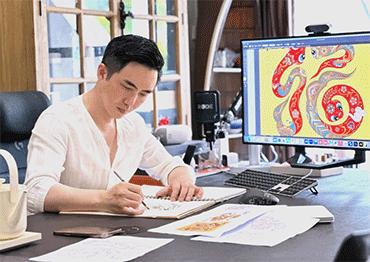
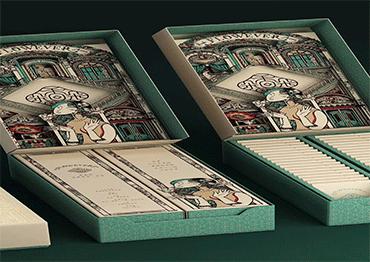
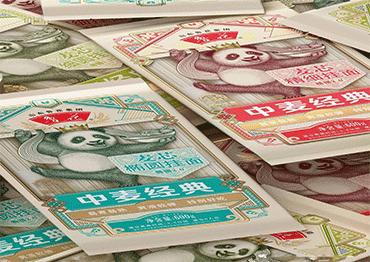
The designer of the 2026 Year of Horse stamps, Pan Hu, known as Tiger Pan (hu means “tiger” in Chinese), told CNS that his aim is to express traditional culture by reimagining it in modern art. He also designed the United Nations Lunar Calendar series for the 2018 Year of the Dog, 2022 Year of the Tiger, 2023 Year of the Rabbit, 2024 Year of the Dragon and 2025 Year of the Snake.
Born in 1973, Pan has a PhD from the Academy of Arts & Design, Tsinghua University in Beijing. He served as the 2024 D&AD Awards’ Packaging Design Jury president. The award, established by British Design & Art Direction, is one of the world’s most prestigious for creativity in design and advertising. He works out of his studio in Shenzhen, South China’s Guangdong Province.
In an interview with CNS in January, Pan spoke about the inspirations behind his stamp designs and how stamp art can enhance cross-cultural understanding.
China News Service: What inspired your design for the UNPA Year of the Horse stamp?
Pan Hu: During our cooperation with the UNPA on the Year of Horse stamp design, we were given enormous freedom and space to be creative. Our idea was to think outside the box and focus on integration and innovation. It means we would depict the aesthetics of our times as precisely as possible on the basis of our deep roots in traditional Chinese culture.
The inspiration for the horse stamp comes from a bronze artwork known as Horse Treading on a Flying Swallow, which dates back to the Eastern Han Dynasty (25-220). I hope the horse in the stamp looks relaxed, free and natural. It should manifest confidence but not aggressiveness, and elegance without being too conspicuous.
The horse on the stamp is a result of recreating the image of the bronze galloping horse: the horse mane looks more dynamic on the stamp to add more sense of motion. The background design borrows elements of patterns from caisson ceilings at Dunhuang. A caisson ceiling is a decorative pattern often seen in interior domes of ancient temples in China. Ancient Chinese people projected their imagination and philosophical understanding of the universe, time and sacredness onto the caisson ceiling patterns. I didn’t just copy the complex patterns often seen in traditional caisson ceilings in ancient Chinese architecture. Instead, I deconstructed, reshaped and reconstructed the traditional patterns to work out symmetrical patterns which highlight the agile movement of the galloping horse. Ancient cultural symbols have been revived in modern design in this way.
This artwork combines modern illustration and print art, which brings the orderliness of 2D pictures and the simplicity of geometrical graphics. The small size of stamps must be taken into account in their design. There are some classical horse images in Chinese traditional ink wash paintings, but the delicate smudging effect of the ink wash could not be fully displayed on a small stamp. Given this, our design is supposed to be customized to suit the size of a stamp in the first place, trying to reach a perfect match between artistic expression and the medium in which it is realized.
In terms of colors, I used ochre, peacock blue, pink and brick red as basic hues, and finally decided to choose jujube red as the main color. This color shows the elegance of the horse and conveys the blessing of happiness and peace that red represents in Chinese culture.
CNS: What are the characteristics of your design for the Year of the Horse stamps? Did you encounter any difficulties?
PH: In my eyes, the horse is one of the most beautiful and graceful animals among the 12 Chinese zodiac animals. It’s tall and erect, which makes it look very spirited and elegant. This beauty of the horse lends unique inspiration to our design of the stamp.
Then I came up with the idea of combining the sense of strength and elegance of a horse, so that the surging vigor of the horse is fully manifested, while at the same time the aggressive side of the animal is softened through detail. The result is the horse has an easygoing and composed vibe. I think this feature will make the stamps more appealing to people around the world.
However, the advantages of the horse as I mentioned, being energetic and graceful, also poses the biggest challenge for our task. There are numerous artworks of horses, including stamps for previous years of the horse, as well as other art forms. Some of these are classical masterpieces. It is very difficult for any artist to create something new. I had to explore a unique lens to distinguish my design from others.
CNS: What are the major considerations when you design stamps for zodiac animals?
PH: There are four major factors that I pay special attention to for designing zodiac animal stamps. First, the special quality of each animal must be visible enough for people to recognize immediately which of the 12 animals it is. Second, current social discourse and aesthetic trends should be reflected in the design to integrate traditional culture and modern vitality. Third, cultural taboos must be avoided. Stamps of zodiac animals for Chinese lunar calendar years should always celebrate the new year, delivering best wishes and positive values. Fourth, the design has to be acceptable and appealing to most people.
CNS: How can a small stamp help people around the world understand Chinese culture?
PH: The 12 zodiac animals are an important part of traditional Chinese culture. Every Chinese has a zodiac animal according to their date of birth.Many countries and regions in the world have issued animal zodiac stamps. The value of the stamps goes far beyond the postal service. Their value lies more in their “uselessness” – they are not only beautiful collectibles to be appreciated, but also carry significant memories of time, which evokes shared nostalgia and resonance among people for a particular period.
Therefore, our design is expected to both manifest distinct Chinese cultural elements and accommodate human cultural commonalities to generate an emotional resonance of ethnic Chinese globally and cultural communication across the world.
Expressing traditional Chinese culture in an international language of art on stamps is not just transporting Chinese cultural elements to the stamps, it is reconstructing traditional culture to adapt to international discourse.
For an artist, having the opportunity to design stamps for zodiac animals for the Chinese lunar calendar is something to be proud of. Chinese artists should be confident and natural. Confidence comes from deep understanding of traditional culture, especially the sophisticated connotation and spirit that underlie each cultural symbol. Staying natural means we should not show off “Chinese style” in our design, and avoid excessive recall of tradition and imposition of ancient cultural symbols.
Design is an art of expression. Different clients have different priorities, and our ideas about design must cater to clients’ demands. But for us, the core of the design never changes whatever our clients ask for: we bring Chinese culture to the world in a more natural, inclusive way.
 Old Version