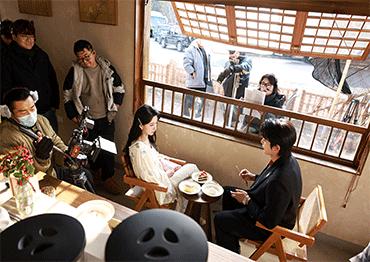
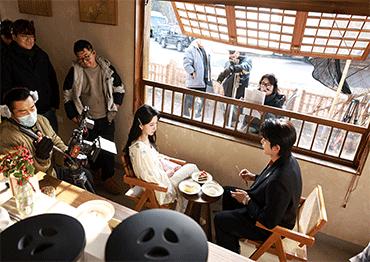
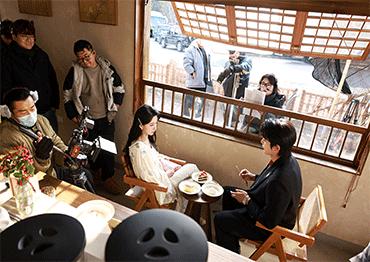
Gao’s extreme workload is common in the micro-drama industry.
Many told NewsChina that 12-hour workdays are the bare minimum, with 16-hour days far more common. Overnight shoots are routine.
Producer Yao Guoli entered the industry after graduating in 2024. He first worked at a studio in Xi’an, Shaanxi Province on a micro-drama with a shoestring 160,000 yuan (US$22,912) budget, compared to the average 400,000- 700,000 yuan (US$57,000-100,000) per production, according to a November 2025 white paper issued by the China Netcasting Services Association.
To cut costs, he and another producer alternated overnight shifts. Eventually, the other producer quit from exhaustion, leaving Yao to handle the workload alone.
At one point, Yao worked for two days straight with only two hours of rest.
“I was completely burned out,” Yao told NewsChina. “My memory quickly got worse. I couldn’t focus or even speak clearly.”
In November 2024, Yao joined a toptier micro-drama production company in Xi’an. Since then, he has worked on more than 30 productions. According to him, an 80-episode project is typically filmed in six to nine days, while a 40-episode production takes four to five days. Between productions, crews usually get no more than three days off before starting again.
As a man in his early 20s, Yao believed his body could take it. “But when a friend saw me after nine months, he said bluntly, ‘You look so old now,’” Yao said.
Pan Le, a producer who recently transitioned from traditional long-form television to micro-dramas, spent one month working at Hengdian World Studios in Zhejiang Province, China’s largest micro-drama production base. In that short time, he noticed what he described as “dangerous warning signs” among colleagues.
“Due to sleep deprivation, some actors start speaking incoherently,” Pan said. “But filming won’t stop for anyone who felt unwell. Some directors developed heart problems and had to quit because their health was truly at risk. When someone left, they were quickly replaced.”
According to industry insiders, budget size largely determines working conditions. Productions with sufficient funding can afford more reasonable schedules.
“In March 2025, when my company had more investment, we started filming at 9 am and wrapped around 8 or 9 pm,” Yao said. “We even had time for late-night snacks. But recently, as investment across the industry has dried up, budgets have been severely cut.”
One of a producer’s key responsibilities is drafting the daily filming schedule, known as “the big plan.” Yao said this task often left him feeling desperate.
“Many projects realistically need eight days to shoot, but because of budget constraints, they’re compressed into six,” he said. “You have to squeeze an impossible workload into fewer days.”
Budget cuts have sharply intensified labor demands. One industry practitioner, who requested anonymity, told NewsChina that the most exhausting project he worked on involved filming a 100-episode micro-drama in just four days.
“No one escapes the pressure,” he said. “From directors and producers to actors, cinematographers, costume designers and prop teams.”
 Old Version