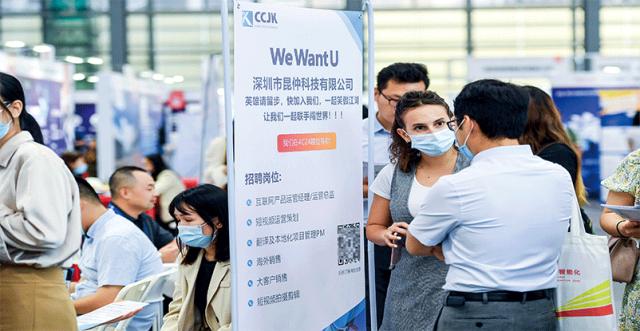
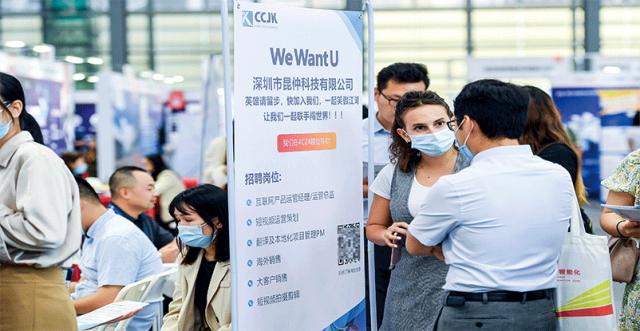
Yang argues that many quality positions are available in the job market.
“An enterprise won’t pay to post recruitment ads on job platforms unless it genuinely needs new employees,” he said. “The core problem is that returned overseas graduates often do not match these positions. In other words, supply and demand are misaligned.”
According to Yang, the main reason for this mismatch is that many job seekers have an overly narrow view of their career paths.
“For example, at one of our job fairs, a world-leading optical fiber manufacturer in Jiangsu Province, with annual revenue in the hundreds of billions of yuan, received very few resumes,” Yang said. “That changed only after the company’s top executive gave a presentation introducing the firm. The company is expanding overseas and has many positions suitable for returned graduates, but many candidates simply ignore companies they haven’t heard of.”
Ji Beibei, who works in overseas study training and consulting in Anhui Province, agreed. She said many of her students hope to join large, well-known private companies, which they perceive as having a freer and more flexible environment than government agencies or SOEs. At the same time, many STEM graduates believe they can better apply their expertise at prominent private firms.
But some just lack clear career goals and simply follow prevailing trends. Zhou Junjun told NewsChina that she applied to numerous internet companies mainly because people around her said they offered high salaries and generous benefits. During her undergraduate years, she focused on academic studies and preparing for postgraduate exams, leaving little time for internships or career planning.
The 2025 LinkedIn report found that nearly 50 percent of surveyed Chinese overseas students preferred jobs in the high-tech or internet sectors.
This preference does not always align with employers’ expectations. “We favor candidates who have a clear sense of their career direction, which is often reflected in their internship experience,” Huang said. “Unfortunately, we see very few such applicants. Many simply submit resumes to every possible position without knowing which industry they actually want to enter.”
Shandou reached the final interview round at a leading mobile phone manufacturer, but was ultimately rejected. The employer told him he lacked internship experience involving direct consumer engagement, which was a must for the position.
“I hoped earning a master’s degree in Hong Kong would strengthen my profile,” he said. “But it turned out that employers value internship experience more than academic credentials.”
Yang Peng pointed out that many returned graduates hold biases against certain professions. Sales, for example, is often overlooked, even by commerce majors, as it does not carry high social status in China.
“Many parents don’t support their children going into sales,” Yang said. “But according to JOBS data, sales positions are among the most urgently needed by companies.”
Zhou Junjun has also struggled with professional bias. One of her undergraduate instructors told her it would be a waste of her Cambridge degree to work as a teacher at a private training institution.
“In many people’s eyes, studying abroad should lead to higher positions and better resources,” she said. “If we end up in what are seen as ordinary jobs, it’s considered a failure or a waste.”
That perception, however, has been challenged by reality. Zhou’s master’s degree from Cambridge did not secure her a position at the training institution, as overseas credentials no longer play a decisive role in determining whether a candidate meets the specific requirements of a job.
“Compared with academic degrees, we place greater emphasis on skill fit and internship experience,” Huang said. “What matters most is whether a candidate can contribute effectively and adapt quickly.”
 Old Version