Old Version
Cover Story

Global Classroom

The US is losing its crown as the most popular destination for Chinese students, who are looking to Europe, Asia and the Middle East for value for money, better visa policies and post-graduate job opportunities

By Xie Ying , Qiu Qiyuan , Ni Fenfen Updated Apr.1

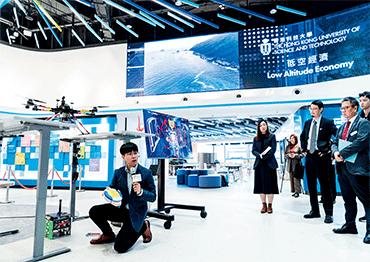
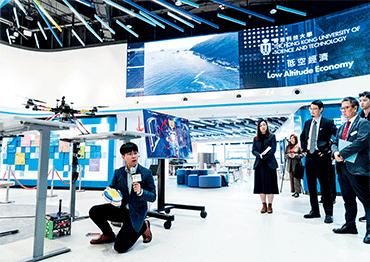
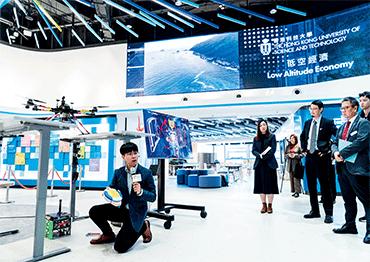
A researcher demonstrates how a drone delivers goods at the opening of the Low-Altitude Economy Research Center at the Hong Kong University of Science and Technology, January 15, 2025 (Photo by CNS)

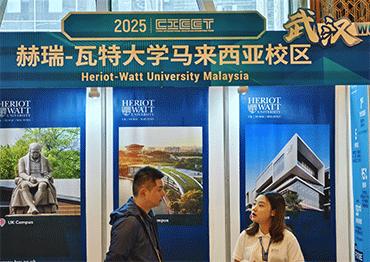
People stand at the booth of Heriot-Watt University Malaysia at the 2025 (30th) China International Education Exhibition Tour held by the Chinese Service Center for Scholarly Exchange under China’s Ministry of Education at the Wanda Reign Hotel in Wuhan, Hubei Province, April 16, 2025 (Photo by VCG)

After spending a night in a detention area along with other people who were being deported from the US at Newark Liberty International Airport, student Fang Ping was sent back to China. 

Despite being issued with a visa and holding the appropriate invitation documentation to facilitate his academic exchange, Fang, studying for a doctorate in engineering mechanics at top Beijing-based Tsinghua University, was denied entry to the US in February 2025. He had been invited to participate in a sixmonth exchange program by a professor at the prestigious Princeton University in New Jersey. 

On arrival at Newark, he was taken to a room and interrogated by three customs officers for several hours, Fang said. He claimed they were especially interested in his area of study and how he applies them. He told them his studies will be used in regular industrial scenarios like oil exploration and environmental restoration, but since Fang was to visit the engineering and aerospace department, they questioned if his studies were connected to aerospace and national defense. They asked why he was going to visit a scholar connected with engineering and aerospace. “But as a matter of fact, the professor I was to visit is in engineering mechanics, which isn’t connected with any sensitive applications for national defense at all,” Fang told NewsChina.  

The questioning lasted until dawn. Fang was told he had to resubmit his visa application back in China because his resume lacked sufficient details, but this application was refused.  

Fang’s experience is a result of the US tightening its rules for admitting international students in recent years. According to a report by the US International Institute of Education (IIE) published in November 2025, the number of new international students admitted to US universities dropped by 17 percent in the autumn semester of 2025 year-on-year, the biggest fall since the pandemic.  

The 2024-2025 Report on Chinese Students Studying Abroad released by the Western Returned Scholars Association (Overseas-educated Scholars Association of China) and the Center for China and Globalization (CCG) found that the number of students going overseas to study is increasing, but their destinations and courses of study are also becoming more diverse.  

“High-income countries represented by the US and UK are still the leading destinations for international students, but northern Europe, Southeast Asia and the Middle East are now attracting international students,” Zheng Jinlian, a research director at the CCG, told NewsChina. “The pattern of international education is expanding in two directions, both to traditional centers and now emerging regions,” he said. 

Stricter Scrutiny 
Fang’s major is in STEM (science, technology, engineering and math), which attracts most international students. According to the Open Doors 2025 Report on International Educational Exchange released by the IIE and the US Department of State, 57 percent of international students majored in STEM.  

During the first Trump administration in December 2017, the White House had already proposed restricting the number of foreign students majoring in STEM, citing national security. In mid-January 2026, the US Department of State posted on X that it had revoked 100,000 visas in 2025, including 8,000 student visas, double the number of 2024.  

After suspending student visa applications in May 2025, in June the Department of State resumed applications, announcing tightened checks and demanding applicants set their social media accounts to public so they could screen posts for “indications of hostility toward the US,” media reported. It would impact F and M student visas, and J visas, used for exchange programs.  

Chen Hang, founder of the Pittsburgh-based WholeRen Education Group, which provides international educational services, said some students were told to resubmit their applications because their social media accounts had no interactions, and others started school late due to holdups with their visa applications, even for non-sensitive majors.  

“It’s a fact that the US has tightened visa and customs checks on overseas students,” Chen told NewsChina.  

According to the Open Doors 2025 Report, the number of Chinese mainland students studying in the US decreased to over 265,919 in 2025, a 4.1 percent drop year-on-year.  

A student majoring in computer science at Jilin University in Changchun, Jilin Province, told NewsChina on condition of anonymity that although she received offers from several American universities, including the University of Chicago and the New York University, she finally chose an AI program at Nanyang Technological University in Singapore.  

“The uncertainty in the US’s visa policy was the main reason I gave up on studying in the US,” she said. 

Back to Asia 
While Singapore has been a popular choice for Chinese students in recent years, ranking sixth, Malaysia is catching up, according to Yu Zhongqiu, general manager of the European and Asian Education Department of New Oriental, a leading Chinese company providing overseas study consultation and language training.  

Molly, a Chinese student studying for a master’s in Malaysia, told NewsChina that she carefully considered where to go. “I ruled out the US and UK due to high tuition fees, then Russia due to the war, then Spain since I do not want to learn a new language, and then Japan because it has a longer preparatory course,” she said.  

Malaysia stood out due to its advantages of being close to China with no time difference, warm climate and teaching in English.  

“I could have gotten an offer from a top American or British university, but I prefer more pocket-friendly tuition,” she said. “The University of Science in [Penang] Malaysia charges about 45,000 yuan (US$6,429) a year, and it only costs 1,700 yuan (US$243) a month to rent a three-bedroom seaside apartment with my classmates, plus 3,000 yuan (US$432) in living expenses,” Molly said, adding that her total costs are lower than expected. 

Data from UNESCO shows that between 2021 and 2022, the number of Chinese students studying in Malaysia increased by 38.8 percent. In 2022, Malaysia was the eighth most popular destination for Chinese students, tied with Germany.  

According to Molly, in autumn semester 2025, her department enrolled 32 international students, nearly half of whom are Chinese. For popular majors like business analytics, up to 90 percent of the students are Chinese. At a seminar she attended for international students in December 2025 hosted by the Chinese Consulate in Penang, a staffer said there were about 7,000 Chinese students studying at the University of Science, Malaysia alone.  

“Many world-leading universities from the UK and Australia established campuses in Malaysia, such as [Australia’s] Monash University, which has the same ranking as its parent institution. Its students can participate in exchanges with the parent school or other cooperating institutes. Many Malaysian universities have high levels of internationalization with a high QS ranking and it costs less to study there than in Singapore or Chinese Hong Kong,” Yu of New Oriental said.  

Beijinger Zhang Shuiguang said his son, who attends the international section of a high school in the capital, plans to study economics overseas. Although not a sensitive major, the family is leaning closer to home. “We as individuals can’t control political events. China’s Hong Kong and Singapore are close to the Chinese mainland and are pretty safe,” Zhang told NewsChina.  

Yu said China’s Hong Kong ranks third after the US and UK for Chinese postgrads. “Hong Kong has a short study term, advanced education, good geographical position and its degrees are well-recognized by mainland enterprises,” he said.  

Ji Beibei, who engages in consulting and training for international education in Anhui Province, told NewsChina that Hong Kong’s advanced finance industry is always a big attraction for students. 

Europe Bound 
Due to uncertainty in the US, many Chinese students are looking to Europe. In a 2025 survey, Zheng Jinlian of the CCG found that Chinese students majoring in STEM either start by studying a non-sensitive major in the US and then try to change to a STEM major, or choose a more receptive country such as Germany, the Netherlands or Sweden.  

Jiang Jie and her boyfriend from Sichuan Province study at Sweden’s Lund University, with Jiang majoring in communications and media studies and her boyfriend in chip design. Jiang told NewsChina that of the 50 students on her course in 2025, around 10 were Chinese, and on her boyfriend’s course, half are Chinese.  

“Some students came here because they couldn’t go to the US, and others didn’t want to risk going to the US because their undergrad majors are considered sensitive,” Jiang said.  

According to the latest report by New Oriental, which publishes annual reports on international study, from 2015 to 2025, the US and UK held on to their top spots for Chinese students. While the US reigned supreme for the first five years of the period surveyed, in the last six years, the UK became more popular as it has a shorter study term and is considered more politically stable. The report was based on a survey of more than 9,000 respondents from China, as well as some overseas regions and countries.  

Germany and France are also popular. Yu Zhongqiu told NewsChina that the number of Chinese students studying in Germany for a master’s degree has risen in the last three years.  

“Germany’s industry is advancing quickly since it implemented the Industry 4.0 strategy and they have made many technological breakthroughs. So more applicants are attracted to engineering majors in Germany,” he said.  

Tuition, living costs and local employment opportunities are also major priorities for international students. Data from UNESCO published in 2025 showed that in 2022, Italy, Ireland and Sweden were among the top 20 destinations for Chinese students.  

Chen Jian, a 26-year-old student from Zhuhai, Guangdong Province who is studying physiotherapy at the University of Antwerp in Belgium, told NewsChina that her main consideration was employment opportunities. “Their courses allow us to get local professional certification, which means we can apply for a job permit as soon as we graduate,” she said.  

Chen said her study program includes a one-year preparatory course and a two-year course for her master’s. “I get some tuition discounts and pay about 2,245 euros (US$2,624) a year, much lower than the US or UK,” she said.  

For similar reasons, Ireland was the seventh most popular destination for Chinese students in 2025, according to New Oriental. “Ireland is dubbed Europe’s ‘Silicon Valley’ where industries like computer science are developing quickly. With a similar educational system to the UK, Ireland charges less and offers more local employment,” Yu said.  

Lin Xi, 26, from Xiamen, Fujian Province, seriously considered Ireland where, according to Lin, graduates can apply for permanent residency after two years of work related to high tech. In the end, she chose the University of Copenhagen in Denmark.  

“You can get a three-year work visa following graduation, which provides more opportunities for an international student to find a local job,” she said. 
Belt and Road Benefits 
Zheng Jinlian also attributed the increase in Chinese students in Malaysia to the country’s increasing trade with China and the exchanges brought about by China’s Belt and Road Initiative.  

Yu agrees, adding this is why more Chinese students are choosing to go the Middle East, although it is not yet a mature market.  

“In the past, most Chinese students studying in the Middle East had parents working there. Now, more families with no connections to the region are considering it as a destination for overseas study,” said Zhou Xiao, who founded Merican International Education, which has engaged in Middle East-focused international education since 2018.  

“Most of those families are in foreign trade or import-export. They have access to more international information and have a deeper understanding of the Middle East. They value the development potential there and believe it’ll be worthwhile getting a foothold in the Middle East in advance,” he said.  

Sheng Ke, 28, from Chengdu, Sichuan Province who is studying for a master’s in international business at the Dubai Campus of Edinburgh-based HeriotWatt University, told NewsChina that the AI industry is developing rapidly in Dubai, which has attracted many Chinese students. “Many high-tech companies like Apple, Google, Huawei and Alibaba have branches or regional headquarters in Dubai offering attractive wages to graduates who majored in IT and AI. Majors like petroleum engineering and construction are also popular as they are local pillar industries with a huge number of job opportunities,” he said.  

Lin Jia, 22, from Chongqing, is studying petroleum engineering at United Arab Emirates University in Al Ain and attended a recruitment fair hosted by the Chinese Embassy in the UAE. 

“Local oil enterprises offer a monthly wage of 35,000-40,000 yuan (US$5,000- 5,714) to a new engineer. There are lots of employment opportunities for international students here because local residents only make up 11 percent of the UAE population,” he told NewsChina.  

Lin added that visa policies in Dubai are easier than other places, and graduates can get a two-year work visa. “I plan to use those advantages to find a job in the UAE or [nearby] coastal regions,” he said.  

“Many Middle Eastern countries have designed development strategies to connect with the Belt and Road Initiative. Along with increasing trade and cooperation with the Middle East, certainly more talented people are needed. Some domestic universities are already planning talent education in the Middle East. It’s definitely a future trend,” Zheng Jinlian said. 

Individual Choices 
“Despite stricter rules, many of my students still want to go to the US,” Ji Beibei told NewsChina. “It is especially the case if they want to study non-sensitive majors, since the US still has unique advantages in international education,” she said.  

Chen Hang of WholeRen agrees. “The US remains in the top two for Chinese students, and over the past two decades, the US has granted nearly half of its PhDs to international students,” he said.  

According to Ji, if cost is not an issue, families value a country’s technological and industrial strength most.  

“Many families operate their own businesses at home, and they hope their children will gain work experience in the US after graduating [from an American university], especially those who run cross-border businesses or ones related to advanced technologies where they believe the US has taken the lead,” Ji said. “For similar reasons, they also favor the UK and Australia,” she added.  

Zheng pointed out that overseas study is more than just an educational investment now. Deciding what the main purpose of studying abroad is should inform where the student goes. 
 
“Overseas study is no longer just for elites. It’s become more and more common among Chinese families,” he said.

Print