Old Version
International

Journey to the East

British Prime Minister Keir Starmer’s January visit to China reflects London’s recalibration of bilateral ties and forms part of a broader wave of Western and European engagement with China amid shifting dynamics in transatlantic relations

By Yu Xiaodong Updated Apr.1

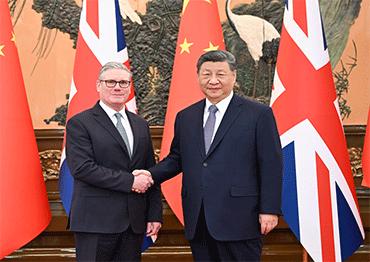
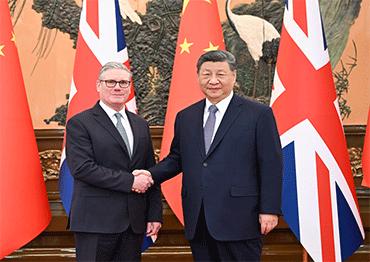
Chinese President Xi Jinping meets with British Prime Minister Keir Starmer at The Great Hall of the People in Beijing, January 29, 2026 (Photo by Xinhua)

From January 28 to 31, British Prime Minister Keir Starmer embarked on a closely watched trip to China aimed at recalibrating diplomatic and economic ties and exploring opportunities for renewed cooperation. 

As the first visit by a British prime minister since Theresa May’s trip in 2018, Starmer’s visit marked a clear departure from the approach of previous UK governments. China and the UK agreed to forge a “global comprehensive strategic partnership” in 2015 under the government of former prime minister David Cameron. However, the so-called “Golden Era” of China-UK relations proved to be short-lived. As the UK decided to leave the European Union and the US launched a trade war against China during US President Donald Trump’s first term as president, the UK aligned itself more closely with Washington on China-related issues. 

In the years that followed, the British government adopted an increasingly distant and confrontational posture toward China, banning Huawei from its 5G network, removing Chinese firms from future nuclear projects, sanctioning Chinese officials over Xinjiang Uygur Autonomous Region and intervening in the 2019 Hong Kong unrest. Together, these moves pushed bilateral relations into what Starmer later described as an “ice age.”  

That approach came under strain after Trump returned to office for a second term in January 2025. Washington’s aggressive use of tariffs, pressure on allies to decouple from China, erratic diplomacy and renewed pledges to seize control of Greenland, an autonomous territory of Denmark, have unsettled European capitals, including London. At the same time, the UK’s post-Brexit economy has been weighed down by weak growth, stagnant investment and declining exports. 

New Trajectory 
Against this backdrop, Starmer, who took office in July 2024, pledged to recalibrate the UK’s China policy. In November 2024, he met with Chinese President Xi Jinping on the sidelines of the G20 summit in Rio de Janeiro, Brazil, where both leaders agreed to stabilize bilateral ties.  

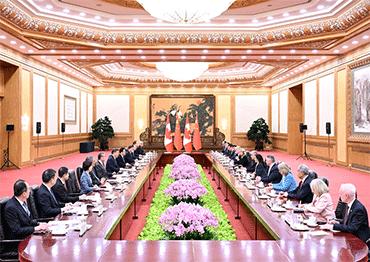
In Beijing, Starmer told President Xi that it had been “too long” since a British prime minister last visited the country. Acknowledging that “China is a vital player on the global stage,” Starmer said it was essential for the UK to build a more “sophisticated relationship” with China. He also met with Premier Li Qiang before traveling to Shanghai to engage with business leaders.  

Xi said China and the UK should work toward a “long-term, stable comprehensive strategic partnership.” The two countries “need to view history from a broader perspective, rise above differences, respect each other and turn the vast potential of China-UK cooperation into real progress,” Xi said. He added that he hoped the British side would provide “an equal, fair and nondiscriminatory business environment for Chinese enterprises.”  

Xi called on the two countries to jointly advocate and practice “true multilateralism” and to “build an equal and orderly multipolar world and realize universally beneficial and inclusive globalization.”  

The two sides reached a series of agreements aimed at restoring dialogue mechanisms and removing accumulated diplomatic obstacles, expanding trade and promoting investment cooperation.  

According to China’s Foreign Ministry, the two countries agreed to establish a high-level bilateral climate and nature partnership and to resume a high-level security dialogue. Institutional dialogues are planned for later this year, including the strategic dialogue, an economic and financial dialogue, and a meeting of the China-Britain Joint Economic and Trade Commission. These mechanisms resumed in 2025 after several years of suspension. China will also reduce tariffs on imported British whisky from 10 to 5 percent.  

In a notable thaw, Beijing and London agreed in principle to restore normal exchanges between their legislative bodies. China will also consider granting visa-free access for British travelers. Just one week prior to Starmer’s visit, the UK approved China’s plans to build a new embassy in central London, bringing an end to an application process that had been stalled for several years.  

On the economic front, the two governments signed 12 intergovernmental cooperation agreements covering trade and economy, agriculture and food, culture, market regulation and law enforcement. The two sides will also hold the first meeting of the China-Britain Financial Working Group and the China-Britain Insurance Forum.  

The Bank of China’s London branch was designated as the UK’s second Chinese yuan clearing bank, broadening the range of services available to UK businesses trading with China and reinforcing London’s role as a leading global center for cross-border finance.  

Starmer led a delegation of about 60 representatives from the UK’s business and cultural sectors. During the visit, the two sides announced a series of investment deals. On the Chinese side, Pop Mart, the maker of the viral Labubu collectible doll, said it would establish its regional hub in London and open seven stores across the UK. Chinese automaker Chery confirmed plans to set up its European headquarters in Liverpool, while battery manufacturer HiTHIUM pledged a 200 million pound (US$274m) investment in UK energy storage projects.  

From the British side, pharmaceutical giant AstraZeneca committed 15 billion pounds (US$20.6b) to expand its research and development programs in China, while Welsh supplements manufacturer Cultech entered a partnership with China Resources aimed at generating 90 million pounds (US$123.3m) in exports. Separately, on January 30, British energy company Octopus Energy Group, whose CEO was part of the delegation, announced a joint venture with Chinese investment firm PCG Power.  

In a video posted on social media on January 31, Starmer said China-UK relations were on a new trajectory. “China is the second-largest economy in the world. There are great opportunities here, and we have to seize them, always acting in our national interest,” he said. 

Broader Trend 
Although modest in scope, Starmer��s trip carried significant symbolic weight. Just days earlier, Canadian Prime Minister Mark Carney had returned from Beijing declaring a “new strategic partnership” with China and outlining what analysts have dubbed the “Carney doctrine” in a speech at the World Economic Forum Annual Meeting 2026 in Davos, Switzerland. 
 
Calling on middle powers to unite and coordinate more closely and to diversify their economic and strategic partnerships to reduce overdependence on the US, Carney openly questioned the durability of the US-led international order. His remarks resonated widely among Western participants in Davos.  

Although Starmer has not adopted language as explicit as Carney’s, the timing of his China visit raises a broader question: whether Washington’s European allies, including Canada and the UK, are beginning to reassess how they engage China in a changing global order.  

The trend appears to be underway. Starmer’s trip is the latest in a series of high-level visits by Western leaders to Beijing, many of which marked their first leader-level trips to China in nearly a decade. In January alone, Beijing hosted Irish Taoiseach Micheál Martin, the first Irish leader to visit China since 2012, Finnish Prime Minister Petteri Orpo, the first since 2017, as well as Carney, also making the first visit by Canada’s leader since 2017.  

In December 2025, French President Emmanuel Macron paid his first official visit to China since April 2023, while Spain’s King Felipe VI traveled to Beijing in November, marking the first visit by a Spanish monarch in 18 years. German Chancellor Friedrich Merz is also reportedly preparing for his first trip to China in late February.  

For many observers, Starmer’s visit is not an isolated diplomatic gesture but part of a broader Western re-evaluation, in which engagement with China is no longer driven primarily by ideological alignment but framed as a form of risk management in an increasingly unpredictable world.  

“Starmer’s visit adds significant weight to the current wave of high-level interactions between China and European countries, providing an important window for observers to assess both the UK’s foreign policy and the development of China-Europe relations,” Feng Zhongping, director of the European Studies Institute at the Chinese Academy of Social Sciences, told NewsChina.  

Feng noted that although the UK has left the EU, it continues to wield considerable influence in European affairs. Less than two weeks prior to Starmer’s visit to China, the UK participated in a joint statement by eight European countries reaffirming support for Greenland’s sovereignty, a move that prompted Trump to threaten 100 percent tariffs on those countries.  

According to Chen Yang, a director at the China Institutes of Contemporary International Relations, as a permanent member of the UN Security Council, the UK’s decision to strengthen cooperation with China carries strong symbolic significance.  

Chen noted that in recent years, the EU has described China as “a partner for cooperation, an economic competitor and a systemic rival,” a stance mirrored by the UK. He argued that by overemphasizing competition and framing the relationship in adversarial terms, this “triptych” framework has inflicted significant damage on European and British ties with China.  

Chen added that the significance of Starmer’s visit lies in its role as a course correction, addressing the misapplication of the “triple positioning” approach. By reaffirming cooperation as the defining feature of the bilateral relationship, the visit has helped reinvigorate its positive dimensions.  

This has long been China’s position on China-Europe relations. On January 28, China’s Foreign Minister Wang Yi said China and the EU are partners, not rivals, during a phone call with Emmanuel Bonne, diplomatic adviser to the French president.  

Wang said China and the EU share similar positions on promoting multipolarity and can resolve trade disputes through dialogue.  

Stressing that recent visits to China by several European leaders have advanced China-Europe relations, Wang said that China and the EU should “further enhance communication, promote mutual trust, and deepen cooperation,” according to the Xinhua News Agency.  

According to Qu Hongbin, former chief China economist and co-head of Asia economic research at HSBC, there is significant untapped potential in China-Western cooperation.  

“The experiences of China-Canada and China-UK relations show that cooperation between developed economies and China is not a zero-sum game,” he wrote in a recent post on the China Chief Economist Forum’s WeChat account.  

“Resource-rich countries gain stable markets, manufacturing nations secure reliable supplies, and service-oriented economies capture increased consumption, while major consumer markets gain access to high-quality goods. Together, this creates value across the entire supply chain and boosts public welfare for all involved,” Qu added. 
A Harry Potter merchandise display in a department store at Wangfujing, a popular shopping street in Beijing, August 5, 2024 (Photo by VCG)

A child plays a ball game in front of the Netherlands booth during a European culture event held in Chengdu, Sichuan Province, April 12, 2025 (Photo by VCG)

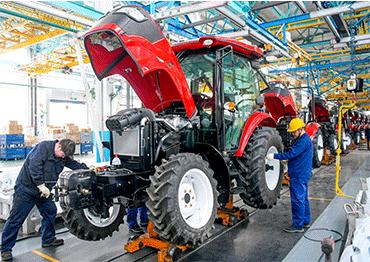
Workers at a tractor plant assemble a tractor for export to Europe, Luoyang, Henan Province, May 11, 2023 (Photo by VCG)

Old Constraints 
Despite improving relations between China and individual Western countries, there is little sign that the EU as a bloc is shifting its stance on China. On January 20, the EU unveiled plans to ban “high-risk” suppliers from public procurement in critical sectors and to require telecommunications networks to remove relevant equipment within three years. Although the measures did not name specific companies or countries, they are widely seen as primarily targeting Chinese firms.  

On February 3, the EU launched a formal investigation into Chinese wind turbine maker Goldwind under the EU’s Foreign Subsidies Regulation. Both developments triggered strong criticism from China. On February 4, Foreign Ministry spokesperson Lin Jian said the probe amounted to protectionism and that China was determined to safeguard the legitimate rights and interests of its enterprises.  

According to Jian Junbo, an associate professor at the Center for China-EU Relations at Fudan University, Europe’s reliance on the US security umbrella and the American market makes a major overhaul of transatlantic relations unlikely in the foreseeable future, despite tensions over issues such as Greenland.  

“What Europe is most likely to do is maintain a measured distance from the US, using diversified trade policies and free trade agreements with other major powers to hedge against pressure and gain leverage in dealings with Washington,” Jian told NewsChina. ��

As transatlantic relations continue to evolve, it remains to be seen how far Western “middle powers” will go in readjusting their engagement with China.

Print