Old Version
International

A New Strategic Partnership?

Canadian Prime Minister Mark Carney’s visit to Beijing signals a careful recalibration of Canada-China relations, expanding trade and strategic ties while navigating the constraints of Ottawa’s relationship with Washington

By Yu Xiaodong Updated Apr.1

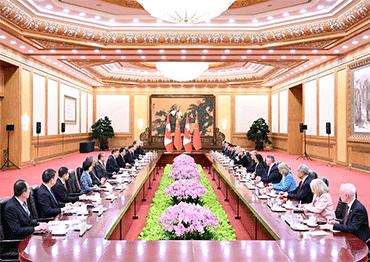
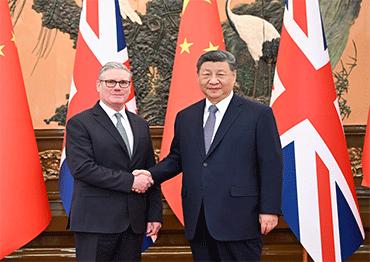
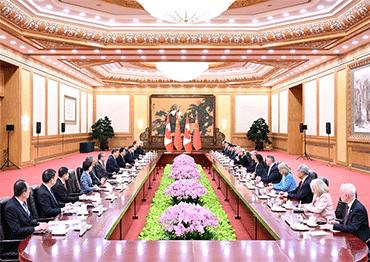
Chinese President Xi Jinping meets with Canadian Prime Minister Mark Carney in the Great Hall of the People, Beijing, January 16, 2026 (Photo by Xinhua)

We are forging a new strategic partnership that builds on the best of our past, reflects the world as it is today, and benefits the people of both our nations,” Canadian Prime Minister Mark Carney told reporters after returning from his landmark visit to China. 

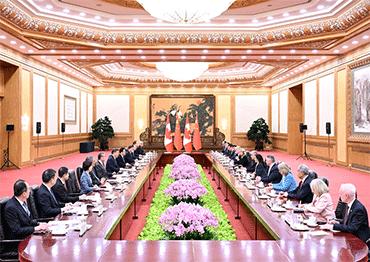
On January 16, Chinese President Xi Jinping met with Carney in Beijing. Chinese Premier Li Qiang also met with Carney on January 15. A joint statement of the China-Canada Leaders’ Meeting was issued after the Xi-Carney meeting, declaring to be “committed to advancing the China-Canada new Strategic Partnership,” and to enhance cooperation and exchanges on a variety of areas, including economy, trade, finance, public security and safety, people-to-people exchanges and multilateralism. Cooperation documents were also signed, covering food, energy, culture, and others.  

It was the first trip by a Canadian prime minister to China since 2017, indicating a major shift in Ottawa’s approach in its policy toward Beijing. 

Turning Point 
Over the past decade, China-Canada relations have been marked by recurrent tensions that eroded mutual trust and cooperation. The rupture began in December 2018 when Canada arrested Huawei executive Meng Wanzhou at Washington’s request, triggering major diplomatic tensions.  

In the years that followed, trade frictions intensified as Ottawa excluded Chinese firms from critical infrastructure projects over alleged security concerns, which China responded to by imposing restrictions on key Canadian exports such as canola and other agricultural products.  

More recently in October 2024, Canada slapped 100 percent tariffs on Chinese electric vehicles, in line with a  similar move  by the US a few months before, and 25 percent tariffs on Chinese steel and aluminum products. China retaliated with 100 percent tariffs on Canadian rapeseed oil, canola oil and meal, peas and related products, and 25 percent tariffs on pork and seafood products.  

Due to the tit-for-tat trade disputes, bilateral trade dropped to US$89.6 billion in 2025, down by 3.6 percent in 2024, according to official data released by China’s General Administration of Customs.  

According to Zhang Xiaoyi, a professor at the Canadian Studies Center at Beijing Foreign Studies University, the deterioration in the bilateral relationship stemmed from Canada’s close alignment with the US.  

“The [previous Justin] Trudeau government pursued an ultra pro-US stance, prioritizing alignment with Washington at the expense of bilateral relations with China. As a result, it adopted a confrontational approach toward China across political, economic, diplomatic and security spheres that pushed bilateral relations to a low point,” Zhang told NewsChina.  

However, after US President Donald Trump took office for his second term in January 2025, Canada faced a series of assertive pressures from Washington. In the first months of the year, the US moved to impose steep tariffs on Canadian imports, triggering fears of a full-scale trade war that would disrupt cross-border economic ties. Trump also repeatedly teased the idea that Canada should become the US’s “51st state” and referred to its prime minister as “governor,” which was widely criticized in Ottawa as undermining Canadian sovereignty.  

Trump’s talk of Greenland as a strategic asset and the possibility of annexing the island with force led to heightened anxiety over Canada’s own vulnerability against US ambitions, and intensified debates on Canada’s reliance on the US and the urgency to diversify economic and strategic partnerships.  

These concerns prompted Carney, who took office in March 2025, to adopt a policy to diversify economic partnership and recalibrate foreign policy, contributing to a broader policy shift toward more balanced engagement with China.  

On October 31, 2025, Carney met with President Xi on the sidelines of the Asia-Pacific Economic Cooperation (APEC) summit in Gyeongju, South Korea. Following the meeting, Carney spoke to reporters about a shift in Canada-China relations.  

“We now have a turning point in the relationship, a turning point that creates opportunities for Canadian families, for Canadian businesses and Canadian workers, and also creates a path to address current issues,” Carney said.  

In Beijing, Carney reaffirmed Canada’s policy shift on China. Describing Canada’s relationship with China as “more predictable and effective” than that with the US, Carney appeared very candid about the link between his policy shift on China and its strained ties with the US. 
 
Speaking to reporters after his meeting with Xi, Carney stressed that nearly a decade of a “distant and uncertain” relationship with China had not only “held back investment” and “stalled growth,” but also “has the consequences of leaving us even more dependent on our largest trade partner,” the US.  

“This is why Canada’s new government began to recalibrate our relationship with China – strategically, pragmatically and decisively,” Carney added.

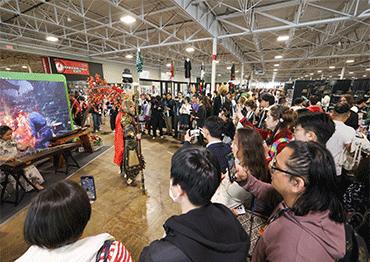
A man cosplays as the lead character from the action RPG game Wukong: Black Myth at an anime and gaming expo in Toronto, Canada, May 25, 2025 (Photo by VCG)

People from Southwest China’s Sichuan Province demonstrate how tofu pudding is made at the 6th China Cultural and Arts Festival held in Vancouver, Canada, September 15, 2024 (Photo by VCG)

Cooperation Roadmap 
During Carney’s visit, the two countries agreed to establish a new strategic partnership and signed the Economic and Trade Cooperation Roadmap, aimed at deepening bilateral ties.  

According to the joint China-Canada statement on January 16, the two sides reinvigorated and set up several senior dialogue mechanisms, including the high-level Economic and Financial Strategic Dialogue (EFSD), the Joint Economic and Trade Commission (JETC), the Joint Agriculture Committee and the Joint Committee on Culture. The two sides also signed agreements covering eight key areas, including trade, agriculture, green technology, e-commerce and financial cooperation.  

To promote cooperation on clean energy and fossil fuels, the two sides agreed to reopen ministerial-level talks, which would allow Canada to import clean-energy technology from China and potentially increase Canadian fossil fuel exports to China.  

The two sides also reached a preliminary trade deal aimed at reducing tariffs, including Canada’s commitment to allow up to 49,000 Chinese electric vehicles into the Canadian market under the most-favored-nation tariff rate of 6.1 percent, down from 100 percent. In return, Beijing will cut duties on Canadian agricultural exports, including on canola seed oil, which will see tariffs drop to 15 percent from March 1. Anti-dumping and countervailing measures on Canadian rapeseed meal, lobster, crab, peas and other products will be lifted.  

In his remarks after his meeting with Xi, Carney said the new strategic partnership between China and Canada will be established on five pillars: energy cooperation, bilateral trade, commitment to multilateralism, public safety and security, and people-to people ties. With improved ties, Carney said Canada has set an ambitious goal of increasing its exports to China by 50 percent by 2030.  

China has long been Canada’s second-largest trading partner after the US, but it accounts for only 5-7 percent of total Canadian trade, compared with roughly 75 percent for the US.  

Carney said that with the new strategic partnership, the two countries will expand two-way investment. “We will also expand Canadian investment in China in sectors such as service, energy, aerospace, agriculture and advanced manufacturing,” Carney said. “We welcome Chinese business plans to significantly scale up their investments in Canada – in major clean energy projects, as well as agriculture and consumer products.” The web site of the Prime Minister of Canada said on January 16 that the electric vehicles agreement is expected to “drive considerable new Chinese joint-venture investment in Canada” “within three years.”  

For his part, Xi said that China and Canada should be partners of mutual respect, common development, mutual trust and collaboration. “The essence of China-Canada economic and trade relations is mutual benefit and win-win cooperation, with both sides benefiting from cooperation,” Xi said.  

Both leaders emphasized the importance of promoting people-to-people and cultural exchanges. According to Carney, China has pledged to include Canada in its visa-free travel arrangement, though China has not yet officially announced that as of time of press. 

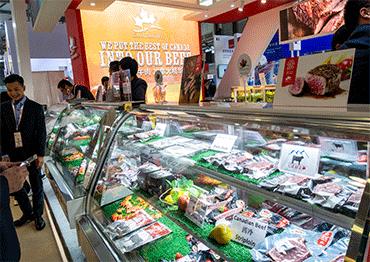
Canadian beef is displayed at the 22nd International Exhibition of Food & Drink, Shanghai, November 13, 2018 (Photo by VCG)

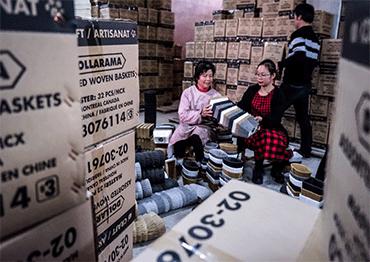
Workers prepare stacks of bamboo baskets for export to Canada, Hengxian, Guangxi Zhuang Autonomous Region, March 4, 2019 (Photo by VCG)

US Influence 
While Carney’s trip focused primarily on promoting economic cooperation and trade, its timing, amid widening rifts between the US and its Western allies that are fueled by Trump’s “America First” agenda and intensified by disputes such as Greenland, prompted speculation about the broader geopolitical significance.  

On January 20, just three days after his visit to China, Carney delivered a well-received keynote speech at the World Economic Forum Annual Meeting 2026 in Davos, Switzerland.  

Emphasizing there is “a rupture in the world order,” Carney said that middle powers like Canada can no longer pretend that the US-led “rules-based international order” still exists in a world “where the large, main power, geopolitics, is submitted to no limits, no constraints.”  

Calling it “partially false” and a “pleasant fiction,” Carney declared Canada “the first” to wake up to the reality and that it has decided to “fundamentally shift our strategic posture.”  

Pointing out that Canada has signed 12 trade and security deals on four continents in six months, including with China, Carney said that Canada is diversifying to “hedge against uncertainties.” Carney also stressed that Canada “stands firmly” with Greenland and Denmark, and “fully supports their unique right to determine Greenland’s future.”  

Without directly naming the US, Carney’s remarks were widely interpreted as a veiled critique of recent US actions and policies, which quickly drew sharp criticism from Trump.  

During Carney’s visit to Beijing, Trump publicly said it was fine for Carney to pursue a deal with China. “If you can get a deal with China, you should do that,” Trump told reporters at the White House. 

After Carney’s outspoken Davos speech, however, Trump threatened to impose a “100 percent tariff” on Canadian goods if Ottawa pursues a comprehensive trade deal with Beijing, framing such a deal as undermining US interests.  

In response, Carney emphasized that Canada has no plans to pursue a full free-trade agreement with China and that the recent tariff changes are limited in scope. Canadian officials reaffirm Canada’s commitments under the United States-Mexico-Canada Agreement (USMCA).  

When asked about Trump’s threat against Canada, Guo Jiakun, a spokesperson for China’s Foreign Ministry said on January 26 that the trade arrangements between China and Canada are not directed at any third party. Guo stressed that “China holds that all countries should handle relations with each other in a win-win rather than zero-sum manner, and in a cooperative rather than confrontational way.”  

As the US continues to have strong influence on Canada’s foreign policy, some scholars have cautioned against overstating the significance of Carney’s trip to China.  

Zhang Juan, managing editor of the Chinese language US-China Perception Monitor  (zmyinxiang.org) launched by the Carter Center, warned in a commentary published on January 14 that while Trump’s pressure on traditional allies may have prompted them to seek to diversify their partnerships, these countries still must carefully balance growing engagement with China against their economic and security dependence on the US.  

While China can play a role in its export diversification strategy, Canada’s foreign policy will continue to center around the US in the foreseeable future, Zhang added.  

“Carney’s visit was neither a comprehensive pivot nor a full breakthrough. Rather, it amounted to a cautious testing of the possibilities for closer ties with China amid a turbulent international landscape,” Zhang said.  

Zhang’s view was echoed by Cheng Hongliang, a research fellow with the China Institutes of Contemporary International Relations in Beijing. In an interview with domestic media guancha. cn, Cheng said that as a key member of the US-led alliance system, the US still has a dominant influence on Canada’s foreign policy.  

As Washington now treats AI, energy and critical minerals as areas of strategic importance, any Chinese investment in these sectors will face both strong US and domestic opposition in Canada, Cheng added.  

According to Cheng, the significance of Carney’s visit is that with a more clear-eyed understanding of its relationship with the US, Canada no longer aligns its China policy with Washington’s.  

“From Canada’s standpoint, it may never fully escape US influence, but it will develop its relationship with China based on its own national interests with a more pragmatic approach,” Cheng said.

Print