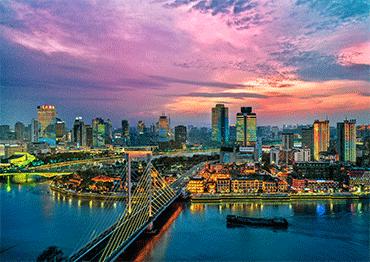
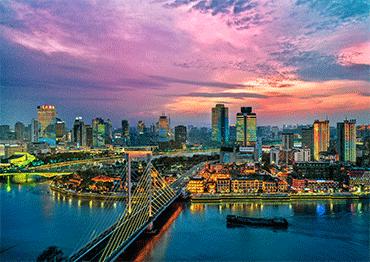
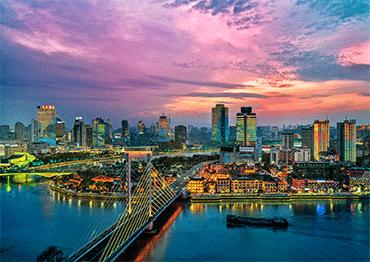
Ningbo, in East China’s Zhejiang Province, offers a fascinating glimpse into China’s relations with the world, both past and present. The city has been a trading hub since at least the Tang Dynasty (618-907), before becoming one of the ports opened to Western trade in the 19th century. In the last few decades, it has again become a magnet for foreign merchants.
Bounded on the east by the East China Sea, Ningbo sits in the Yangtze River Delta, with Shanghai looming large north across Hangzhou Bay.
The earliest evidence of human occupation dates back to the neolithic Hemudu culture, some 7,000 years ago. Eventually the important commercial port Mingzhou developed, becoming the starting point of Maritime Silk Road, where Chinese goods were sent to the world over the waves. The Ming Dynasty (1368-1644) brought a name change, as the city was no longer permitted to use the same name as the dynasty. Instead, it was given a rather poetic name, with ning meaning tranquil and bo meaning wave.
While tranquil waves can bring prosperity, the city’s new name did not ensure it saw perpetual peace. In the 16th century, following a brawl between rival delegations from Japanese clans, one clan pillaged the city and sparked a wave of piracy along the coast. In the 19th century, foreign forces would again come to the city, Ningbo was briefly occupied by the British during the First Opium War (1839-42) and was one of the five “treaty ports” opened to trade by the conflict.
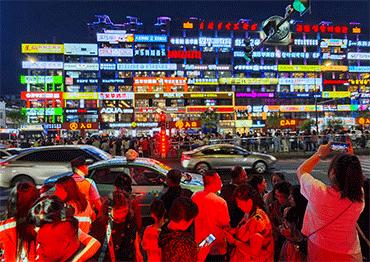
The most obvious remnant left by the British is the Laowaitan, or Old Bund, which sits at the intersection of the city’s three rivers. This small district was home to British and Dutch traders, as well as a customs house and post office. It’s reasonably well preserved, and as you walk along its stone-slab streets, you could imagine yourself transported back to the 19th century, as Chinese and European merchants haggled and sealed deals. At least, if you keep your eyes above first-floor level. Let your gaze drift down to street levels and you’ll find a tourist hub-come-bar street, with the streets lined with restaurants, cafes and quite a number of bars. After dark, the area turns into an LED kaleidoscope with thrumming music blaring out. Keep your eye out for a place posing as a traditional British pub. A Chinese bar tender dressed like a Downton Abbey butler in dark suit and black bowtie will bring you your Heineken and put on an off-kilter RP accent to ask if you “would like anything else, sir?”
Ningbo Museum can provide you another perspective on the history. While the museum has interesting exhibits about the city’s history, including some amusing mannequins of imperious English businessmen, it’s the building’s outstanding design that made its name. It is monumental, referencing the nearby mountains, with a facade formed of salvaged bricks from the city’s demolished residences and concrete textured to resemble bamboo. The building has been cut through with large voids and chasms, creating a roof-scape that calls to mind a traditional village.
If you want something a bit more ancient, you can visit what’s claimed to be Asia’s oldest still-standing private library, Tianyige Library. Located in the west of the city, it was built 500 years ago by Ming Dynasty military official Fan Qin, and some of the books and documents date back to the 11th century. The building is also an architectural gem typical of the period, with sweeping eaves and dark wood pillars lining its corridors. A century after it was completed, Fan Qin’s great-grandson renovated the pavilion by laying artistic rockeries, adding exquisite carvings and stone bridges, as well as planting flowers and bamboo. Some rocks are in the shape of Chinese characters meaning happiness, wealth and longevity. Others form an elephant, and yet others look like lions, though from a modern point of view they more resemble cute cartoonish cats. They’ve been adopted by netizens as the library’s mascots.
The library is adjacent to the man-made Moon Lake, which was built nearly 1,000 years ago. The lakeshore is dotted by traditional pavilions and elegant gardens. As water was a favorite inspiration of ancient literati, the lake was a hub for scholars and poets. Now, the literati are fewer but its still a hotspot for strolling locals, tai chi practitioners and people looking to take a quick nap on the lawn among the stray cats.
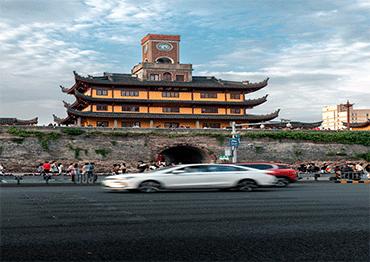
If you keep walking along the lake to the north, you’ll find an intriguing sight – The Drum Tower. This five-meter-tall gate in the old city wall is topped with a three-story yellow building with classic overhanging eaves. However, atop this very traditional Chinese building is a Western, Romanesque clock tower that chimes precisely on the hour. Walking through the 10-meter-wide wall mottled with moss and grass, a noisy commercial pedestrian street stretches in front of you. White brick-and-timber buildings line the main street, neatly separated by steeped “horse head” gables. They are now mostly turned into local shops, where you can find all kinds of antique products, from old books and paintings to ceramics and ancient coins. Its also a good place to try street food, hawked by bellowing local vendors.
Ningbo is also known for its food, especially savory dumplings, often stuffed with seafood, and sweet dumplings known as tangyuan. One dessert shop you shouldn’t miss in Ningbo is Gangyagou, a 100-year-old institution which serves dumplings fried in lard, boiled sticky rice balls served in the glutinous rice wine, “eight treasures” rice pudding and fruit dumplings. The store is now a local chain popular with locals.
As befits a port city, Ningbo is seafood mad. Crab, shrimps, mussels and a bewildering variety of fish cooked with bamboo shoots and pickled cabbage, blending the salty and fresh. A top dish is seafood noodles. Rich, long-simmered seafood soup is poured over chewy noodles, topped your choice of tender fish, chunky crab and mussels, pickled vegetables and ribbons of scrambled eggs. There’s no better way to have an oceanic feast.
Reflective of the city’s enduring status as an international trading hub, it’s easy to find a good-quality foreign meal in Ningbo, especially compared to other second or third tier cities. The city is home to half a dozen Indian restaurants. If you decide to sate your curry cravings, you might find yourself sharing the restaurant with a birthday party attended by a few local Indian families, with Bollywood movies projected on the wall outside.
Getting to Ningbo is very easy as it’s a major city in the region with high-speed rail and an international airport, as befits its status as a global trading hub. There are seven subway lines (and more on the way) so all the tourist spots are well linked and it is easy to travel both in the downtown or to the suburbs. The 37-kilometer Hangzhou Bay Bridge has cut the driving time between Shanghai to Ningbo from four to two hours.
Many will come to Ningbo to trade, but it is worth staying for the history too.
 Old Version