The speed limit itself is not new. It was first introduced in a 2018 safety specification, and is being enforced in the updated version.
“The rule is about safety,”said Zhang Ruihua, a director at the Tianjin Bicycle and Electric Vehicle Industry Association. “Over 25 kilometers per hour, braking distance gets dramatically longer as speed increases, and the fatality rate in moped accidents jumps from around 10 percent to more than 30 percent,” he told media.
According to a China Central Television report that aired on December 4, 2025, China has about 400 million electric mopeds and bikes. Data from the Road Traffic Safety Center under the Ministry of Public Security show that mopeds were involved in 10 percent of all urban road traffic accidents in 2024. The China Statistical Yearbook 2024 also found that deaths from moped-related accidents rose by an average of 5.85 percent annually between 2019 and 2023.
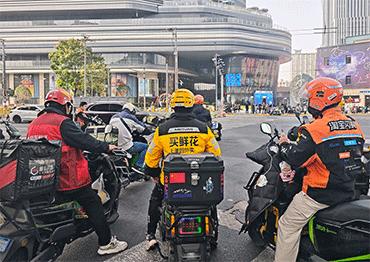
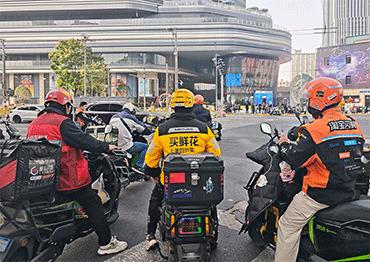
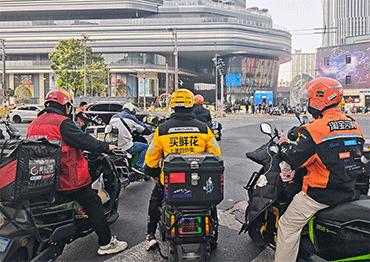
Delivery riders, however, say safety concerns often have to take a back seat.
“I usually go 40 to 50 kilometers per hour and work from 7 am to 8 pm. It takes me 50 to 60 orders a day to earn 300 to 500 yuan (US$43-71),” said Zhou Zhi, a Beijing-based delivery rider.
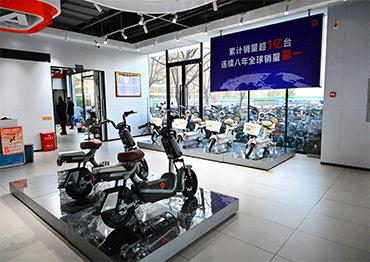
Although manufacturers and retailers are prohibited from selling mopeds without speed limiters, most delivery riders modify their vehicles to bypass the restrictions.
Wang Liang, a 20-year-old former delivery rider in Beijing, said his first moped was modified to reach a top speed of 40 kilometers per hour, but even that felt slow. “When I rode at around 30 kilometers per hour, everyone else was passing me, and I earned only about half of what other riders made,” he said.
He replaced it with another moped modified to hit over 60 kilometers per hour. “Then I could keep up with almost anyone,” he said.
Beijing roads typically have speed limits of between 50 and 80 kilometers per hour for motor vehicles, but electric mopeds are defined as non-motor vehicles and speeds are rarely monitored.
“Sixty kilometers per hour is dangerous,” Wang said. “But when I was new to delivery work, I got extremely nervous whenever I felt I was running out of time.” Wang recalled narrowly avoiding a collision with a truck while taking a turn at full speed.
Media often reports on delivery riders running red lights or riding against traffic to beat the clock. In response, major delivery platforms such as Meituan have replaced financial penalties for late deliveries with a points-based system.
Each rider starts with 12 points. When the number of points drops below three, the platform halves the number of orders a rider can receive. The account is suspended when the points reach zero. The system also deducts points for rider-related delays, excluding factors such as slow food preparation, incorrect addresses or traffic controls.
Even so, Zhou said the system does little to ease riders’ anxiety. “Losing points can mean fewer orders, or no orders at all. That’s even worse than losing money directly,” he said.
Adding to the pressure, platforms continue to emphasize speed in their marketing. During an interview in a residential compound in Beijing’s Chaoyang District, a NewsChina reporter saw a Meituan advertisement playing on an elevator screen, boasting that its one-to-one deliveries take 20 minutes less than average delivery times.
According to Zhou, riders can also be penalized for traffic violations if reported, further increasing the pressure.
“When restaurants are slow, we sometimes have only 10 to 15 minutes left to deliver an order,” he said. “Even riding at 40 or 50 kilometers per hour, we can’t always make it on time. If the speed is capped at 25, how is anyone supposed to deliver on time without breaking traffic rules? Even the best deliverer couldn’t do it.”
In one Douyin video, a rider in Guangdong Province tested the 25-kilometer-per-hour limit and found it took twice as long to deliver an order just two kilometers away.
“At that speed, we’d lose six points on a single order,” Zhou said. “Two orders later, we’d be blocked. It’s unimaginable. We’d lose our jobs.”
 Old Version