Old Version
Politics

Gateway to the World

With the launch of an island-wide free trade port featuring special customs operations for trade liberalization and investment facilitation, China is eyeing developing the province into a pivotal gateway that links it to the global economy through deeper opening-up and institutional innovation

By Yu Xiaodong Updated Mar.1

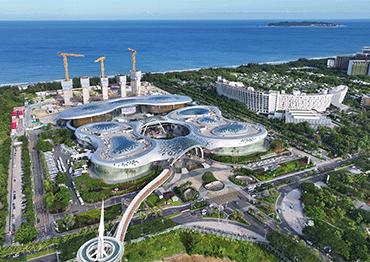
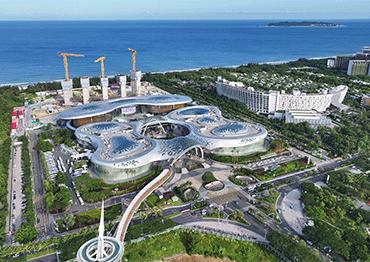
Sanya International Duty Free Shopping Complex, an integral part of Hainan Free TradePort, December 23, 2025 (Photo by VCG)

On December 18, China launched an island-wide “closed-loop” customs zone in Hainan Province, turning the tropical island in the South China Sea, covering more than 30,000 square kilometers, into the Hainan Free Trade Port (FTP), the world’s largest by area.  

Under the new arrangements, Hainan FTP will adopt a special “two-line” customs arrangement. The first line refers to trade between Hainan and overseas markets, through which 74 percent of overseas goods, up from 21 percent, can now enter Hainan with zero tariffs, value-added tax or consumption tax, as well as an expedited customs clearance process. While these goods can be used, traded and circulated freely within the province itself, they will be subject to the same import duties and taxes as foreign goods if they are shipped to other parts of China, through the “second line.” This system is officially described as “freer access at the first line, regulated access at the second line and free flows within the island.”  

To enhance Hainan’s role as a global trade and manufacturing hub, the island allows nationals from 86 countries to enter Hainan visa-free, granting eligible companies and talents access to a reduced 15 percent corporate income tax rate and 15 percent personal income tax rate. In addition, goods produced in Hainan using imported inputs can enter the rest of China duty-free if the value added in Hainan exceeds 30 percent, further enhancing Hainan’s role as a global trade and high-end manufacturing hub. 

From SEZ to FTP 
Designated a “special economic zone” in 1988, Hainan has rolled out various economic preferential policies as a testing ground for economic liberalization. Within China, its duty-free tax policies are a magnet for millions of domestic tourists, who enjoy its tropical sandy beaches while purchasing luxury goods without the tax burden found in the rest of China.  

In 2018, China announced a plan to develop Hainan into a “free trade port with Chinese characteristics.” In 2020, the central government issued the Hainan FTP Overall Scheme, outlining the strategic goal to transform Hainan into a globally influential high-level free trade port by 2035 and to begin island-wide special customs operations by the end of 2025. The plan serves as a blueprint for incremental reforms in trade, investment, taxation and regulation to deepen opening-up in the island province.  

In June 2021, China enacted the Hainan FTP law, the country’s first provincial-level FTP law, to provide the legal foundation for the institutional framework of the establishment of the Hainan FTP regarding customs, trade, investment, taxation and market access. In the meantime, Hainan provincial government rolled out a raft of zero-tariff policies over several stages for imported goods, including raw materials, production equipment, transport vehicles and yachts. 

These policies have already had a profound impact on the island’s economy and industrial landscape. In the five years since the Hainan FTP plan was released in 2020, the province has attracted 102.5 billion yuan (US$14.7b) in foreign direct investment, with an average annual growth of 14.6 percent. A total of 8,098 new foreign-invested enterprises from 176 countries and regions were established in that time, with an average annual growth of 43.7 percent.  

Meanwhile, trade in goods and services between Hainan and overseas markets expanded at average annual rates of 31.3 percent and 32.3 percent. In 2024, Hainan’s goods trade volume reached 277.65 billion yuan (US$39.8b), a 20 percent growth from 2023 and a threefold growth from 2019. Thanks to its tariff-free policies, Hainan is one of the few provinces and municipalities in China that runs a trade deficit, with imports in 2024 reaching US$24.1 billion in 2024, almost triple the US$5.1 billion recorded in 2021.  

After the new scheme kicks in, there has been a quick and warm response from consumers in and beyond China. Citing data provided by major travel platforms Tongcheng Travel and Qunar, Chinese media the Global Times reported on December 26 that hotel bookings in Hainan rose by more than 20 percent month-on-month in the week immediately following the launch of the island-wide special customs operations, and international air tickets booked to Haikou, Hainan’s capital city, for the 2026 Spring Festival holidays in mid-February had more than doubled year-on-year. 

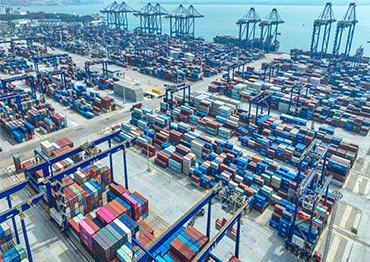
Shipping containers ffll Hainan’s Yangpu International Container Hub Port, November 23, 2025 (Photo by VCG)

Investment Highland 
The launch of the Hainan special customs zone in December 2025 is believed to mark a milestone development with the ambition to position Hainan not just as a regional duty-free zone, but more importantly, as a testing ground for further opening up at the institutional level. 

Companies in Hainan now have free flow of capital with their overseas business partners by establishing an Electronic Fence Account (EF Account), officially known as a multi-functional free trade account, at Hainan branches of major Chinese banks. The transactions can be done online.  

According to the People’s Bank of China, the country’s central bank, since the launch of this operation in May 2024 to the end of November 2025, 729 EF accounts had been established with 11 banks, with a combined transaction settlement of 295 billion yuan (US$42b) with 80 countries and regions, covering transactions such as foreign exchange trading of banks, cross-border trade payment, loans and external debts. According to Zheng Yuhua, general manager of Hainan Special Economic Zone East-Lake Hi-Tech Investment, an investment and development vehicle company focusing on fostering high-tech and industrial clusters, the new policies are particularly appealing to two types of firms: processing enterprises that source raw materials overseas while selling into the Chinese mainland, and export-oriented companies seeking to use Hainan as a gateway to global markets.  

“Industries characterized by high tariffs, high value added and relatively low logistics costs, such as bio-pharmaceutical companies that rely on imported inputs and equipment, as well as high-end manufacturers dependent on imported core components, stand to benefit most from the policies,” Zheng told NewsChina.  

Zheng’s company operates Donghu Hi-Tech Haikou Bio-City, which has attracted more than 170 companies across sectors such as bio-pharmaceuticals and medical devices, including multinational corporations listed on the Fortune Global 500.  

Mingyang Smart Energy, a leading player in offshore wind power, was among the early corporate entrants to Hainan. In December 2021, the company began construction of a high-end offshore wind equipment manufacturing base in the province, which has since entered production.  

A Mingyang executive told NewsChina that compared with coastal bases on the mainland, Hainan offers irreplaceable advantages for serving international markets, particularly in Southeast Asia and Oceania, thanks to its geographical location, policy openness and institutional innovation.  

Following the full launch of Hainan customs zone, the executive said that import costs for specialized steel, composite materials, core components and intelligent manufacturing and maintenance equipment required for large offshore turbines are expected to fall significantly. Combined with the 15 percent corporate income tax incentive, these advantages are especially compelling for the capital-intensive wind power sector, where investment horizons are long and returns take time to materialize. 
Foreign tourists take a photo next to a rock inscribed with the Chinese character for love in Luhuitou Park, Sanya, Hainan Province, December 18, 2025. The day also marked the start of the island-wide special customs zone (Photo by VCG)

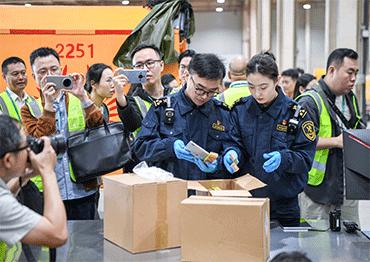
Customs offfcers complete clearance procedures for the ffrst batch of goods sold under the processing value-added 30 percent tariff exemption policy from the island to the Chinese mainland, Haikou Meilan International Airport, Hainan Province, December 18, 2025 (Photo by VCG)

Challenges Ahead 
While the new policies have begun to draw investors’ attention to Hainan, policymakers have made clear that they do not intend to turn the island into a tax haven by attracting shell companies that register locally without substantive business operations.  

In designing the province’s tax regime, Hainan built in clear constraints to curb arbitrage. For example, the 15 percent corporate income tax rate applies only to encouraged industries and is conditional on “substantive operations,” including real offices, staff and business activities.  

Zheng Yuhua said the industrial park she works in adopts a screening mechanism centered on substantive operations, requiring companies to break ground and begin production within defined timeframes, while imposing higher entry thresholds to pure trading firms or companies lacking R&D and manufacturing foundations. 

According to Li Shijie, president of the Hainan Province Open Economy Research Institute, in the past, many industrial parks offered cash subsidies in their investment promotion efforts, leaving much room for arbitrage. But after the 2024 Regulations on Fair Competition Review came into effect in August 2024, these tax rebate schemes have been suspended, effectively reducing opportunities for companies to exploit policy loopholes.  

Li cautioned against using staff headcounts or social security contributions as screening tools, which he said could inadvertently deter genuinely operational firms. Instead, Li said the local government should focus on improving institutional establishment arrangements to allow market forces to determine whether a company can stay or leave.  

Despite the new policy incentives, Hainan still faces challenges attracting investors. Many companies reported that setting up factories in Hainan generally involves higher costs than on the mainland. Not only are industrial electricity prices considerably higher, local supply chains are underdeveloped. 

Showcase & Operations Hub 
Li Shijie told NewsChina that Hainan faces structural bottlenecks in both logistics and talent. As an island, the province faces high logistics costs and lower efficiency compared with the prosperous Yangtze River Delta and Pearl River Delta. With only around 10 million residents, Hainan also lacks both high-end scientific talent and basic labor.  

Although tax incentives can offset some costs, these fundamental constraints could dampen companies’ willingness to invest. Li said a top priority for Hainan FTP is building a stable, efficient system for key resources to ensure that talent, capital and labor can move freely to form the foundation for longterm industrial growth.  

For other experts, Hainan should employ its own advantages to explore a different development approach from other regions.  

Ruan Ning, head of the Haikou Cross-Border E-Commerce Association, said Hainan does not need to serve as a traditional manufacturing base. With supportive policies, the island can instead function as a showcase, operations hub and marketing center.  

“Major orders still require face-to-face meetings,” Ruan noted, adding that visa-free entry allows overseas buyers to visit Hainan, gain a deeper understanding of local industries and turn that insight into orders or investment. Even with higher logistics costs and the absence of traditional industrial clusters, companies can locate production in lower-cost regions while using Hainan for their headquarters, settlement and marketing functions, leveraging tax incentives and free cross-border capital flows under the FTP scheme. 

Ambitious Plans 
For Chi Fulin, president of the China Institute for Reform and Development, China holds far more ambitious plans for Hainan. “The central government’s plan to build Hainan into a free trade port is a forward-looking strategic move, designed to secure a competitive edge and greater initiative for China amid accelerating regional economic integration,” Chi said in an interview with outlet China Economy Weekly on December 15, 2025.  

Drawing lessons from free trade ports such as Dubai, Singapore and Hong Kong, he notes that Hainan’s role as an important gateway depends on the seamless combination of geographic advantages and high-level openness. Located at the heart of the Regional Comprehensive Economic Partnership region, the island’s strategic value lies in serving as a corporate and regional gateway, connecting China with ASEAN markets, Chi said.  

At the core of this strategy is the establishment of “two headquarters bases” – one for Chinese companies expanding into ASEAN markets and another for ASEAN and other foreign firms entering China. Chi stressed that experience from other free trade ports shows that concentrating headquarters helps companies coordinate regional supply chains and strengthen control.  

Li noted that in 2023, 8.5 percent of China’s direct investment in ASEAN flowed through Hainan FTP, signaling the island’s growing role as a bridge between the two markets. By prioritizing rapid development of the first headquarters base for Chinese firms, he said that Hainan should aim to accelerate the construction of both bases, solidifying its position as a strategic hub linking China and ASEAN, even as production and manufacturing remain concentrated in regions with lower costs.  

Ever since China launched its reform and opening-up in the late 1970s, special economic zones and free trade zones have acted as testing grounds for the country’s wider market opening and trade liberalization policies. Hainan FTP is no exception.  

In an article in Qiushi magazine, published under the Central Committee of the Communist Party of China in July 2025, Feng Fei, Hainan’s Party secretary, made clear that the plan marks a “strategic move” by China to “support and promote economic globalization, break through external containment and demonstrate through concrete actions China’s firm resolve to keep its door opening ever wider.”  

Given Hainan’s long-standing role as “a major national platform for comprehensive reform and opening-up,” Feng said that the province will continue to serve as a pioneer in major reforms, helping to propel the entire country to further deepen reform across the board to ever greater depth.  

Feng vowed the province will “forge an open institutional framework with international competitiveness, blaze a trail and set examples for China’s high-level opening-up, and support the building of a new, higher-standard open economic system.”

Print