Xu Bao’an spent his entire life fishing and raising a family as part of Honghu Lake’s boat-dwelling community. For generations, families lived exclusively on boats, owning no land or homes on shore. Xu recalled that in earlier years, each household had only a small wooden boat. As living standards improved, boats were outfitted with televisions, air conditioners and washing machines, and they bought separate vessels for work and fishing. Each household was also allocated 20 mu (13,333 square meters) of aquaculture waters in Lake Honghu, allowing families to supplement fishing income through fish farming.
At its peak, the lake supported 1,465 fishing households and more than 4,000 fishers, with rods and nets stretching across the water.
Lake Honghu collects runoff from more than 10,000 square kilometers of the Yangtze River Basin. But since the 1990s, overfishing and enclosed aquaculture have severely weakened its ecological functions. According to a 2014 report by the Hubei Daily, the lake suffered worsening water pollution, degradation of aquatic vegetation and sharp declines in wild aquatic species, especially fish and waterfowl. Surveys recorded 81 fish species before the 1970s. After river-lake connectivity was severed, that number fell to 57, with fish showing a clear trend toward smaller body sizes.
Mei Lianqing, a fisher from Meitan Village in Honghu, worked on the water for three decades before the fishing ban. After finishing primary school, he began fishing alongside his father. During the 1996 flood season, the two earned about 300,000 yuan (US$42,605) fishing in the Yangtze, enough to build a house and allow Mei to marry soon afterward. “Fish resources were abundant back then, and prices were good,” Mei said. He believed he would fish for the rest of his life.
Over time, the populations of major commercial species such as silver carp, bighead carp and tapertail anchovy plummeted. By the mid-2010s, Mei said, some species had disappeared from his nets altogether.
Honghu began implementing the fishing ban and promoting fishers’ resettlement in 2018, a process that proved far from easy.
Wan Kai oversaw the resettlement program. As a member of the Standing Committee of Honghu Municipal Party Committee, Wan recalled boarding fishing boats countless times to explain the policy to fishers. Their biggest concern, he said, was how they would make a living after giving up fishing, a trade passed down through generations.
Wan detailed the compensation package: each fishing license was reimbursed at 85,600 yuan (US$12,157), boats and gear were appraised on site by third-party agencies, typically yielding 3,000 to 6,000 yuan (US$426-852), and each household received a 5,000- yuan (US$710) vocational transition subsidy. Mei said that each retired fishing households in his village received about 120,000 yuan (US$17,040) total in subsidies. The city of Honghu also provided a one-time transitional living allowance of 31,500 yuan (US$4,474) per household.
In 2016, Honghu’s human resources bureau organized a job fair on the lake to assess fishers’ skills and employment preferences. Wang Huan, deputy director of the city’s Public Employment and Talent Service Center, told NewsChina that although the boats rocked violently in the wind, some fishers still came to learn about onshore job opportunities and wages.
Others were eager to move ashore. Xu Bao’an noted that life on the lake lacked access to education and healthcare and carried constant safety risks, especially during floods. To prevent accidents, fishers often tethered young children to their boats. Xu said that one of his younger sisters drowned after falling into the lake.
Many fishers still vividly remember the day they handed over their boats. Wang Linkun piloted his small motorboat ashore, where officials registered, photographed and appraised it. His houseboat was valued at less than 50,000 yuan (US$7,101), with compensation transferred directly to his bank account.
Official data shows that Honghu has retired 1,910 registered fishing boats and resettled all 3,417 local fishers.
Yang Nuo, a scholar from a Chinese university who has led surveys of retired Yangtze fishers, told NewsChina that most have little formal education and lack professional skills beyond fishing, limiting their employment options to low-skilled, low-wage jobs.
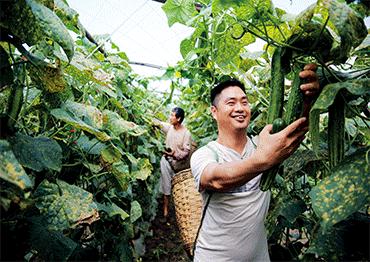
By the end of 2022, the central government had invested more than 26.9 billion yuan (US$3.82b) to help fishers transition to new livelihoods. Governments at all levels rolled out targeted measures, including resettlement subsidies, vocational training in aquaculture, logistics and tourism, and dedicated employment service windows. In Ma’anshan, Anhui Province, more than 10,000 fishers had resettled ashore by 2019, many shifting to aquaculture or joining river patrol teams. By 2023, all 4,674 employable fishers in the city had found jobs, with “fishing-to-farming” projects boosting 376 households’ annual income by an average of more than 80,000 yuan (US$11,361).
Today, Mei Lianqing works as a river patroller, guarding a stretch of the Yangtze near his home. Each morning at 6 am, he rides his motorcycle to the river dyke. The damp wind hits his face as he scans the riverbanks and shoals. When he spots illegal fishing or harvesting, he approaches and urges offenders to leave.
“No anglers found during today’s patrol,” Mei types, attaching a selfie by the river before posting his first update of the day to his patrol team’s WeChat group.
“This job requires a lot of persuasion, and it’s not easy,” Mei said. Honghu has 135.5 kilometers of Yangtze River shoreline, where living off the river remains a way of life. Poaching still occurs from time to time, with some locals fishing for leisure and others traveling from neighboring cities to cast their lines.

 Old Version