Old Version
International

Resetting Ties

South Korean President Lee Jae-myung’s state visit to China signals a strategic recalibration of China-South Korea relations, aiming to restore high-level dialogues, rebuild political trust and forge new economic cooperation amid shifting regional dynamics

By Yu Xiaodong Updated Mar.1

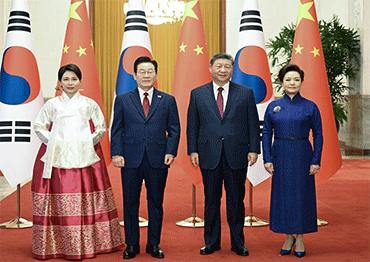
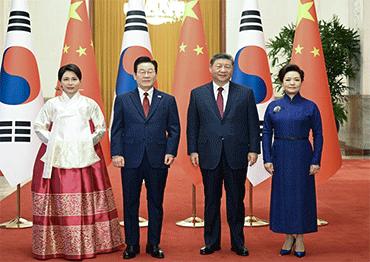
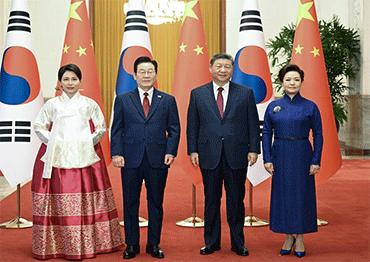
Chinese President Xi Jinping and his wife Peng Liyuan pose for a group photo with South Korean President Lee Jae-myung and his wife Kim Hea-kyung, Beijing, January 5, 2026 (Photo by Xinhua)

South Korean President Lee Jaemyung paid a four-day state visit to China from January 4 to 7, holding talks with Chinese President Xi Jinping in Beijing and visiting key historic sites in Shanghai. The meeting marked their second summit in two months, following Xi’s visit to South Korea in November to attend the 2025 APEC Economic Leaders’ Meeting in Busan. The visit is widely viewed as a significant step toward restoring China-South Korea relations, which had remained largely volatile over the past decade.

Ups and Downs 
China-South Korea relations have experienced considerable swings over the past decade under different administrations in Seoul. Bilateral ties reached a high point under South Korean president Park Geun-hye (2013-2017), as Seoul adopted a more balanced diplomatic approach toward major powers and elevated relations with China. In 2013, the two sides formally forged a “comprehensive strategic partnership,” leading to frequent high-level exchanges, strengthened political trust and rapidly expanding trade and people-to-people ties.  

Relations deteriorated sharply following South Korea’s decision to deploy the US THAAD missile defense system in 2016, marked by frozen dialogue and cooling economic and cultural exchanges. When president Moon Jae-in took office in 2017, his administration sought to repair ties by addressing China’s core security concerns, including the Terminal High-altitude Area Defense (THAAD) missile system. This helped stabilize ties and led to a gradual recovery in high-level engagement and economic cooperation.  

However, relations worsened again after Yoon Suk-yeol assumed the presidency in March 2022. Yoon adopted a explicitly “values-based” and alliance-centric foreign policy, aligning South Korea more closely with the US on regional security, supply chain restructuring and technology controls targeting China. His administration also made public statements on issues China considers core interests, including the South China Sea and the Taiwan question. As a result, China-South Korea relations entered a prolonged period of stagnation.  

By contrast, Lee has called for a more pragmatic and balanced foreign policy. Since taking office in June 2025, he has highlighted the need to restore stable relations with neighboring countries, particularly China. Lee has long argued that China is “a neighbor that cannot be ignored or replaced.” Warning against framing diplomacy in binary or ideological terms, he has made clear that excessive confrontation with China would carry economic and strategic costs for South Korea. 

‘Full Restoration’ 
Lee’s visit to China is widely interpreted as an effort to restore regular high-level dialogue, rebuild political trust and prevent bilateral ties from becoming further entangled in great power rivalry.  

During his meeting with Xi, Lee said that his visit would serve as “an important turning point in making 2026 the first year of a full restoration” of bilateral ties. “We will continue our unwavering efforts to develop our strategic cooperative partnership into an irreversible trend of the times,” Lee said, according to The Korea Herald.  

Pledging to work with China “in step with the changing currents of the times” and to “open a new phase” in bilateral relations, Lee said the two countries should “firmly strengthen the foundation of public goodwill that underpins the political basis of Korea-China relations.”  

For his part, Xi said that China has consistently placed relations with South Korea high on its regional diplomatic agenda and maintained continuity and stability in its policy toward the country. He added that China will work with South Korea to uphold the direction of friendly cooperation, adhere to the principle of mutual benefit and win-win outcomes, advance the bilateral strategic partnership along a healthy path, enhance the well-being of both peoples and contribute positively to regional and global peace and development.  

Following their meeting, the two leaders witnessed the signing of 15 cooperation documents covering areas including science and technology, ecological environment, transportation and economy and trade. 

Historical Bond 
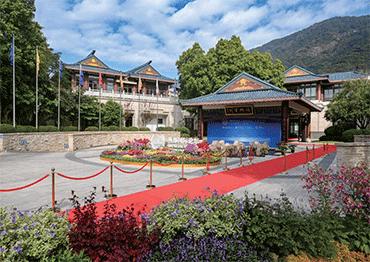
After Beijing, Lee flew to Shanghai on the final day of his trip, where he visited historical sites linked to Korea’s struggle for independence from Japanese colonial rule. At the former headquarters of the Provisional Government of the Republic of Korea in Shanghai, Lee expressed gratitude for China’s support of Korea’s independence movement and for the Chinese government’s efforts to preserve the site. “The history of Korea’s independence movement cannot be told without China,” Lee said, noting that China hosts nearly half of Korea’s independence movement sites, “making it the principal stage of our struggle.”  

The provisional government was established in April 1919, one month after Korea launched an independence movement against Japanese colonial rule which lasted from 1910 to 1945. Serving as the Korean government in exile, the provisional government was based in the Shanghai building from 1926 to 1932. Lee attended a ceremony marking the 100th anniversary of the building on January 7.  

Lee also visited a historical park in Shanghai where Korean independence fighter Yun Bong-gil (1908-1932) detonated a bomb during a Japanese military celebration in 1932, killing and fatally wounding several senior Japanese officials.  

Lee said the incident prompted the Chinese government at the time to formally recognize Korea’s provisional government in exile and helped rally independence forces scattered across the region. “Shanghai became a center of solidarity for freedom and dignity beyond borders,” Lee said.  

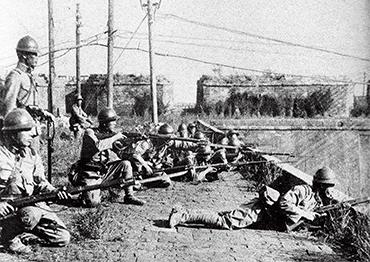
During their meeting in Beijing, both Xi and Lee highlighted the shared historical experience of resisting Japanese militarism. “Over 80 years ago, China and the ROK made great sacrifices in resisting Japanese militarism and achieved victory,” Xi said, according to China’s Foreign Ministry. “Today, it is all the more important for the two sides to join hands to defend the victories of World War II, and safeguard the peace and stability of Northeast Asia.”  

“Korea’s independence movement history forms the foundation of today’s Korea-China friendship and cooperation,” Lee said during his visit, according to The Korea Herald. “I believe that setting history right is the path to opening the future together,” he added. 

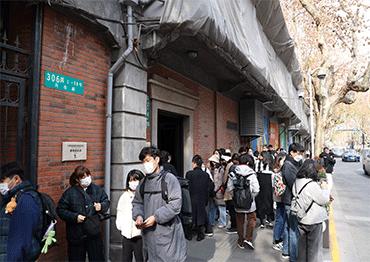
South Korean tourists visit the old site of the Provisional Government of the Republic of Korea, Shanghai, January 10, 2026 (Photo by VCG)

Common Ground 
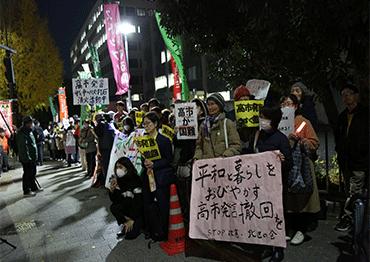
Against the backdrop of rising tensions between China and Japan following controversial comments by Japanese Prime Minister Sanae Takaichi in early December suggesting Japan could take military action in case of a “Taiwan contigency,” Lee’s visit to these historical sites in China and related remarks carry subtle but important political messages, both at home and abroad.  

Compared with his predecessor Yoon Suk-yeol, who prioritized rapid rapprochement with Japan to advance USled trilateral security cooperation, often sidelining historical justice and strong domestic opposition to what critics labeled “subordinate diplomacy,” Lee has argued that sustainable cooperation with Japan must rest on clear historical accountability and reciprocity, not unilateral concessions.  

While acknowledging the need for pragmatic engagement with Tokyo, Lee has emphasized a more conditional and interest-based approach. Many South Koreans share China’s concerns over Japan’s efforts to revise its pacifist constitution, especially under Takaichi, a well-known right-wing politician who took office in October 2025.  

In late November, South Korea’s National Assembly Speaker Woo Wonshik posted on social media platform X urging Japan to show sincere reflection on both historical and territorial issues. He warned that continued provocative statements by Tokyo risk destabilizing the region.  

During the same Diet session in November in which Takaichi made her “Taiwan contingency” remarks, she also reignited tensions with South Korea by reiterating Japan’s claim over the disputed islets known as Dokdo in Korea and Takeshima in Japan. Describing the islands, which are under Seoul’s control, as Japan’s “inherent territory,” Takaichi labeled Seoul’s administration an “illegal occupation,” prompting the South Korean government to issue a formal rebuttal.  

By visiting key historical sites in China, Lee’s trip may help South Korea find common ground with Beijing on historical issues while also shaping the agenda and tone for his planned midJanuary summit with Takaichi.  

Meanwhile, Lee made it clear that South Korea does not share Japan’s position on Taiwan.  

In an interview with China Central Television ahead of his state visit, Lee said South Korea would continue to respect the one-China policy on Taiwanrelated issues, describing it as a “core guideline” of bilateral relations.  

Lee reiterated this stance in his meeting with Xi, saying the South Korean side respects China’s core interests and major concerns and remains committed to the one-China stance, according to China’s Foreign Ministry. 

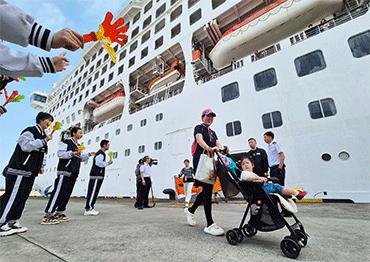
Chinese tourists disembark the cruise ship Dream at Jeju Island, South Korea, April 30, 2024. The voyage started at China’s Tianjin Port (Photo by VCG)

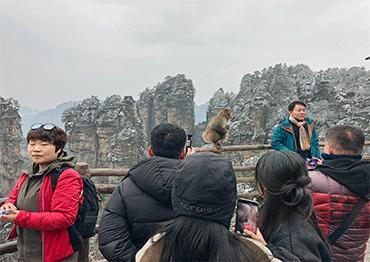
South Korean tourists visit Zhangjiajie National Forest Park, Zhangjiajie, Hunan Province, January 5, 2026 (Photo by VCG)

Economic Cooperation 
Besides political realignment and symbolism, a major focus of Lee’s visit was economic cooperation.  

Lee was accompanied by a business delegation of about 200 people, including the heads of South Korea’s four largest conglomerates Samsung, SK, Hyundai Motor Group and LG, as well as executives from the fashion, entertainment and gaming sectors. The previous instance of a South Korean leader traveling with a large business delegation was in December 2019, when then president Moon Jae-in led around 100 business representatives on his visit to China.  

“From China’s perspective, the meeting between President Xi and President Lee on the sidelines of the APEC summit last November reaffirmed the bilateral strategic cooperative partnership,” Li Min, an associate research fellow at the China Institute of International Studies, told NewsChina. 

“Lee’s follow-up visit, therefore, should focus on consolidating that framework and ensuring it is translated into substantive policy alignment rather than remaining largely symbolic,” Li added. 
 
Among the 15 agreements signed during the visit is a memorandum establishing a new commercial cooperation dialogue. The mechanism upgrades what had previously been sporadic ministerial-level talks between South Korea’s Ministry of Trade, Industry and Energy and China’s Ministry of Commerce into a regular channel for managing economic and trade issues.  

Amid strained relations, bilateral trade has stagnated in recent years. According to South Korean customs data, goods trade between China and South Korea reached US$272.9 billion in 2024, only 12 percent  up from the US$243.4 billion recorded in 2019.  

While China remains South Korea’s biggest trading partner, the structure of bilateral trade has changed substantively. In 2019, South Korea ran a trade surplus of US$28.97 billion with China. But starting in 2023, South Korea shifted to a trade deficit with China, reaching US$18 billion in 2023 and US$6.83 billion in 2024.  

Huang Fei, an associate professor at the Seoul School of Integrated Sciences and Technologies, said the reversal of South Korea’s long-standing trade surplus signals a structural turning point in China-South Korea trade relations.  

“For decades, bilateral trade was built on a model in which South Korea supplied high-end intermediate goods while China handled large-scale manufacturing and exports,” Huang said in an interview with Chinese financial outlet Yicai. “That model began to break down in 2023,” Huang added.  

Huang attributed the shift to China’s push for domestic substitution in sectors such as semiconductors, display panels, chemical materials and general components, which has sharply reduced reliance on South Korean imports. At the same time, rising global protectionism has reduced China’s processing exports to the US and Europe, prompting China to pivot toward Southeast Asia and other emerging markets, diminishing South Korea’s position as a key upstream supplier.  

“As the result, the once tightly coupled export-oriented industrial chains between the two countries are beginning to loosen,” Huang said. 
‘New Route’ 
Both sides appear keenly aware of the challenges. Speaking to business leaders at a forum held hours before the summit in Beijing, Lee called the two countries to “open a new route” for economic cooperation.  

Highlighting that bilateral trade peaked at around US$310.3 billion in 2022 before entering a downturn in 2023, Lee said that “it is precisely why charting new routes, and opening new markets, has become imperative.”  

Lee said consumer goods including household items, beauty products and food, along with cultural industries such as film, music, gaming and sports, could provide new avenues for growth.  

Huang said China and South Korea could also expand complementary cooperation in new energy, aging-related industries, the digital services trade and selected high-end manufacturing. These sectors, she said, feature more symmetrical demand and could help stabilize bilateral economic ties.  

Li Min added that while the “vertical division of labor” era that combined South Korea’s technology and capital with China’s land and low-cost labor had passed, businesses in both countries should explore high-level “horizontal division of labor” to enable mutual development. 

During Lee’s visit, the two countries also signed an agreement to strengthen cooperation for China-South Korea industrial parks, aimed at promoting trade and investment and supporting joint entry into third-country markets to deepen industrial and supply-chain ties.  

Despite the ongoing challenges, analysts said the most significant outcome of the Xi-Lee summit was the strong political will from both leaders to stabilize and promote bilateral relations.  

“One of the most important functions of head of state diplomacy is its steering role,” Li said. “Once the strategic direction is firmly set, even the inevitable disputes and tensions that emerge can be managed effectively.”  

“As long as both sides remain committed to improving ties and maintain a clear, shared vision, many specific disputes can be resolved,” Li added.

Print