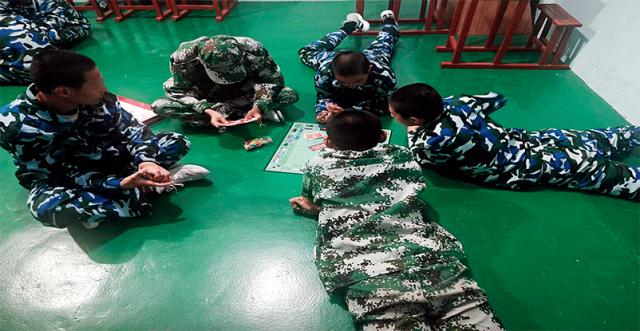
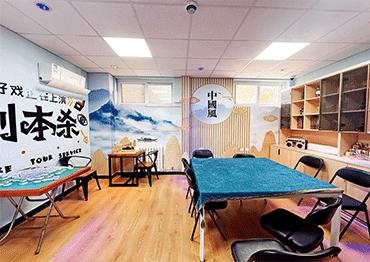
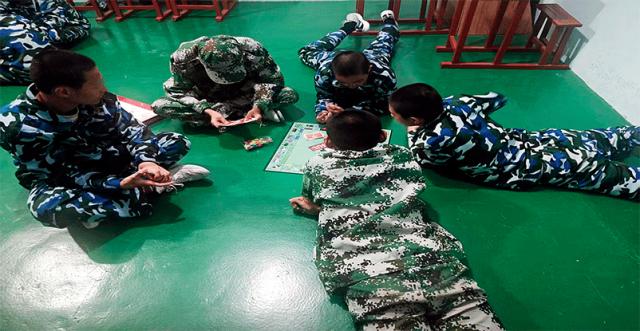
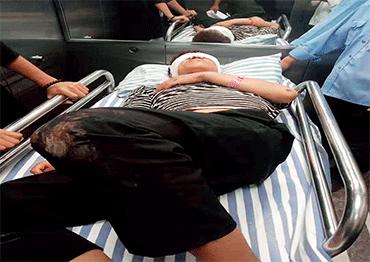
In previous years when such services and online courses were rarer, parents turned to “anti-internet addiction” centers. Many of them have since been exposed for physical and mental abuse of children.
In 2022, Zheng Xin sent her son to such a school, despite multiple media investigations into allegations of beatings, confinement and even electroshock therapy. Zheng said she paid 30,000 yuan (US$4,225) for seven months.
To this day, her son refuses to tell her what happened there. Zheng says guilt keeps her from asking.
“I regret sending him to the school. But there’s no medicine for remorse,” she said.
Li Chi, 24, told NewsChina his mother had him committed to Yuzhang Training School, a well-known internet addiction treatment center in Jiangxi Province, when he was a teenager in June 2016.
Upon arrival, Li claimed he was stripped down to his underpants and locked in a dark room for seven days. In his cell, he saw messages by other children scratched into the walls with their nails, reading “I hate my parents” and “Sorry, my father and mother.”
Soon after, Li attempted suicide by drinking laundry detergent and was then released to his mother. He had so much fear of being sent back that he stayed awake for three nights armed with a knife to fend off school employees.
“They usually carted off children at midnight,” Li said.
Li said he always left his window cracked open, giving himself an escape route in case they returned, even though the family lived on the seventh floor. A year later, authorities shut down Yuzhang Training School, charging them with “illegal confinement.”
Internet addiction centers have faced strong public criticism since at least 2009 for alleged physical abuse, yet they continue to operate, often rebranded as “behavior correction,” “quality training” or “summer camps.”
When NewsChina searched “internet addiction” on enterprise registration site qichacha.com, only a few inactive entities appeared. But a search for “behavior correction” returned 271 companies.
Social media outlet Lanzi Jihua estimates that at least 600 such institutions operate nationwide.
According to a 2010 survey by China Youth & Children Research Center, most minors are coerced or tricked into these facilities. Many lack qualified teachers or staff and routinely use corporal punishment and confinement.
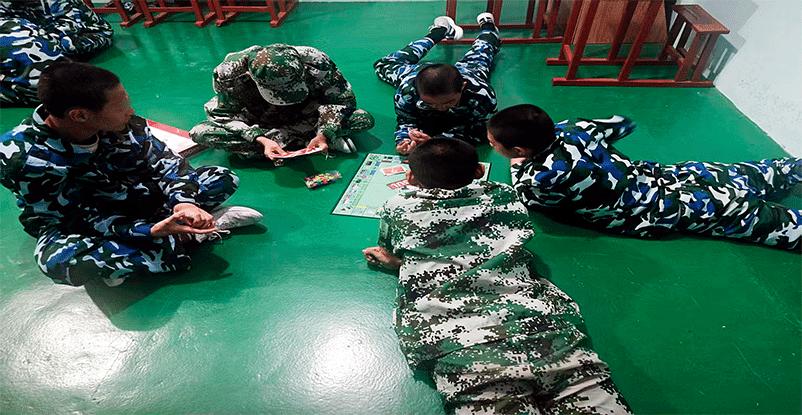
Xu Xiaoxi, 15, told NewsChina he was forced into a correction center by his parents in March 2025. The facility, located on the grounds of an abandoned primary school, was surrounded by high walls lined with barbed wire. When Xu resisted, several staff members allegedly struck him in the abdomen with a rod. They then threw him into a dark room and informed him he would undergo six months of “education.”
Xu later learned the program cost 28,000 yuan (US$3,950), money his mother had borrowed.
“Instructors beat students at any time and force them to train even while injured. Rods, clothes hangers and even stun batons were commonly used to punish those they saw as ‘disobedient,’” Xu claimed, adding that his arm still bears scars from a beating.
“The leaders supervise for ‘safety’ to avoid serious injuries or escapes. Punishment usually lasts about 45 minutes, and they ask students to sign forms saying they received it voluntarily,” Chen Jing, a former instructor at a Jiangxi Province facility, told NewsChina.
After leaving the center, Xu and several classmates reported it to local authorities and even the county mayor. But as their parents had signed an agreement with the institution, the complaint was forwarded back to the center. Several instructors visited Xu’s home, took him out to dinner and pressured him to withdraw the report. The case ended with the dismissal of the most violent instructor, but the center remains operational.
Yang Weihua, a lawyer at the Shanghai-based Dehehantong Law Offices, told NewsChina that gathering sufficient evidence of illegal confinement or child abuse is extremely difficult due to vague legal boundaries, the closed-off nature of these facilities and minors’ inability to collect evidence. “Unless something serious happens, it’s hard to bring a case,” he said.
Although some centers have shut down after media exposure and public criticism, many pop back up under new names. Because they are often registered as “non-enterprise organizations,” a status in China for social enterprises that combine commerce with charity, they fall under fragmented oversight from multiple authorities.
 Old Version