Old Version
Cover Story

Disconnected Relationships

Parents and children describe how online gaming has strained family ties amid a generational communication gap many find hard to bridge

By Xie Ying , Yue Qiuyuan , Ni Fenfen Updated Feb.1

I work hard, I never bow down to other people and I’ve never done anything bad, but my son is disappointing. Online games have harmed my family too much,” Zhu Qin told NewsChina after he finished his shift at a construction site in Huzhou, Zhejiang Province. He looked exhausted and sad, sweat dripping down his forehead and nose. Zhu’s teenage son had been accused of theft to get money for online games, media had reported.  

According to The Fifth National Survey Report on Internet Use Among Minors published by the Central Committee of the Communist Young League in December 2023, by the end of 2022, China had over 193 million internet users under 18, 97.2 percent of the total number of the age group. The internet penetration rate in primary school increased from 89.5 percent to 95.1 percent from 2018 to 2023. More than 90 percent of juveniles own internet-enabled devices, mostly mobile phones.  

The survey found that among young internet users in 2022, 67.8 percent play online games, with 32 percent using their parents’ accounts after China’s cyber authorities introduced restrictions on how much time children can spend on gaming.  

Besides, 51.8 percent of parents out of the 11,624 parents sampled said they have great concerns about children’s internet use, with time spent on gaming and short videos the biggest issues.  

Parents told NewsChina their relationships with children are deteriorating, and they are often struggling to reconnect. 

‘Totally Changed’ 
Wang Mingxiang, a 62-year-old single father in Southwest China, only found out how obsessed his son was with gaming when he discovered 20,000 yuan (US$2,817) was missing from his bank account. His son had stolen the money and spent it on online gaming.  

“That money was donated to me for my medical expenses,” Wang said, who has had kidney disease since 2019. He has to do dialysis every two days.  

Wang told NewsChina his son’s obsession started in 2022 when students were quarantined at home due to the Covid-19 pandemic and he had to use a mobile phone to take online classes. After successfully claiming the money back from the game developer, Wang threatened severe consequences if his son played the game again.  

But two days later, he was gaming again. He failed to get into high school, although he used to be a good student. Now, he boards during the week at a residential vocational high school. He goes home on weekends, but just plays games day and night, waiting for Wang to cook for him after he finishes his dialysis.  

Wang spoke of the closeness of their relationship before his son’s gaming addiction. “He went with me to my hospital appointments and comforted me during my dialysis... but after his gaming addiction, he totally changed and refused to talk with me,” he said. “Once when I tried to talk with him, he told me to get out.” 

Online Victims 
He Qing did not believe her son was addicted to online games until his teacher told her that his grades had plummeted. His classmate with whom he shared a desk was so addicted that he played all night, and had even attacked his mother, He said.  

He believes children are victims of online gaming, and that they need saving.  

At first, He, who lives in Central China’s Anhui Province, tried playing games with her son, but finding her skills lacking, her son quickly tired of playing with her, she told NewsChina.  

Her son, now 26, once voluntarily gave up his phone and told her not to give it back until he finished his homework. But just a week later, she found that he was increasingly reluctant to give her the phone and stayed on it longer and longer, much more than the agreed-on 15 minutes.  

“I gingerly reminded him he’d already spent too much time on his phone, but he got upset,” He said. 

Wang Mingxiang also agreed on time limits with his son, who promised to study hard and limit his phone use to a maximum two hours a day. But his son broke the deal several days later, and threatened to commit suicide if Wang took away his phone.  

In desperation, Wang turned to a local TV station for help. They brought a psychologist to Wang’s home. After they spoke, Wang’s son cried and said he would give up gaming. “I want to hang out,” he said.  

Wang took his son on days out, to department stores, parks and zoos. But whenever they went out, his son wanted to shop. “He wanted everything he saw, so I was spending hundreds of yuan whenever we went out. When I stopped buying him things, he started gaming again,” he said.  

As children grow and get stronger, threats of physical punishment are not a deterrent. Zhu Qin said his son beats him. “Once he beat me so violently I couldn’t stand up. Online games have made him cold toward his family,” he said.  

Liu Qingxia, who lives in Yangzhou, Jiangsu Province said her son, now 32, started gaming when he was around 9 years old. If they tried to discipline him, he would self-harm. Once when she unplugged his computer, he ran out of the house and straight into a busy road, nearly getting hit by a car.  

“Both me and the driver were really shocked. Ever since then, I haven’t dared to directly challenge him,” she said. 

Spiritual Prop 
When Wang asked his son why online games are so addictive, his son replied “online games are my spiritual prop. I only feel happy when I’m gaming.”  

According to psychologists, the instant dopamine hits online games provide are a huge temptation for emotionally immature children.  

Beijing-based internet addiction expert Jiang Wen says a typical child gaming addict is one who feels under pressure, dissatisfaction with their life, reluctant to open up to people, and lonely or ostracized at school. Their families are usually restrictive and parents spend little time talking, except to nag.  

Zhu Qin’s son lived with his grandparents in Anhui Province until he was a teen. He was already addicted to gaming by the time he went to live with his father.  

Jiang Cheng, 16, told NewsChina his parents were always busy working and he and his sister were raised by their grandma in Wuhan, Hubei Province. He was being bullied at school, and his parents paid no attention.  

Online games became his biggest comfort.  

“I forgot everything when I played. It took me away from the real world for a while. It made me happy,” he said. “My friends in game communities chatted with me, comforted me and backed me up against the bullies and my parents. They told me they’d listen to anything I had to say. I was moved, and I was thinking finally, there are people willing to listen to me,” he said.  

Xiao Ting, now 32, recalled she liked being online when she was a teenager to stave off loneliness, since her parents were busy with their business and no one was there when she got back from school.  

“We never understood each other. Although many people told me my parents loved me, I didn’t feel the love,” she said.  

“I admire the parent-child relationship where they’re like friends who can talk about anything with parents, like gossip and what kind of boys I like,” she added.  

Jiang Wen said there is an enormous lack of healthy communication between parents and children in China.  

“We did a survey at a school and asked 100 parents whether or not they have communicated with their children that day. Eighty percent said yes. But when we asked the 100 children the same question, only 20 said yes. Many parents had no real connection with their kids. Their only communication was nagging, and the kids just ignored that,” she said.

Zhu Qin’s son is treated in hospital after allegedly being beaten in a conffict over an online game (Photo Courtesy of Interviewee)

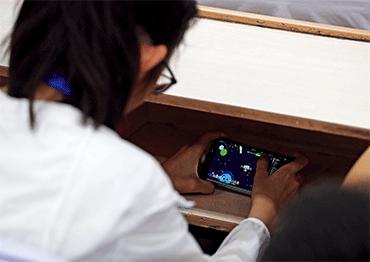
A student hides a phone during class to play an online game (Photo by VCG)

Print