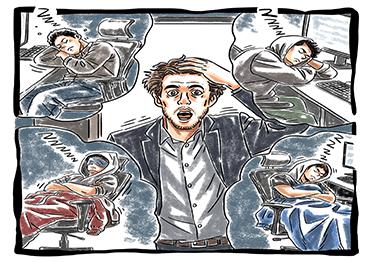
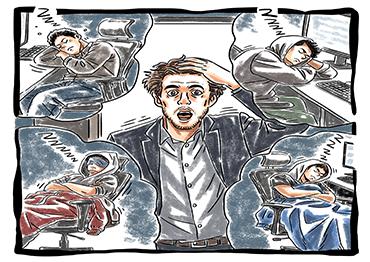
t was shortly after lunch when I entered the IT department office in search of some tech support. The room was much darker than usual, so my eyes took a while to adjust. As my vision returned, I noticed numerous changes across the room. Each of the office’s ergonomic chairs was in full recline, in one corner a colleague’s headphones had become eye masks, while a few colleagues were using jackets as quilts. Every single one of my colleagues was fast asleep. With arms as pillows, and hoods pulled over eyes, productivity itself appeared to be taking a power nap. ���
Chinese work days can be long, especially when compared to typical practices in Europe. A good friend of mine worked in a large energy company, the only foreigner. She observed with bafflement how her colleagues would regularly remain in work long after the official end of their shifts, but would compensate for this by taking exceptionally long lunch breaks, including using foldable camp beds and roll-up mattresses to ensure a good quality midday snooze. When she explained her willingness to work through the collective siesta, in order to leave work on time, her leadership were happy to support and oblige. However, she could not shake the feeling that what seemed logical to her, made her stand out as the person with odd behavior.
In the rapid, dynamic, and busy world of China, taking a rest is a survival tool not a confession. Public spaces, like offices can easily transform into comfortable, consequence-free nap zones. Even large furniture shops can rapidly transform into a sea of horizontal couples, and dozing toddlers, test-driving mattresses in full view of other shoppers. However, while these practices remain common, they are not recommended for the shy or self-conscious, as more than one curious foreigner has discovered upon attempting a discreet test-snooze in a shop, only to wake and discover they have become part of the visual display.
Micro-dozing has become an urban superpower in modern China. From the heroic neck control of a standing sleeper on the subway, to heads bobbing in synchrony on the ferry. This level of public relaxation demonstrates an inherent trust in public order. There is a choreography of shared space in China, a social and community dimension even among strangers. However, this modern culture of public napping reflects the hectic nature of urban life, and the challenging consequences of China’s rapid success and growth. Whether observing school children asleep at their desk, or workers dreaming in a park, it is clear, that hectic modern lives are not always compatible with getting a good night’s sleep.
Nevertheless, the pandemic of poor sleep is a global phenomenon among industrialized economies. The solution that different cultures have adopted speaks volumes. Where the global West has embraced the cult of caffeine bravado, China has developed a “sleep then sprint” mentality. Some of this is pure pragmatism. Chinese commutes can be very long, and days can be very full. In this regard, taking naps is practical time management. Yet there is something deeper than pragmatism at play. Chinese society has discovered a comfort in crowds which still escapes people from many other nations. Privacy in China is not about physical space. By embracing a collective rhythm of shared post-lunch snoozing, the potential for social guilt is eliminated.
Unfortunately, there are some common risks associated with Chinese nap culture. Many people have popped to the bathroom after a post-lunch nap to see a perfect QWERTY imprinted upon their forehead. Others have placed their faith in the collective timekeeping of synced body clocks, only to wake up two hours after colleagues. My own most embarrassing moment was awaking to realize that I had mistaken a stranger’s shoulder for a travel pillow. With unbelievable politeness, and perhaps an element of cultural uncertainty, the stranger had chosen to accept my foible and allowed me to snooze against them. As I woke and apologized profusely, they smiled at me, with a fascinating look that mixed pity, confusion, and annoyance.
For those international visitors who wish to embrace Chinese culture there are a few simple tips to learn. If you want to nap like a local, face away from colleagues, set two alarms, respect the quiet, apologize with a smile if you drool, offer your seat to elders before napping on public transport and never photograph sleeping strangers.
 Old Version