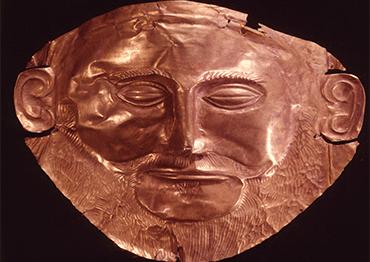
ne of the most iconic images of the Greek Bronze Age is Agamemnon’s Mask, a death mask made of a thin sheet of gold, unearthed in 1876 at the Bronze Age site of Mycenae, which was active from 1750-1050 BCE in the Peloponnese region to the west of Athens.
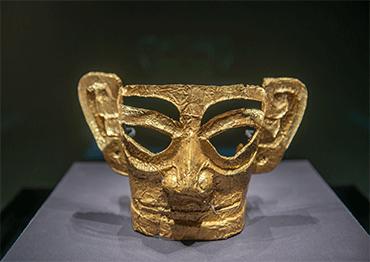
While well-known to many, Agamemnon’s Mask has two lesser-known lookalikes, found thousands of miles away in Guanghan, near Chengdu in Southwest China’s Sichuan Province. Both gold masks that were excavated at the Sanxingdui Ruins site in 2021 represent the ancient Shu culture, which was active from around 4,500 to 2,900 years ago.
From July to December 2025, visitors to Sanxingdui Museum have been able to compare these gold masks, as a replica of the ancient Greek relic has been included in an exhibition showcasing the Mycenaean civilization. The original is in the National Archaeological Museum of Athens.
The heavier of the two Sanxingdui gold masks is missing half, but still weighs 280 grams. It is estimated that the whole mask would have weighed more than 500 grams, making it the biggest and heaviest gold object of its time. The full gold mask is much lighter and thinner.
At the Sanxingdui Forum held in September in Deyang, near the site, Ma Yanru, a researcher with the National Museum of China who led the gold relic restoration team, said that combined, the gold objects found at Sanxingdui contain around two kilograms of gold, more than at any other contemporary sites found in China. The techniques “represent the highest level in early years of precious metal processing in China,” Ma said. She stressed that it is more compelling evidence that the Chinese civilization had diverse origins.
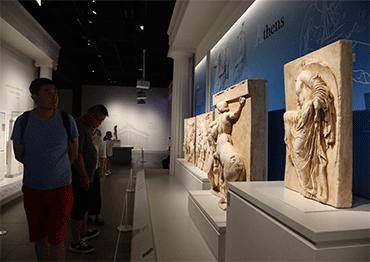
The exhibition, titled “A Journey to Ancient Greece: Archaeological Explorations,” features artifacts from the Bronze Age to the era of Alexander the Great (356-323 BCE). The 172 artifacts, which include nine replicas, have been lent by 31 Greek museums and cultural institutions. Besides Agamemnon’s Mask, gold objects such as rosettes and palm leaves are an important part of the exhibition. However, the mask predates Agamemnon according to modern research. It more likely belonged to a king of Mycenae around 1550-1500 BCE than the legendary Agamemnon, who ruled some three centuries later, and who according to Homer’s epic poem The Iliad, commanded the Greek forces at the Battle of Troy.
In a video address at the exhibition’s launch on July 7, 2025, Li Xinwei, director of the Chinese School of Classical Studies at Athens, established in the Greek capital in 2024, said there was a similar trajectory of development of the Chinese and Greek civilizations from 5,000 years ago to the establishment of the unified imperial system in China in the 3rd century BCE and the Hellenistic era in Greece in the 4th century BCE.
“The cultural legacy of ancient Greece profoundly influenced subsequent civilizations across regions of the Eurasian continent. And this exhibition’s panoramic presentation will inspire comparative reflections between Chinese and Greek civilizational traditions,” he said.
Speaking to China News Service, Yang Yufei, an associate researcher at Sanxingdui Museum and the show’s curator, expresses her views on how the shared passion for gold in ancient China, Greece and other major civilizations sheds light on both the similarities and differences of these early societies, and how it can promote cultural dialogue today.
China News Service: Why was Sanxingdui Museum chosen as the exhibition’s first stop in China? What are the highlights?
Yang Yufei: This exhibition is the fourth held by the Greek Ministry of Culture in collaboration with China. We selected Sanxingdui Museum for the inaugural exhibition due to Sichuan’s close cooperation with Greece in muse-ology and archaeology in recent years.
Based on the existing collaboration between China’s Palace Museum (also known as the Forbidden City) and Greece’s Institute of Electronic Structure and Laser of the Foundation for Research and Technology-Hellas (IESLFORTH), the China-Greece Belt-and-Road Joint Laboratory on Cultural Heritage Conservation Technology launched its Sanxingdui Workstation at the excavation site of the ritual area of the Sanxingdui Ruins in 2021.
In May 2025, a themed event titled “Ancient Shu and Ancient Greek Civilizations” was held at the Nea Smyrni Museum in Athens, where the Greek edition of China’s cultural exchange project “Sanxingdui-Jinsha Message in a Bottle” was launched in front of distinguished guests including Konstantina Benisi, director of the Ephorate of Antiquities of Prehistoric and Classical Antiquities at the Greek Ministry of Culture, as well as Li Xinwei, director of the Institute for the Study of Ancient Chinese Civilization. [The project invites people around the world to participate in activities promoting Sanxingdui, including short videos of Sanxingdui exhibitions, mystery boxes containing Sanxingdui cultural products and Instagram posts.]
From July to December 2025, the [current] exhibition called “A Journey to Ancient Greece” was held at Sanxingdui Museum. It showcases 172 precious artifacts unearthed in Greece [including nine replicas].
The Mycenae and Sanxingdui gold masks date from similar periods. They share commonalities while boasting distinct differences. At first, exhibiting a replica of the Mycenae gold mask seemed impossible due to scheduling conflicts. With the aim of showcasing the artifacts in tandem in an exhibition, our team exchanged multiple emails, offering information on Sanxingdui’s gold masks, which explained in detail their shared characteristics. In the end, Greece’s Ministry of Culture helped coordinate with heritage authorities in Mycenae, who allowed the replica’s inclusion in this exhibition.
CNS: Why do the gold masks from Sanxingdui and Greece’s Aegean Sea area share striking similarities?
YY: The coincidental use of gold for crafting masks in Sanxingdui and Mycenae – civilizations thousands of miles apart – reflects the similarity of artistic expression and aesthetic preferences among early humans. After all, who doesn’t love things that glitter?
Even humans of the Paleolithic and Neolithic eras selected glittering stones and animal tusks as adornments. If there were precious metals available, they would use them to craft objects. This is why gold masks have been unearthed at numerous Eastern and Western archaeological sites beyond Sanxingdui and Mycenae, such as King Tutankhamun’s tomb in Egypt, the Thājite Princess’s tomb in Saudi Arabia and a grave in Uttar Pradesh, India.
Though Sanxingdui and the Aegean gold masks are strikingly similar, they also have many differences.
The Sanxingdui gold masks were unearthed in the ritual area of the capital city of the ancient Shu Kingdom, which dates to the late Shang Dynasty [1600- 1046 BCE], and they are likely objects for ritual offering. The Mycenaean gold mask was unearthed at Grave Circle A at the ancient Aegean city of Mycenae, dating to around the 16th century BCE. It was found covering the tomb owner’s face, indicating that it is a funerary artifact.
In design, the Sanxingdui gold masks feature hollowed out eyebrows and eyes, with rather abstract facial features, while the Mycenaean mask boasts finely carved facial features, as well as detailed hair and eyebrows.
CNS: What else do Sanxingdui’s artifacts have in common with those of ancient Greece?
YY: The commonalities between the ancient Shu and Greek civilizations include reverence for nature, which is in fact commonly shared by many great civilizations. They tended to transform elements observed in daily life into decorative motifs on artifacts.
These artifacts reflect how ancient Greeks and Sanxingdui people perceived nature, environment and life. As human societies grew increasingly complex, these things could gradually evolve into religious beliefs.
Furthermore, we can see in Sanxingdui and Mycenaean sculptures distinct artistic expressions of human figures from Eastern and Western civilizations. Sanxingdui’s sculpture blends realism with exaggeration and deification, while Greek sculpture, from the Archaic period [800-500 BCE] to the Hellenistic age [323 BCE-30 CE], evolved from simple stylized forms into increasingly rich and vivid ones.
CNS: How can cultural relic exhibitions help Eastern and Western audiences understand the beauty of other civilizations?
YY: As the Sanxingdui and Jinsha Ruins [in Chengdu, dating back from the 12th-7th century BCE in the ancient Shu kingdom] sites are preparing for a joint application for UNESCO World Cultural Heritage status, we need to reach out to the world, continuously strengthening their global influence and our capabilities of cultural interpretation.
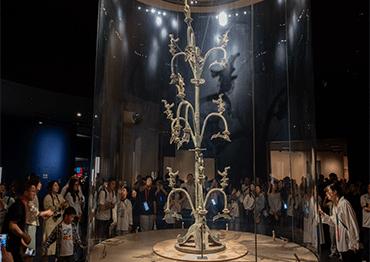
Visitors to Sanxingdui Museum do feel stunned by the artifacts there. But we can only take a very limited number of relics to display abroad. We can’t show the giant bronze statue, nor the bronze sacred tree [centerpieces of the museum]. In the same way, precious artifacts in the West, like the Mycenaean gold mask, can’t realistically be shown abroad. So we ought to continue to innovate exhibition technology which will allow us to present the beauty of cultural relics as much as we can.
Exchanges and mutual learning make civilizations richer and more colorful. The dialogue between Sanxingdui and ancient Greece is not just an encounter between the two civilizations, but a profound reflection on the origins and commonalities of human civilizations.
These ancient civilizations are great, not just in their uniqueness, but also in the coincidence of their similar choices. Even though people from the East and West have different cultural backgrounds, when they stand before the gold masks or the bronze sacred tree, they feel the same about the beauty of cultural artifacts.

 Old Version