Old Version
Politics

New Metrics

With the newly unveiled 15th Five-year Plan (2026-2030), China has set a course for the next stage of modernization, aiming for innovation-driven growth, domestic resilience and wider opening up, and more “investment in people”

By Yu Xiaodong Updated Jan.1

Following the closely watched fourth plenary session of the 20th Communist Party of China (CPC) Central Committee held between October 20 and 23 in Beijing, China’s central leadership adopted a document that outlines the priorities of the 15th Five-Year Plan (FYP) for the period between 2026 and 2030.  

Titled “The Recommendations of the Central Committee of the Communist Party of China on Formulating the 15th Five-Year Plan for National Economic and Social Development,” the document is designed to serve as a blueprint of policy priorities in the next five years for the world’s second-largest economy.  

Describing the period from 2026 to 2030 as a “critical stage” for “basically realizing socialist modernization,” an objective China’s leadership has long pledged to achieve by 2035, the document reaffirms the country’s efforts to pursue “high-quality development,” and vows to build a modern industrial system, boost innovation and technological self-reliance, expand domestic demand and open up more broadly to the world. 

Innovation as a Driver 
Reaffirming that pursuing economic development remains the government’s “central task,” the document identifies innovation as “the fundamental driving force” of China’s future economic growth. Throughout the document, the words “technology” and “technological” appear a combined 46 times, and the word “innovation” is mentioned 61 times.  

Pledging to strengthen support for “basic research and original innovation” to achieve “breakthroughs in core technologies in key fields,” the document emphasizes the importance of achieving “scientific and technological self-reliance.”  

A variety of industries is mentioned, including new energy, new materials, aerospace and the low-altitude economy, quantum technology, bio-manufacturing, hydrogen energy and fusion energy, brain-computer interfaces, embodied intelligence and sixth-generation (6G) mobile communications.  

The document also recommends that efforts be made in four areas: strengthening original innovation and core technology breakthroughs, promoting the deep integration of scientific and industrial innovation, advancing the coordinated development of education, sci-tech and talent, and further boosting the construction of the Digital China initiative, which focuses on eight major areas, such as AI plus, digital, infrastructure upgrading and digital talents. 
 
The guideline reaffirms China’s focus on technology and innovation in the past years. In late 2023, Chinese President Xi Jinping raised the idea of “new quality productive forces,” which was formally adopted in the 2024 government work report during the annual session of the National People’s Congress (NPC).  

According to data released by the Ministry of Science and Technology in September, China’s total R&D expenditure in 2024 exceeded 3.6 trillion yuan (US$505.7b), up 48 percent on 2020. Of this, 250 billion yuan (US$35b) was spent on basic research in 2024, up 70 percent on 2020.  

Accounting for 2.68 percent of annual GDP, China’s R&D intensity surpassed the average level of EU member states, which stood at about 2.22 percent in 2023. For five consecutive years, China has led the world in the number of high-level scientific papers published in international journals and in international patent applications.  

At a press conference held after the conclusion of the fourth plenary session of the 20th CPC Central Committee on October 24, Zheng Shanjie, head of the National Development and Reform Commission (NDRC), China’s top economic planner, told reporters that China’s priority in the next five years will be building a modern industrial system and reinforcing the foundations of the real economy.  

Efforts will also be made to accelerate the development of strategic and emerging industry clusters. These industries are poised for significant growth, with the scale designed to be added over the next decade equivalent to creating a whole new high-tech sector, thus injecting continuous momentum into the high-quality development of the Chinese economy, Zheng said. 

The LEGO booth at the 8th China International Import Expo (CIIE) in Shanghai, November 7, 2025 (Photo by VCG)

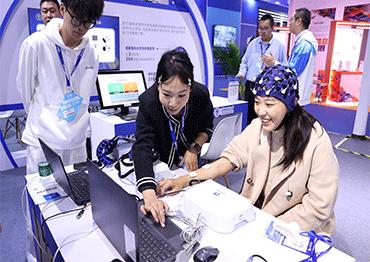
A visitor experiences a brain-computer interface controlling a soft hand exoskeleton integrated with functional electrical stimulation technology at the HICOOL 2025 Global Entrepreneurs Summit held in Beijing, October 17, 2025 (Photo by VCG)

A group of foreign tourists stroll through one of Suzhou’s classical gardens in Jiangsu Province, November 6, 2025 (Photo by VCG)

Investing in People 
The document also highlights the importance of domestic demand as a major component of the much-desired “high-quality development.” “Domestic demand should play an increasingly greater role as the principal engine of economic growth,” it says, calling for the creation of “more models of economic growth that are led by domestic demand, driven by consumption and sustained by self-generating momentum.”  

Domestic demand has long been considered a weak link in China’s economic growth, and its importance has been repeatedly highlighted by government policies in the past few years. What makes the new document different is that it calls for a people-centered approach and proposes the concept of “investing in people.”  

Recognizing that “a strong domestic market provides strategic support for Chinese modernization,” the document emphasizes the importance of “improving living standards while increasing consumer spending and combining investment in physical assets with investment in human capital.”  

“For more than four decades, China’s economic growth has been powered by heavy investment in tangible fixed assets, infrastructure and the relentless pursuit of GDP expansion,” Su Jian, a professor and economist at Peking University told NewsChina.  

“Those investments delivered impressive results during China’s early development stages, but as the economy matures, there is much less room for material investment, with many industries facing intense competition and diminishing returns,” Su added.  

As China positions technological innovation as the main engine of its next phase of growth, Su said the government is shifting its investment focus from physical assets to people. The document outlines a wide spectrum of social policies, from education, employment, healthcare and pensions to tax reform and birth incentives. Among these, promoting childbirth is likely to become a top policy priority, followed closely by education reform, he said.  

China has already been moving in this direction, steadily strengthening its social security network, healthcare system and education infrastructure. Analysts believe the clear articulation of the “investing in people” concept marks a symbolic shift and that China will gradually shift from a GDP-centered growth model to a development path oriented toward well-being and quality of life. 

‘Opening China Wider’
Another highlight of the 15th FYP document is the commitment to “opening China wider to the outside world.” The document declares that “opening up and cooperation for mutual benefit are integral to Chinese modernization,” adding “we must continue to expand opening-up at the institutional level, safeguard the multilateral trading system and promote broader international economic flows.”  

More specifically, the document pledges to “expand market access and open up more areas, in particular in the services sector, and unilaterally open up more sectors to more regions,” while highlighting the importance of “expanding two-way investment cooperation,” and pursuing high-quality Belt and Road cooperation. “We should work faster to facilitate regional and bilateral trade and investment agreements, and expand our network of high-standard free trade areas,” the document reads.  

At the October 24 press conference, Wang Wentao, China’s commerce minister, told media that in the next few years, China will expand pilot programs to open up its value-added telecommunication and biotechnology sectors, allow more wholly foreign-owned hospitals and increase the openness of the education and culture sectors.  

Wang said that China plans to enhance green and intermediate goods trade, improve the system managing its negative list for cross-border services and steadily increase the openness of its digital trade. Stressing that China will foster a transparent, stable and predictable regulatory environment, Wang said that investing in China is “not an option, but a must” for international investors. Warning against the “zero-sum approach” in opening-up and attracting investment, Wang added that China will focus on “mutually beneficial and shared development.”  

On October 28, during the ASEAN Summit held in Kuala Lumpur, Malaysia, China and the Association of Southeast Asian Nations (ASEAN) formally signed an agreement on the second upgrade of the ASEAN-China Free Trade Area (ACFTA), first inked in 2002. The new 3.0 version covers nine areas, including the digital and green economies as well as supply chain connectivity.  

China and ASEAN are each other’s largest trading partners, and the upgrade of their free trade deal marks a new stage in regional economic integration.  

Then on November 3, China announced a one-year extension to its visa-free entry policy up to the end of 2026 and added Sweden to the list. This now allows citizens of 45 eligible countries to travel in China for up to 30 days for tourism, business and family reunion. China also expanded its 240-hour visafree transit policy to more points of entry, increasing the number of ports eligible for the 240-hour visa free transit from 60 to 65 around the country.  

Amid rising protectionism and geopolitical tension, these policies reflect China’s ongoing efforts to promote inbound travel and international engagement. The visa-free programs are believed to be behind the rapid rebound of the inbound travel sector in the past months.  

According to the National Immigration Administration, the number of foreign arrivals in the first half of 2025 reached over 23 million, a year-on-year increase of nearly 130 percent.  

Dong Yu, professor and executive vice dean of the China Institute for Development Planning at  Tsinghua  University, said that China’s consistent emphasis on advancing high-level opening-up sends a clear signal of policy stability, and that the 15th FYP is underscoring this commitment shows that opening up to the outside world has become a key starting point of China’s development strategy. 

People shop in a supermarket in Huaian, Jiangsu Province, November 10, 2025 (Photo by VCG)

Implementation Challenges 
Following the adoption of the guideline in October, a more detailed implementation plan for the 15th FYP will be presented to the NPC for approval in March 2026.  

According to Wei Qijia, director of the industrial economy research office at the State Information Center’s Department of Economic Forecasting, in order to implement the 15th FYP successfully, China needs to overcome several challenges.  

“First, the world is experiencing an unprecedented pace of technological revolution that is reshaping nearly every sector of the global economy. Second, uncertainty caused by geopolitical tensions is affecting and challenging all countries around the world,” Wei told NewsChina.  

Domestically, China will need to address some challenging issues, such as achieving a dynamic balance between industrial supply and demand, curbing excessive competition, tackling population aging, managing local government debt and stabilizing and restructuring its trade sector.  

“With the ongoing economic restructuring, upgrading and optimizing the economic system has become a challenge China must tackle head-on,” Wei noted.  

Looking ahead, Wei said the 15th FYP will serve as a critical foundation for attaining China’s long-term goal of achieving basic modernization by 2035, with per capita GDP reaching the level of middle-income nations.  

“During this period, China must realize both quality improvements and steady quantitative growth, promote all-round human development and make concrete strides toward common prosperity, ensuring decisive strides toward basic socialist modernization,” Wei said.

Print