Old Version
International

An ‘Inevitable Peace’?

President Xi and President Trump’s meeting in South Korea suggests that both countries are exploring how to manage their differences and prevent their rivalry from escalating

By Yu Xiaodong Updated Jan.1

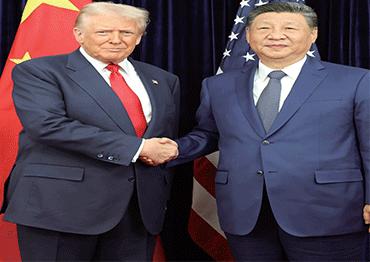
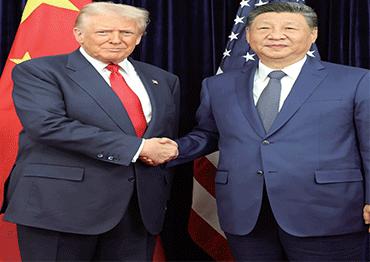
Chinese President Xi Jinping meets with US President Donald Trump in Busan, South Korea, October 30, 2025 (Photo by Xinhua)

On October 30, Chinese President Xi Jinping met with US President Donald Trump in Busan, South Korea, for about 90 minutes. Held on the sidelines of the 32nd APEC Economic Leaders’ Meeting, it marked the first face-to-face meeting between the two leaders since Trump returned to the White House. The last meeting between them was during Trump’s first presidency in 2019 during the G20 Summit in Osaka, Japan.  

The meeting is the latest in the cycle of confrontation and detente between the world’s two largest economies.  

While both sides only agreed to a temporary trade war truce without signing a joint statement or inking deals, many analysts believe that the meeting marks a new phase for the China-US relationship. 

De-escalation 
The two leaders previously had a phone call in September. It followed a high-level talk in Madrid, Spain between China and US commerce officials, which many had hoped would result in a lasting truce. However, the US soon launched a spate of new trade control measures against China, including expanding the US Entity List rules that subjected thousands more of Chinese companies to export controls and high port fees on ships linked to China.  

China responded with its own expanded toolkit, retaliating with a range of countermeasures that mirror many of the US’s actions, including tightening export controls on rare earths and imposing reciprocal port fees to ships linked to the US. As China has a dominant position in the rare earths industry, especially in the processing of rare earths, its export controls have far-reaching consequences for US tech industries.  

Right after the meeting between Xi and Trump, the two countries announced a roll-back of trade measures after officials reached agreements during talks in   Kuala  Lumpur, Malaysia on October 25 and 26. Both countries agreed to suspend, reduce or remove their tit-for-tat measures adopted since early 2025, mainly including additional tariffs, port fees, entity list expansion and export controls.  

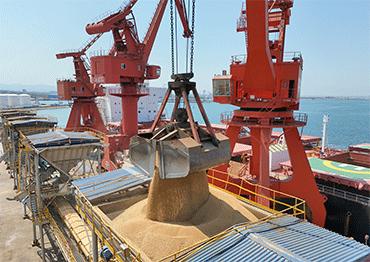
The US announced it would cut fentanyl tariffs on China in half, to 10 percent from 20 percent, while China said it would remove the additional duties of 10 to 15 percent it had imposed on a range of US agricultural products, including soybeans. Both sides have suspended the 24 percent “reciprocal tariffs” for a year until November 10, 2026.  

Since early November after the Xi-Trump meeting, several US trade delegations and business leaders have visited China, including an agricultural delegation, according to China’s Ministry of Commerce. 

‘Co-Equals’ 
Notably, the two leaders struck a much more conciliatory tone for long-term development of the bilateral relationship before, during and after the Busan meeting. Trump told the press aboard Air Force One that he rated the talks a “12 on a scale of one to 10.”  

In an interview with CBS News later on November 2, Trump said that “it is important that China and the US get along,” and that the US “can be bigger, better and stronger” by working with China.  

What struck observers the most was Trump’s hailing the meeting on social media as a “G2 meeting” which he said would usher in “everlasting peace and success,” something many analysts believe suggests that the US is ready to deal with China on equal terms.  

Coined by economist C. Fred Bergsten first in 2005 primarily for his proposition for a US-China joint leadership in the global economy, the G2 concept gained traction and was raised by US leaders during the 2008 global financial crisis as China’s massive stimulus helped to stabilize both its own economy and the global recovery. But China rejected this idea, arguing that it was still a developing country and would always uphold the “non-alignment” principle of its foreign policy, and that every country should have a say in global issues.  

Trump’s recycling the G2 concept is thought to bear a different connotation, as much has changed since the birth of the term. The US has labeled China as a strategic rival, and China has become more assertive toward US pressure, something more evident in its effective pushbacks against Washington’s trade war in recent months.  

“It[Trump’s G2 rhetoric] sent two important signals,” Wu Xinbo,  a professor and dean of the Institute of International Studies at Shanghai-based Fudan University, told NewsChina. “First, with China’s countermeasures, Trump has realized that pressure and coercion are not effective tools in dealing with China. Dialogue, negotiation and mutual compromise are.”  

“Second, despite persistent frictions and disputes, both China and the US are demonstrating a shared desire to stabilize the broader relationship, which is a positive development for the region and the world,” Wu added.  

According to Gao Zhikai (Victor Gao), vice president of the Center for China and Globalization, a Beijing-based nongovernmental think tank, the meeting is a “turning point” in the China-US relationship.  

“China considers the US neither as an enemy nor a rival, and has made its stance clear. If it’s a talk, the door is wide open. If it’s a fight, China will stand its ground to the end,” Gao said in global affairs program Cross-Strait Roundtable uploaded to YouTube on November 5. 
 
Concluding that China and the US are now recognized as “co-equals,” Gao said that the meeting has shown that despite their disputes, the two countries will live in an “inevitable peace.” Gao first raised the idea of “inevitable peace” in 2021, arguing that a war between the two powers would be disastrous for both countries and the whole world.  

China still appears reluctant to embrace the G2 idea, largely due to it suggesting a hierarchical world order, which runs counter to the underlying doctrine of China’s overall global diplomacy.  

At a press conference in Beijing on October 31, while recognizing that China and the US can shoulder their responsibilities as major countries, China’s Foreign Ministry spokesperson Guo Jiakun reiterated China’s commitment to an independent foreign policy of peace, and stressed its status as the largest developing country, a partner of the Non-Aligned Movement and a member of the Global South.  

“China will continue to practice true multilateralism,” he said. 
‘Mutual Success’ 
Meanwhile, Beijing has long argued for a bilateral relationship based on mutual respect and equality. In the past, Xi has repeatedly said that the world is big enough for China and the US to coexist, and the China-US relationship should be built on “win-win cooperation.”  

However, the idea of win-win cooperation has never been well received in the US. As John Thorton, chair emeritus of the Brookings Institution, said in an interview with China Focus in March 2024 that people in the US either think there is no such thing as having two winners in a sporting event, or believe it simply means China wins twice.  

This time, President Xi adopted a different approach to deliver the same message by aligning China’s goal of “national rejuvenation” with Trump’s iconic “Make America Great Again” agenda. 

“China’s development and revitalization goes hand in hand with US President Donald Trump’s vision to ‘Make America Great Again,’” Xi said during the Busan meeting, adding that the two countries “are fully able to help each other succeed and prosper together.”  

Given different national conditions, the two sides do not always see eye to eye with each other, and it is normal for the two leading economies of the world to have frictions now and then, Xi said, reiterating that China does not aim to replace the US as the leading world power.  

“China has no intention to challenge or supplant anyone. Our focus has always been on managing our own affairs well, improving ourselves and sharing development opportunities with all countries across the world,“ Xi said. “China and the US should be partners and friends. That is what history has taught us and what reality needs,” he added.  

Xi also called on both countries to “jointly shoulder our responsibilities as major countries, and work together to accomplish more great and concrete things for the good of our two countries and the whole world.”  

According to Shen Yi, a professor of international politics at Shanghai’s Fudan University, Xi’s remarks reflect that China has taken proactive and positive approach in guiding the healthy interaction and development of China-US relations.  

“It represents an innovative way of thinking and a new perspective to convey China’s view that, based on its own strength, actions and existing realities, the two countries do not necessarily have to fall into a so-called zero-sum rivalry,” Shen said in a column for guancha.cn on October 30.  

“On the contrary, through this series of dialogues, it has become clear that China and the US have lots of room for cooperation that can lead to win-win outcomes and shared development,” Shen added.  

Shen argued that by emphasizing cooperation rather than confrontation, Xi’s statement indicates that China is seeking to “inject positive substance” into the strategic framework that would pave the way for a more stable and cooperative relationship in the future. 

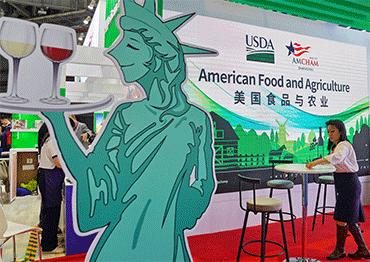
Staff at the American Food and Agriculture booth at the 6th China International Import Expo, Shanghai, November 9, 2023 (Photo by VCG)

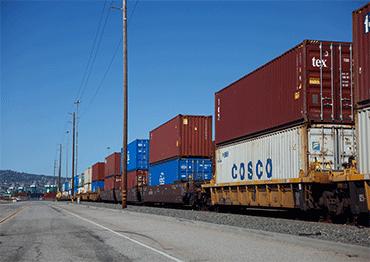
Containers from China Ocean Shipping Company (COSCO) are stacked at the Port of Los Angeles, California, US, October 15, 2025 (Photo by VCG)

Gaining Balance 
While the two countries have reached a truce over trade issues, more serious issues were unaddressed during the meeting, such as the Taiwan question and the South China Sea. As the two leaders are expected to exchange visits in 2026, analysts argue that they need to take these opportunities to rebalance and recalibrate their policies to rebuild mutual trust.  

In a commentary published in US-based Foreign Affairs magazine on October 30, Da Wei, director of the Center for International Security and Strategy and a professor of international relations at Beijing-based Tsinghua University, argued that the Trump administration should formally oppose Taiwan independence in exchange for Beijing’s scaling down its military exercises in the Taiwan Strait.  

“If leaders in Beijing believe there is hope for peaceful reunification, there is less urgency to use military force to resolve the question of Taiwan’s status. This arrangement aligns with Trump’s global vision of trying to broker peace in areas of long-standing conflict,” Da wrote. 

Likewise, Da said that the US could lower tensions by reducing the frequency of reconnaissance missions along China’s coastline and refraining from politically provocative action in the Indo-Pacific region.  

Following the Xi-Trump meeting in Busan, the two countries’ militaries appeared to have stepped up communications. The following day on October 31, China’s Defense Minister Dong Jun met with his US counterpart Pete Hegseth in Malaysia, the first time the two ministers had met in person.  

During the meeting, Dong urged the US to “take a clear stance” against Taiwan independence and to honor the commitment Hegseth made during their phone conversation in September that the US does not seek to contain China and pursue conflict. For his part, Hegseth pledged to “deconflict and deescalate any problems that arise” between the two militaries.    

According to Zhao Minghao, a professor at the Institute of International Studies at Fudan University, the priority for either country, whether seeking to achieve “rejuvenation” or be “great again,” is not to fall into confrontation and conflict.  

“Through their own reforms and adjustments, they should explore new complementary areas in China-US relations, open up broader space for cooperation and focus on long-term benefits, rather than fall into a vicious cycle of mutual retaliation,” Zhao told NewsChina.  

“In the meantime, China must be prepared for unexpected changes that may arise in China-US relations. In dealing with the Trump administration, which pursues practical interests and respects power, China can only draw confidence from the momentum of its own rapid, robust and resilient development,” Zhao said.

Print